
◎
Get clear
Get clarity on what matters most right now.

Pick a ripe blackberry fruit and a ripe red raspberry, then look at the stem end of each. One has a solid, pale core packed inside it. The other is hollow, like a tiny thimble. That single detail is the most reliable way to tell the two bramble fruits apart, and it says a lot about how each one is built on the plant.
In Google Trends data for the US over the past 7 days, related searches for the seed term "berries" included "black berries" with a top score of 42. Related searches for the seed term "blackberry" included raspberry (27), blackberry fruit (21), blackberries (15), blackberry bush (15), and blackberry plant (15). These top scores are relative interest, scaled so the most popular term in a set equals 100; they are not search counts, and none of these terms was listed as rising. Read together, people want to know what the fruit is, how it differs from a raspberry, and what the plant looks like.
Blackberries and raspberries are close relatives. Woody Plants of Ohio, the companion site for the course ENR 3321: Biology and Identification of Woody Forest Plants, describes the so-called brambles (blackberries, raspberries and dewberries) as members of the genus Rubus in Rosaceae, the rose family. The Penn State Extension Tioga County Master Gardeners piece "What is the Difference Between a Raspberry and a Blackberry?" (2022) gives typical wild species: red raspberry (Rubus idaeus), black raspberry (Rubus occidentalis), and blackberry (Rubus allegheniensis).
What looks like one berry is actually many tiny fruits. The same Penn State piece explains that raspberries and blackberries are made of single-seeded drupelets held together by microscopic hairs around the receptacle, and that both produce aggregate fruits, where several ovaries are found on a single flower. Woody Plants of Ohio puts it the same way: each carpel of the flower develops into a drupelet, and an aggregate fruit is a tight cluster of small fruits that disperse as a unit.
Each little bead on a blackberry is one drupelet. The receptacle is the part of the flower the drupelets sit on, and it is the piece that matters most when you compare blackberries with raspberries.
That aggregate structure is also why a blackberry is not a "true berry" in the botanical sense. We cover that word in full in what counts as a berry, so here we will stay with the brambles themselves.
Color seems like the obvious test, but it fails. Penn State Extension points out that blackberries are red when unripe, and that the two main types of raspberries are red and black. A black raspberry and a blackberry can look nearly the same in a bowl.
The core is the real tell. Per Penn State Extension, when a raspberry is picked, the receptacle stays on the plant and the fruit is hollow. When a blackberry is picked, the receptacle stays with the fruit, leaving a spongy white center inside it. NC State Extension's "Blackberries for the Home Garden" (Gina Fernandez, 2024) describes the same split: the core of the black raspberry fruit is hollow, while in a blackberry the receptacle is picked along with the fruit.
Penn State Extension adds a few secondary clues. Blackberries tend to be more oblong and raspberries more rounded, though shape is less reliable. Blackberry canes are usually taller and purplish red, while black raspberry canes look whitish. Thorns differ too: blackberries carry thick, straight, broad-based thorns depending on the cultivar, black raspberries have scattered, smaller, hooked thorns, and red raspberries are bristly with few or no thorns.
| Feature | Blackberry | Raspberry |
|---|---|---|
| Genus | Rubus | Rubus |
| Fruit type | Aggregate of drupelets | Aggregate of drupelets |
| Core after picking | Receptacle stays inside, spongy white center | Receptacle stays on the plant, fruit is hollow |
| Ripe color | Black (red when unripe) | Red or black, depending on type |
| Typical shape | More oblong | More rounded |
| Thorns | Thick, straight, broad-based (or thornless cultivars) | Black: small and hooked. Red: bristly, few or none |
So when someone searches "black berries" and is not sure which fruit they are holding, the quickest answer is to look inside. Solid core: blackberry. Hollow cup: raspberry, whether it is red or black.
A blackberry bush is less a bush than a clump of canes rising from a long-lived base. NC State Extension's "Plant Growth" chapter of the Southeast Regional Caneberry Production Guide (Gina Fernandez, Amanda McWhirt and Christine Bradish, 2023) states that the crown of blackberry and raspberry plants is perennial, while the canes have a two-year lifecycle.
That two-year cycle gives the canes two names:
Some newer cultivars break the pattern. "Blackberries for the Home Garden" describes primocane-fruiting types, also known as everbearing or double cropping, that fruit in late summer or fall on the tips of new canes.
The NC State guide also notes that leaves on primocane-fruiting canes change from five leaflets on vegetative growth to three leaflets on reproductive growth, and that many blackberries keep their leaves through the winter. Fruit, per the same chapter, moves from green to pink to red and finally black as it ripens. That color sequence is exactly why a red, unripe blackberry fools people into calling it a raspberry.
Not every blackberry plant grows the same way. "Blackberries for the Home Garden" divides blackberries by growth habit (trailing, semi-trailing, and erect) and by the presence or absence of thorns (thorny or thornless).
The Introduction to NC State Extension's Southeast Regional Caneberry Production Guide (Fernandez, McWhirt and Bradish, 2023) describes each habit. Erect caneberries produce stiff, upright canes. Semi-erect caneberries produce very thick, arching canes. Trailing blackberries, often called dewberries, have prostrate canes that lie on or close to the ground. "Blackberries for the Home Garden" spaces trailing plants 6 to 8 feet apart, and erect and semi-trailing plants 3 to 4 feet apart, which gives you a feel for how far trailing canes spread.
Thorns are not a raspberry giveaway either. The same caneberry guide notes that most commercial blackberry growers in the South plant thornless cultivars because they are easier to manage. A smooth cane can still be a blackberry plant, so go back to the fruit and its core.
You will sometimes see a fruit named on a label as a flavor rather than as the star ingredient. That wording has a defined meaning in US labeling rules. The FDA regulation 21 CFR 101.22(a)(3) defines a natural flavor as a substance containing flavoring constituents derived from sources including a spice, fruit or fruit juice, vegetable or vegetable juice, where the significant function of the substance is flavoring.
The same section, 101.22(i), treats the primary recognizable flavor named on a label as the "characterizing flavor," and gives naming examples such as "strawberry flavored shortcake." In plain terms: when a label says something is flavored with blackberry juice, it is telling you about taste. It is a flavor note, not a statement about how much fruit is inside.
We like the blackberry because it rewards a closer look. Two fruits that sit side by side in the same carton are built in visibly different ways, and the difference is right there at the stem end once you know to check.
We also think the plant is worth understanding on its own terms. A perennial crown, canes that live two years, leaves that change their leaflet count, fruit that passes through red on its way to black: the blackberry bush is a small lesson in how plants time their growth. And once you read "blackberry juice" on a label as a flavor term, labels get easier to read too.
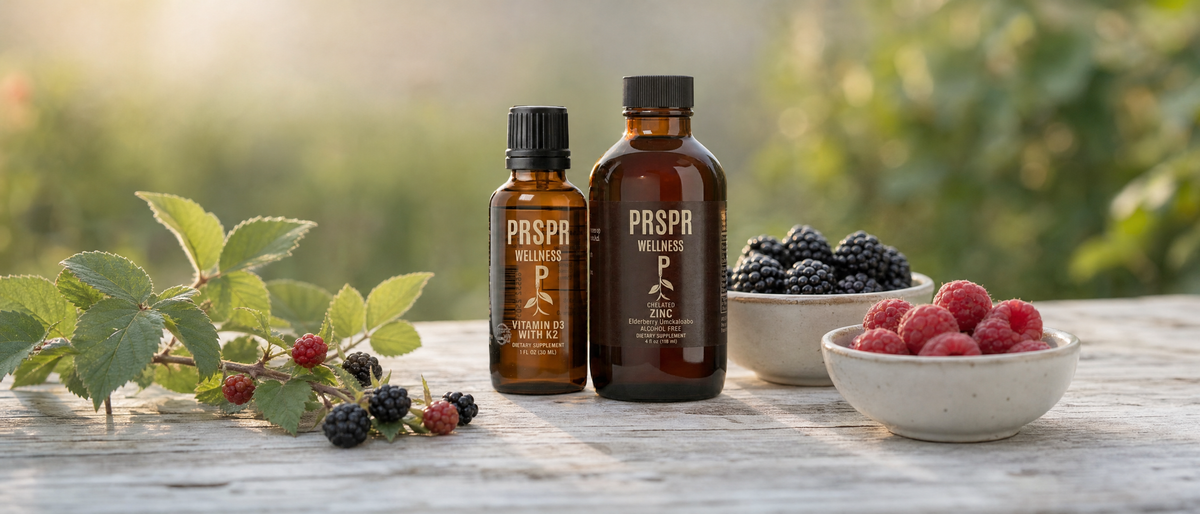
Blackberry turns up in one of our own formulas as a flavor. The Adult Immunity Bundle pairs two liquids. The first is Chelated Zinc + Elderberry, an alcohol-free liquid in a 4 fl oz (118 ml) bottle whose label reads "Elderberry Umckaloabo." Its listing describes it as "naturally flavored with elderberry and blackberry juice." The second is Vitamin D3 + K2 Plus MK7, liquid drops in a 1 fl oz (30 ml) bottle.
Elderberry is a different plant from the brambles, in the genus Sambucus; our explainer on what elderberry is covers it.
The bundle is $69.99. Both products are made in a GMP-certified facility and third-party batch tested, so what is listed on the label is what is in the bottle. You can see it alongside our other pairings in Bundles.
See the Adult Immunity Bundle at PRSPR
Not in the strict botanical sense. Penn State Extension describes blackberries as aggregate fruits made of single-seeded drupelets clustered around a receptacle, with several ovaries on a single flower. That is a different structure from what botanists call a true berry.
Check the core. Penn State Extension explains that a picked raspberry leaves its receptacle on the plant and is hollow, while a picked blackberry keeps the receptacle inside as a spongy white center. Color is not reliable, because blackberries are red before they ripen and raspberries come in red and black types.
It is a clump of canes growing from a perennial crown. NC State Extension describes first-year primocanes that stay vegetative in most types and second-year floricanes that bear fruit, with plants that grow erect, semi-trailing, or trailing, and with or without thorns.
No. A black raspberry (Rubus occidentalis) and a blackberry are different Rubus species. Per Penn State Extension and NC State Extension, the black raspberry has a hollow core once picked, while the blackberry keeps its receptacle inside the fruit.
Answer all five questions to unlock a clear wellness plan made around your goal, schedule, preferred supplement format, and biggest roadblock.
Get clarity on what matters most right now.
See the product and routine connected to your goal.
Simple next steps you can use right away.
Pick the one you would fix first if you could.
This helps us make the guide easier to follow.
Consistency beats the “perfect” routine you never follow.
Be honest. We’re building something you’ll actually use.
Your guide will include one simple way around it.
Answer two more questions to unlock your product starting point, five-step plan, two-week routine, and one practical tip for your biggest roadblock.
Enter your details to open your five-step plan.
Verified PRSPR customer reviews
Expires when you close this page
*Your personal credit for completing the quiz. It's applied automatically at checkout on one-time purchases and expires when the timer runs out.
View full product detailsEverything in your plan, together — one add to cart.
Expires when you close this page
*Your personal credit for completing the quiz. It's applied automatically at checkout on one-time purchases and expires when the timer runs out.
View full product details Botany
You pick up a fallen leaf on a walk, or you read a product label that says a botanical comes from a leaf, and you realize you do not have the words...
 Food Science
You are fine, you just ate, and then one specific food lands in your head and will not leave. Not food in general. That food. Researchers have a na...
 Fitness Terms
You have heard it from a coach, a gym sign-up form, a friend who just bought a set of dumbbells. Strength training. Resistance training. Hypertroph...