
◎
Get clear
Get clarity on what matters most right now.

Does BPA free mean no microplastics is up 50 percent in search this week. It rises out of a steady cluster: bpa free plastic holds a volume score of 100, what is bpa free and what is bpa are at 49 each, bpa free meaning and bpa meaning are at 18, what does bpa free mean is at 16, and is bpa free plastic safe is at 13.
That rising question is a sharp one, because it goes straight at the easiest way to misread a very common label. It is tempting to see BPA free on a bottle and take it as a broad statement about plastic. It is not. It is a statement about one chemical.
The last search on that list, is BPA free plastic safe, is a health question. It is one for a food-safety regulator or a qualified healthcare professional rather than for a company selling a bundle, and we are not going to answer it in either direction. What we can do is explain what the words on the label name, which turns out to be exactly what the rising question is asking.
BPA stands for bisphenol A. The US Food and Drug Administration describes it as an industrial chemical used to make polycarbonate, a hard, clear plastic used in many consumer products, and notes that BPA is also found in epoxy resins that act as a protective lining on the inside of some metal food and beverage cans.
Chemically it is one specific molecule. PubChem, the chemistry database run by the US National Library of Medicine, gives its formula as C15H16O2. Its structure is two phenol rings joined through a single carbon atom that carries two methyl groups. Two phenols is what the bis in bisphenol records, and the A tells you which bisphenol this is.
So the plain answer to BPA meaning is this: bisphenol A, a building block of polycarbonate plastic and of some epoxy can linings. It is an ingredient of certain materials, not a material in its own right, and that distinction is the key to everything that follows.
Here is the whole of it. BPA free means an item is described as made without bisphenol A. It is a statement about the absence of one named molecule.
What that sentence leaves out is where this week's searches are pointing, so it is worth being precise about the gaps.
That is what BPA free meaning comes down to: a narrow, specific, checkable absence. Narrow is not a criticism. Narrow labels are the ones you can actually hold a maker to, because they say one thing and you can check that one thing.
It also answers the related search, what is BPA free, which is really the same question typed in a different order. The label is not naming a type of plastic. It is naming a molecule that is not there.
Not by its wording, and the reason is definitional. The two terms describe different kinds of thing.
The National Oceanic and Atmospheric Administration defines microplastics as small plastic pieces less than five millimeters long, about the size of a pencil eraser. Its explanation of where they come from includes larger plastic debris breaking down into smaller and smaller pieces, tiny manufactured microbeads, and the resin pellets used to make plastic products.
Put that beside the label. Microplastics is a size category for pieces of plastic, whatever that plastic was made from. BPA free is a statement about one ingredient chemical. A plastic made without bisphenol A is still plastic, and whether a particular item ever produces small pieces is not something those two words address at all.
The label answers a chemistry question. The rising search is asking a question about particles. That gap is the honest answer, and it applies to every product carrying the phrase, not to any one bottle.
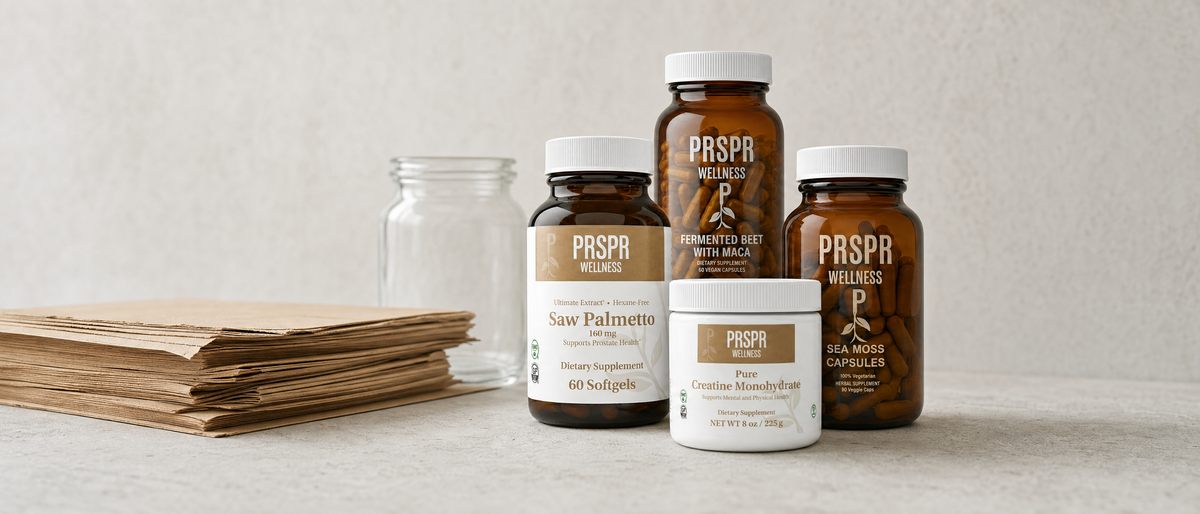
BPA free rarely travels alone. On our Men's Vitality Bundle listing it sits at the end of a short list the listing calls its Clean Formula Promise: vegan and cruelty-free; non-GMO, gluten-free; no artificial colors or preservatives; and "BPA-free, recyclable packaging".
Read as a list, those tokens teach something useful. Each one answers a different question about a different object.
That last point is the easiest one to skim past. The first four tokens describe what is inside. The last one describes what it is inside of. We did the same token-by-token reading on a different product in three tokens on a vitamin label, and the method carries over. Ask of each token which object it is about, then ask exactly what it rules in or out.
We like narrow labels, and BPA free is one of the narrowest you will meet on a shelf.
The trouble is never the phrase. It is the halo around it. A short, specific statement about one molecule gets read as a broad statement about plastic, then about particles, then about whatever a shopper happens to be thinking about that week. This week's search data holds every step of that drift at once: what is BPA, what does BPA free mean, and does BPA free mean no microplastics. Each step asks the label to say more than it does.
Our view is that the respectful way to read a label is at its actual size. BPA free names an absence. Recyclable names a destination. Neither one is a promise about anything else, and neither one is a verdict on health, which remains a question for regulators and clinicians. Reading each token at its actual size is the whole skill, and it works on every package in every aisle.
Our Men's Vitality Bundle is a set of individual products sold together. Its listing closes its Clean Formula Promise with the words "BPA-free, recyclable packaging", and that line, in those words, is the whole of what we say about its packaging. We are not extending it to microplastics, to other bisphenols or to anything else the line does not say.
What we will add in our own voice is the quality story alone. Each product in it is made in a GMP-certified facility and third-party batch tested, so what is on the label is what is in the bottle. No guessing, no filler.
Our earlier piece for this bundle, beard oil and beard balm are not the same product, reads a different pair of words the same way. Otherwise open the Men's Vitality Bundle page and read the listing for yourself, browse the bundles collection, or take the build-your-stack quiz.
Answer all five questions to unlock a clear wellness plan made around your goal, schedule, preferred supplement format, and biggest roadblock.
Get clarity on what matters most right now.
See the product and routine connected to your goal.
Simple next steps you can use right away.
Pick the one you would fix first if you could.
This helps us make the guide easier to follow.
Consistency beats the “perfect” routine you never follow.
Be honest. We’re building something you’ll actually use.
Your guide will include one simple way around it.
Answer two more questions to unlock your product starting point, five-step plan, two-week routine, and one practical tip for your biggest roadblock.
Enter your details to open your five-step plan.
Verified PRSPR customer reviews
Expires when you close this page
*Your personal credit for completing the quiz. It's applied automatically at checkout on one-time purchases and expires when the timer runs out.
View full product detailsEverything in your plan, together — one add to cart.
Expires when you close this page
*Your personal credit for completing the quiz. It's applied automatically at checkout on one-time purchases and expires when the timer runs out.
View full product details Mind vocabulary
What is cognition? You have probably seen the word "cognitive" printed on a label, in a headline, or in a product name, and kept scrolling. It is o...
 Biology vocabulary
What is metabolism? You see the word on labels, in gym talk and in nutrition headlines, almost always used as if it were a single setting. Read eno...
 Sleep vocabulary
What are sleep cycles? You hear the phrase on podcasts, see it on sleep trackers, and read it in articles that assume you already know what it mean...