
◎
Get clear
Get clarity on what matters most right now.

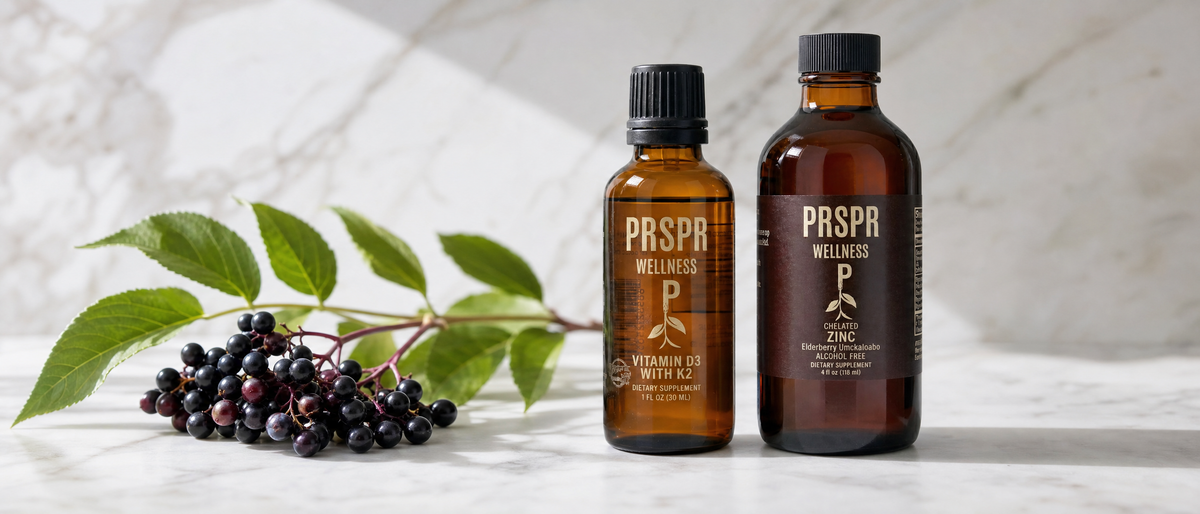
There is a product in this set whose name reads like a partial serial number. D3. K2. MK7. Three tokens, no obvious relationship, and no explanation printed anywhere near them.
Meanwhile the category around it is busy. "Supplements for immune support" sits at 100 on the relative interest scale, "best immune support supplements" at 88, and "best supplements for immune support" at 43. Climbing steeply underneath, "vitamin d3 dosage for adults per day" is up around 250 percent, which is a dosage question and therefore one we will name and hand straight to a healthcare professional rather than answer.
What we can do is decode the label. Those three tokens are not a code. They are three different levels of specificity stacked on top of each other, and once you can see that, a whole shelf of vitamin labels becomes readable.
D3 narrows twice. "Vitamin D" is not one substance, it is a small family, and the numeral picks a member of it. D2 and D3 are the two that turn up in supplements, and they differ in origin and in molecular detail. So the "3" is doing real work: a label that says only "vitamin D" has told you less than one that says D3.
K2 does exactly the same job for a different vitamin. Vitamin K is also a family, K1 and K2 are its two main branches, and they are found in different places in the food supply. Again, the numeral narrows a family down to a branch.
MK7 narrows one step further, and this is the token almost nobody can read. K2 is not a single molecule either. It is a group of related compounds called menaquinones, abbreviated MK, distinguished by the length of a side chain on the molecule. MK7 means menaquinone-7, the version with seven units in that chain. MK4 is the other one you will see on labels.
So the three tokens are a zoom sequence. Vitamin family, then branch, then the specific molecule. D3 tells you which vitamin D. K2 tells you which vitamin K. MK7 tells you which K2.
Once you see the pattern, the general lesson is more useful than the specific one. Numerals and hyphenated codes on a vitamin label are almost always narrowing devices, and a label carrying more of them is being more specific about what is inside, not showing off. When you compare two products and one says "vitamin K" while the other says "K2 as MK7," they are not necessarily different products, but only one of them has told you what it is.
The other half of this set is a different kind of thing entirely, and the pairing is worth reading as a deliberate choice.
The Adult Immunity Bundle puts that vitamin preparation next to Chelated Zinc with Elderberry, which combines a mineral with botanical ingredients including elderberry, echinacea and umckaloabo root. So the box contains one vitamin-and-mineral side and one botanical side, and both arrive as liquids rather than as capsules.
That format decision has consequences worth planning for. Liquids are measured, not counted, which means they follow the same awkward arithmetic as any measured product: how long a bottle lasts depends on how carefully the dose is measured. A dropper makes that more precise than a spoon, but it is still a measurement rather than an object.
The flip side is that liquids allow very different serving sizes in the same box. A few drops of one thing and a larger measure of another can sit side by side without either being awkward, which a two-capsule format cannot do as gracefully. When a set is entirely liquid, that flexibility is usually the reason.
One word in there is worth flagging as vocabulary rather than as a claim. "Chelated" describes how the mineral is presented: bound to an organic molecule rather than supplied as a simple salt. It is a chemistry descriptor about the form in the bottle, and we are using it only in that sense.
The same reading habit works on the botanical half of this box, with one difference. Botanicals are narrowed by Latin binomial and plant part rather than by numerals, so the equivalent of "MK7" on a herbal label is a species name plus the part used. Elderberry means the fruit of a Sambucus species; umckaloabo refers to the root of a South African pelargonium. Different notation, identical purpose: telling you precisely which thing is in the bottle.
It is also worth saying what MK7 does not tell you. It identifies a molecule, not a quantity, and not a source. Two labels can both say MK7 and differ in how much they contain and where it came from. A code narrows what a thing is; the numbers beside it in the supplement facts panel tell you how much. You need both, and only one of them is the part people photograph and compare.
Label codes are treated as decoration, and they are the most information-dense thing on most packs.
People skim past MK7 because it looks technical, and they read the marketing sentence above it instead, which is precisely backwards. The marketing sentence was written to persuade. The code was written to specify. One of those two is checkable and it is not the one in a nice typeface.
Our frustration is that the industry knows this and mostly leaves the codes unexplained. It costs a manufacturer nothing to write "K2 as MK7 (menaquinone-7)" and it turns an opaque token into something a shopper can look up. Instead the codes get printed as-is, they read as jargon, and the marketing sentence wins by default.
So learn the three or four codes that recur in whatever corner of the aisle you actually shop in. It is a small amount of vocabulary and it lasts forever. And keep the dosage questions, which are the ones people most want answered, with a healthcare professional. Those genuinely do depend on you.
If you want a single habit out of this piece, make it the comparison test. Put two labels side by side and count how many narrowing tokens each one carries: a numeral, a hyphenated code, a Latin binomial, a named plant part. The label with more of them has committed to more, and a manufacturer that commits in writing has given you something you can hold it to. That test takes ten seconds and it works in every aisle, on every brand, including this one.
The Adult Immunity Bundle keeps its two formulas separate, so each label stands on its own and you can read what is in each bottle without anything being folded into a blend.
Everything we make is manufactured in a GMP-certified facility and third-party batch tested. What is on the label is what is in the bottle. No guessing, no filler, no cutting corners. On a product whose value is essentially a promise about specificity, that verification is the whole point.
If you want the botanical half covered properly, we wrote about what elderberry, echinacea and umckaloabo actually are. If you want the vitamin naming covered from the other direction, we wrote about what "D3 and K2" names part by part. Our wellness quiz takes a couple of minutes, and the set sits with the rest of our bundles.
Answer all five questions to unlock a clear wellness plan made around your goal, schedule, preferred supplement format, and biggest roadblock.
Get clarity on what matters most right now.
See the product and routine connected to your goal.
Simple next steps you can use right away.
Pick the one you would fix first if you could.
This helps us make the guide easier to follow.
Consistency beats the “perfect” routine you never follow.
Be honest. We’re building something you’ll actually use.
Your guide will include one simple way around it.
Answer two more questions to unlock your product starting point, five-step plan, two-week routine, and one practical tip for your biggest roadblock.
Enter your details to open your five-step plan.
Verified PRSPR customer reviews
Expires when you close this page
*Your personal credit for completing the quiz. It's applied automatically at checkout on one-time purchases and expires when the timer runs out.
View full product detailsEverything in your plan, together — one add to cart.
Expires when you close this page
*Your personal credit for completing the quiz. It's applied automatically at checkout on one-time purchases and expires when the timer runs out.
View full product details Electrolytes
Salt is having a comparison week. Searches for celtic sea salt vs himalayan pink salt are up about 70 percent, pink himalayan salt vs table salt is...
 Kids
KidsPick up a box of children's snacks and somewhere on the front there is a number with the letter g after it, next to the word fiber. It looks like o...
 Label Reading
It is printed on the front of a lot of mineral bottles and it is one of the least understood words in the supplement business. Chelated. Search int...