
◎
Get clear
Get clarity on what matters most right now.

Caffeine free coffee is one of the most-searched phrases in a cluster that all starts from the same two words. This week, caffeine free tea carries a volume score of 100, caffeine free drinks 53, caffeine free coffee 52, caffeine free energy 36, and caffeine free energy drinks and caffeine free green tea 14 each.
Look at that list closely and one entry does not quite add up. Tea can be caffeine-free, because plenty of plants that get steeped in hot water never had caffeine in them. Coffee is harder. Coffee is made from coffee beans, and coffee beans are where the word caffeine comes from. So what is a person actually buying when the bag says caffeine-free?
The answer sits in two label words that most people treat as the same thing: "caffeine-free" and "decaf." They are not the same. One describes something that never had caffeine. The other describes something that had caffeine and had most of it taken out. Once you can tell them apart, every drink aisle gets easier to read.
We are going to stay on the vocabulary, because that is what these searches are circling. What caffeine, or its absence, does in a body is a question for a qualified healthcare professional, and we are not going to answer it in either direction.
Start with the substance itself. MedlinePlus, the National Library of Medicine's consumer health site, describes caffeine as a bitter substance that occurs naturally in more than 60 plants. Its list of common sources includes coffee beans, tea leaves, kola nuts and cacao pods.
The name tells the same story. According to the Online Etymology Dictionary, the word caffeine dates to 1817 and was formed from "coffee" plus the chemical suffix "-ine," because the compound was found in coffee beans. So caffeine is, quite literally, named after coffee.
That is the key to everything that follows. Caffeine is not an additive that some drinks have and others skip. In coffee and in true tea, it is already inside the plant before anyone processes it. Which means a label has only two honest ways to arrive at "no caffeine": start with a plant that never had any, or take it out of one that did.
Here is the distinction in one line. Caffeine-free describes where something started. Decaf describes what was done to it.
"Decaf" is short for decaffeinated. The Online Etymology Dictionary defines the verb decaffeinate as "remove the caffeine from," and dates it to 1909. The word only makes sense for something that had caffeine to begin with. You cannot decaffeinate chamomile.
And removing is not the same as zero. The FDA's consumer guidance on caffeine says decaffeinated coffees and teas have less caffeine than their regular counterparts, but still contain some caffeine. It gives a figure for coffee: decaf coffee typically has 2 to 15 milligrams in an 8-fluid-ounce cup, according to the FDA.
Caffeine-free, used carefully, points the other way. It describes a drink built from ingredients that did not contain caffeine in the first place, so there was nothing to remove. That is why the two words are not interchangeable on a label, even though people swap them in conversation all the time.
So when you search caffeine free drinks, you are really searching two piles. Pile one is drinks made from plants or ingredients with no caffeine in them. Pile two is drinks made from a caffeine plant that went through a decaffeination process. The front of the package may use either word. The ingredient list tells you which pile you are holding.
Tea is where the word "tea" itself causes trouble.
The National Center for Complementary and Integrative Health, part of the NIH, says all types of tea, including green, black, oolong and white, are produced from the Camellia sinensis plant using different methods. It adds that herbal teas are made from plants other than Camellia sinensis.
So "tea" names two different things. True tea comes from one plant. Herbal tea borrows the word for any plant steeped in hot water. Harvard's T.H. Chan School of Public Health, in its Nutrition Source guide to tea, describes herbal teas as naturally caffeine-free and says they do not undergo a decaffeination process. The same guide says decaffeinated teas have been processed to remove most of the naturally occurring caffeine from the leaves and may still contain trace amounts.
That makes caffeine free tea a slightly slippery search. An herbal blend fits it. A true tea only fits it after decaffeination, which puts it in the decaf pile, not the never-had-any pile.
Caffeine free green tea is the clearest case. NCCIH states plainly that green tea does contain caffeine. So a green tea sold without it is a decaffeinated green tea, whatever word the front of the box chooses. If you want the full story of what is in the green tea leaf, including the caffeine questions around its powdered form, our piece on what matcha is made of walks through it.
One practical habit: an herbal blend is only as caffeine-free as every ingredient in it. Read the whole list, not just the word on the front.
Now back to the search that started this. Caffeine free coffee is the phrase people type, but coffee beans are a caffeine source by definition. So a bag using that phrase is doing one of two things.
It may be decaf coffee: real coffee beans that went through a decaffeination process. By the FDA's description, that coffee still carries some caffeine, just less than regular coffee. In strict label vocabulary, that is decaf, not caffeine-free.
Or it may not be coffee from coffee beans at all. Some drinks are sold as coffee alternatives, brewed and served like coffee but made from something other than coffee beans. Those can be caffeine-free in the true sense, because the coffee bean was never in the cup. The ingredient list is where you find out which one you have.
Neither option is a trick. They are two different products that happen to answer the same search. The word on the bag just has to match what is inside it.
Two of this week's searches, caffeine free energy and caffeine free energy drinks, push the vocabulary question one step further. People are typing those phrases, and it is worth being precise about what a label can tell you when it sits near them.
A label can tell you what is in the product, and it can tell you what is not. "Caffeine-free" is a statement about the second part: an ingredient that is absent. That is a reading-the-panel fact, and you can check it yourself against the ingredient list.
What a label word cannot do is tell you how a product will make you feel. That is a different kind of question entirely, and whether any caffeine-free product does anything in particular for a person is a question for a qualified healthcare professional. We are not going to answer it.
So read the phrase at its actual size. When a listing names no caffeine, the useful fact is exactly that: caffeine does not appear on the list. If you want another example of an ingredient people assume is caffeine and is not, our explainer on what taurine is covers one. And for how a whole product category gets named when there is no caffeine in it, see what "pre-workout" means without caffeine.
Caffeine-free and decaf deserve to be kept apart.
They sound like synonyms, and in a coffee shop they mostly work like synonyms. On a label they are not. One tells you a plant never had caffeine. The other tells you caffeine was removed, and, per the FDA, not all of it. If you care about the difference, the word on the front is your first clue and the ingredient list is your proof.
That same habit applies to supplement listings. The honest version of "no caffeine" is simple: the ingredient list names none. That is the statement we can point to on our own stack, and it is the only thing we say about caffeine. We would rather you check the ingredient lines yourself than take any front-of-pack word on faith, including ours.
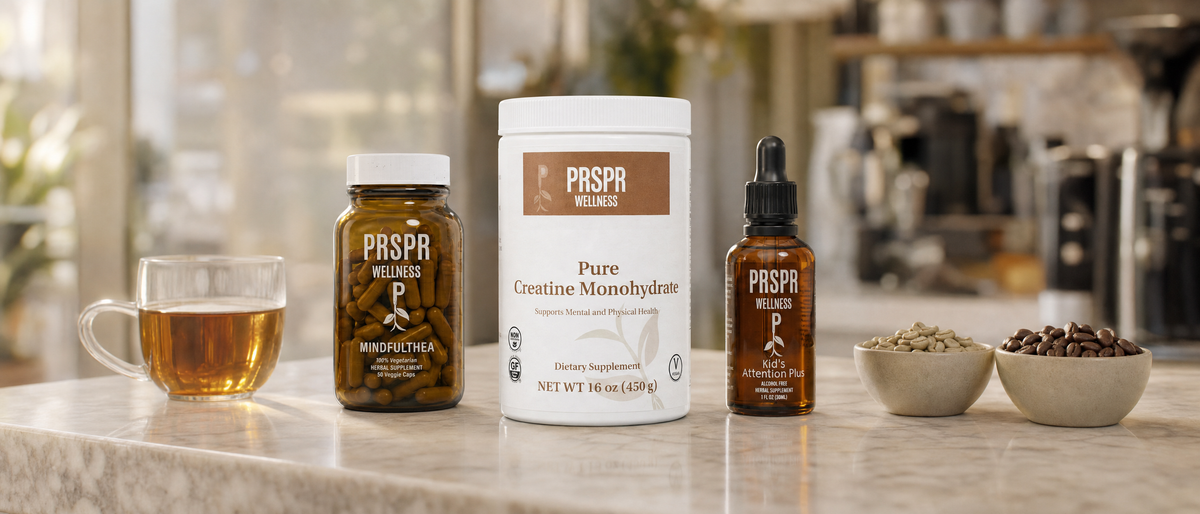
The Energy & Focus Stack is a stack of three of our products: Pure Creatine Monohydrate, MindfulThea (L-Theanine) and Attention Plus. Each one has its own listing, and each listing describes what it is made with.
None of those three listings names caffeine as an ingredient. That is the whole of what we say about caffeine and this stack, and it is something you can check line by line.
What we will add in our own voice is how our products are made. They are manufactured in a GMP-certified facility and third-party batch tested, so what's on the label is what's in the bottle.
If you want to read those ingredient lines for yourself, open the Energy & Focus Stack page, browse the rest of our bundles collection, or take the build-your-stack quiz to see where it fits alongside everything else we carry.
Answer all five questions to unlock a clear wellness plan made around your goal, schedule, preferred supplement format, and biggest roadblock.
Get clarity on what matters most right now.
See the product and routine connected to your goal.
Simple next steps you can use right away.
Pick the one you would fix first if you could.
This helps us make the guide easier to follow.
Consistency beats the “perfect” routine you never follow.
Be honest. We’re building something you’ll actually use.
Your guide will include one simple way around it.
Answer two more questions to unlock your product starting point, five-step plan, two-week routine, and one practical tip for your biggest roadblock.
Enter your details to open your five-step plan.
Verified PRSPR customer reviews
Expires when you close this page
*Your personal credit for completing the quiz. It's applied automatically at checkout on one-time purchases and expires when the timer runs out.
View full product detailsEverything in your plan, together — one add to cart.
Expires when you close this page
*Your personal credit for completing the quiz. It's applied automatically at checkout on one-time purchases and expires when the timer runs out.
View full product details Mind vocabulary
What is cognition? You have probably seen the word "cognitive" printed on a label, in a headline, or in a product name, and kept scrolling. It is o...
 Biology vocabulary
What is metabolism? You see the word on labels, in gym talk and in nutrition headlines, almost always used as if it were a single setting. Read eno...
 Sleep vocabulary
What are sleep cycles? You hear the phrase on podcasts, see it on sleep trackers, and read it in articles that assume you already know what it mean...