
◎
Get clear
Get clarity on what matters most right now.

What is Camellia sinensis? If you drink tea, you have almost certainly met it, whether or not the name was on the box. And this week a lot of people went looking for it. On Google Trends (US, past seven days), "camellia sinensis tea" and "gyokuro tea" both carry a volume score of 100, "camellia sinensis plant" sits at 52, "what is camellia sinensis" at 36, "tea plant" at 30 and "sencha" at 22.
The rising searches are even more telling. "Gyokuro vs sencha" is marked Breakout, and "black tea" is up +80%.
Put those together and a pattern shows up. People are running into a Latin plant name, two Japanese tea names and one very ordinary English one, and wondering how they connect. The short answer is that they are all the same plant. The long answer is about what happens to the leaves after, and sometimes before, they are picked.
Camellia sinensis is the botanical name of the tea plant. The North Carolina State University Extension plant database describes it as "a hardy evergreen shrub or small tree" in the family Theaceae, lists its origin as south-central and southeast China, and gives its common names as tea camellia, tea plant, tea tree camellia and Assam tea. The same database records a height of 6 to 15 feet and "white fragrant flowers."
So when a package says "camellia sinensis tea," it is not describing a special variety. It is simply using the Latin name for tea itself. Every true tea, from a supermarket teabag to a ceremonial Japanese green, starts as a leaf from this one species.
The first half of the name gives away the family resemblance. The tea plant is a camellia, a relative of the ornamental camellias grown for their flowers. If you have seen a camellia hedge, you have seen the tea plant's cousins. The NC State database notes the tea plant's leaves "emerge beginning early spring," which is when a picking season starts.
Here is the fact that surprises most people. Green, black, white and oolong tea are not four plants. They are one plant, handled four ways.
The National Center for Complementary and Integrative Health (NCCIH), part of the NIH, puts it plainly: "Green, black, and oolong teas all come from the same plant, Camellia sinensis, but are prepared using different methods." Washington State University's vegetable extension program says the same thing from the grower's side: "It is the processing method that determines the type of tea." The NC State database agrees, noting that the leaves are "processed in different ways to create white, green, oolong, and black teas."
That is why "black tea" can trend in the same week as a Latin plant name. It is not a separate crop. It is a separate process.
It also explains why herbal drinks are a separate conversation. A cup of chamomile or peppermint is steeped from a different plant altogether, so by this definition it sits outside the tea family, even when it shares the same mug, the same kettle and the same shelf. When people say "true tea," this is the line they are drawing: a leaf from Camellia sinensis, or not.
Washington State University's extension guide breaks tea processing into a handful of steps. Which steps a leaf goes through, and how far, decides what ends up in the cup.
WSU describes white tea as "non-oxidized tea simply made by drying the leaves. The least processed tea." In WSU's guide, green tea is heated early to halt oxidation, oolong is partially oxidized before its heat step, and black tea sits at the far end as the most heavily oxidized. NCCIH describes the same ladder in older vocabulary: green tea is not fermented, oolong is partially fermented, and black tea is fermented.
Even within green tea there is a split. WSU describes the fixation step as "quickly heating the oxidized leaves, either by steaming (Japanese method) or heating in a pan/wok (Chinese method) to halt the oxidation process and preserve green color." Same plant, same goal, two kitchens.
This is where the Breakout search comes in, and it is the best illustration of the whole idea. Gyokuro and sencha are both Japanese green teas. Both come from Camellia sinensis. The big difference happens in the field, before a single leaf is picked.
A 2026 review in the journal Molecules, which compared matcha, sencha and gyokuro, describes sencha as "produced from tea leaves grown in full sunlight." After picking, the review says, the leaves are steamed "to inactivate enzymes responsible for oxidation, followed by rolling and drying." That is the standard green tea path, done the Japanese way.
The same review calls gyokuro "a premium form of sencha," produced by shading the tea plants from direct sunlight "using reed screens or synthetic shade nets for approximately 20 days following the emergence of new shoots." So the gyokuro tea in the Breakout search is, by that description, a sencha that spent its last few weeks on the bush under cover.
Shading changes the chemistry of the leaf itself. According to the Molecules review, under direct sunlight theanine in the leaf "is rapidly metabolized into glutamic acid and ethylamine," and shading "inhibits the degradation of theanine and suppresses catechin synthesis." The review concludes that gyokuro "is characterized by higher theanine content and lower catechin levels compared with standard sencha." The same review ties catechins to astringency. All of that is a statement about what is in the leaf, and it is why the two teas are sold as different things.
If theanine is a new word, our piece on what L-theanine is tells the story of how it was first found in tea, and our explainer on amino acids covers why theanine is one that sits outside the familiar twenty. And for the powdered green tea that sits next to both in that same review, see what matcha is made of.
We love a fact that rearranges a whole aisle, and this is one. The tea shelf looks like dozens of different plants. It is really one plant and a set of decisions: how long to wither, whether to roll, how far to oxidize, whether to steam or pan-fire, and whether to shade the bush before picking.
Gyokuro and sencha make that visible. Same species, same country, and the headline difference comes down to a few weeks of shade. That is a good reminder that the name on a package often describes a process, not just a source.
So when we see "camellia sinensis" on a label, we read it for what it is: the tea plant, named in Latin. And we read the chemistry for what it is, too: a description of a leaf, not a promise about a person. What any tea or supplement means for you personally is a question for a qualified healthcare professional.
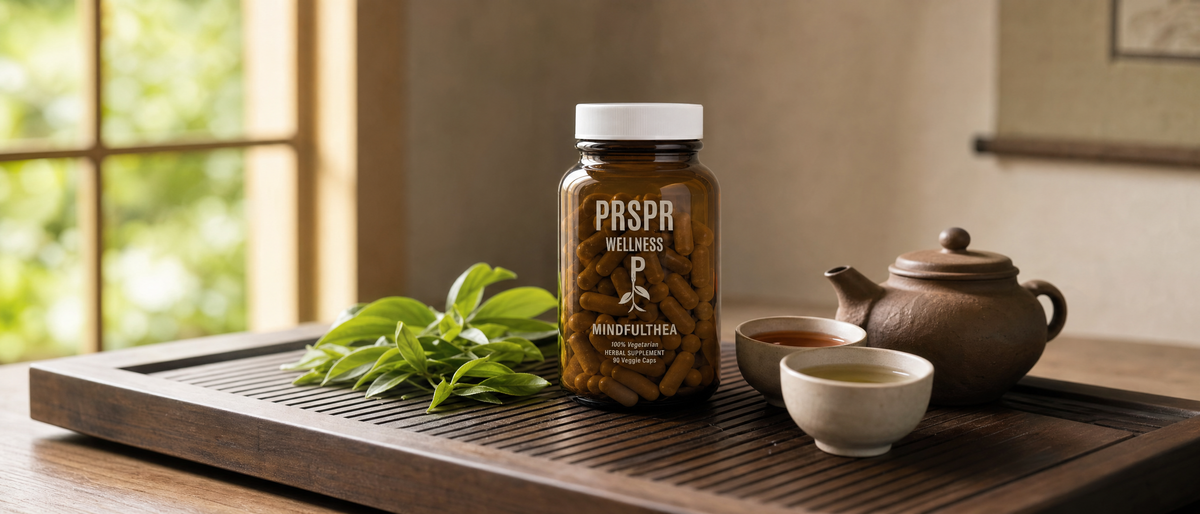
Which brings us to our own bottle. PRSPR MindfulThea is, in the listing's own words, "a dietary supplement made with L-theanine. It is formulated for convenient daily use." That is how the listing describes it, and that is the description we stand behind. It comes in a bottle, not a teapot, and its connection to this piece is the word on its label. It is made with L-theanine, the same compound the tea chemistry above keeps coming back to.
What we will add in our own voice is how it is made. MindfulThea is manufactured in a GMP-certified facility and third-party batch tested, so what's on the label is what's in the bottle.
To read the full label for yourself, open the MindfulThea product page, browse the rest of the vitamins and supplements collection, or take the build-your-stack quiz to see where it fits alongside everything else we carry.
Answer all five questions to unlock a clear wellness plan made around your goal, schedule, preferred supplement format, and biggest roadblock.
Get clarity on what matters most right now.
See the product and routine connected to your goal.
Simple next steps you can use right away.
Pick the one you would fix first if you could.
This helps us make the guide easier to follow.
Consistency beats the “perfect” routine you never follow.
Be honest. We’re building something you’ll actually use.
Your guide will include one simple way around it.
Answer two more questions to unlock your product starting point, five-step plan, two-week routine, and one practical tip for your biggest roadblock.
Enter your details to open your five-step plan.
Verified PRSPR customer reviews
Expires when you close this page
*Your personal credit for completing the quiz. It's applied automatically at checkout on one-time purchases and expires when the timer runs out.
View full product detailsEverything in your plan, together — one add to cart.
Expires when you close this page
*Your personal credit for completing the quiz. It's applied automatically at checkout on one-time purchases and expires when the timer runs out.
View full product details Mind vocabulary
What is cognition? You have probably seen the word "cognitive" printed on a label, in a headline, or in a product name, and kept scrolling. It is o...
 Biology vocabulary
What is metabolism? You see the word on labels, in gym talk and in nutrition headlines, almost always used as if it were a single setting. Read eno...
 Sleep vocabulary
What are sleep cycles? You hear the phrase on podcasts, see it on sleep trackers, and read it in articles that assume you already know what it mean...