
◎
Get clear
Get clarity on what matters most right now.

Chlorophyll in water is holding a maximum volume score this week. Chlorophyll drops benefits is at 98. What is liquid chlorophyll sits at 53, what is chlorophyll at 50, what is chlorophyll water at 49, and the rising side of the chart is stacked with questions: what does chlorophyll do for the body is up 80 percent, what are the benefits of chlorophyll water up 70 percent, what is chlorophyll good for up 40 percent.
Strip out the outcome questions and what is left is a shelf full of people asking what the green stuff actually is. That is a fair question, because chlorophyll arrived in the supplement aisle through social video rather than through the usual route, and a lot of people met the dropper before they met the molecule.
So this article does the identity work. What the pigment is, where the chlorophyll in our dropper comes from, and what liquid chlorophyll means as a format compared with the glass of green water everyone has seen on a screen.
Chlorophyll is the pigment that makes plants green. That is not a simplification, it is the definition. It sits inside chloroplasts in plant cells and it is the molecule that absorbs light for photosynthesis, which is the process plants use to turn light, water and carbon dioxide into sugars. The green you see is the part of the light spectrum the pigment does not absorb, reflected back at you.
Structurally it is a large ring-shaped molecule with a magnesium atom at its centre. If that arrangement sounds familiar it is because haemoglobin, the pigment that makes blood red, is built on a similar ring with iron at the centre instead. That resemblance is a genuine and long-noted piece of chemistry, and it is also the origin of a great deal of internet speculation that runs well past what the resemblance actually establishes. We are noting the structure, not drawing a conclusion from it.
Chlorophyll is not one compound either. There are several types, labelled a, b and onward, differing in small details of their side groups. Plants generally carry more than one.
Here is where the format question gets interesting, and it is the practical heart of this article.
Chlorophyll as it exists in a leaf is fat-soluble. It does not dissolve in water, which anyone who has boiled spinach has observed without thinking about it: the water goes green-ish and cloudy rather than becoming a clear green solution. So a product that dissolves cleanly into a glass of water is not raw leaf pigment straight from the plant. It has been prepared into a water-soluble form, and that preparation is a manufacturing step, not a marketing one.
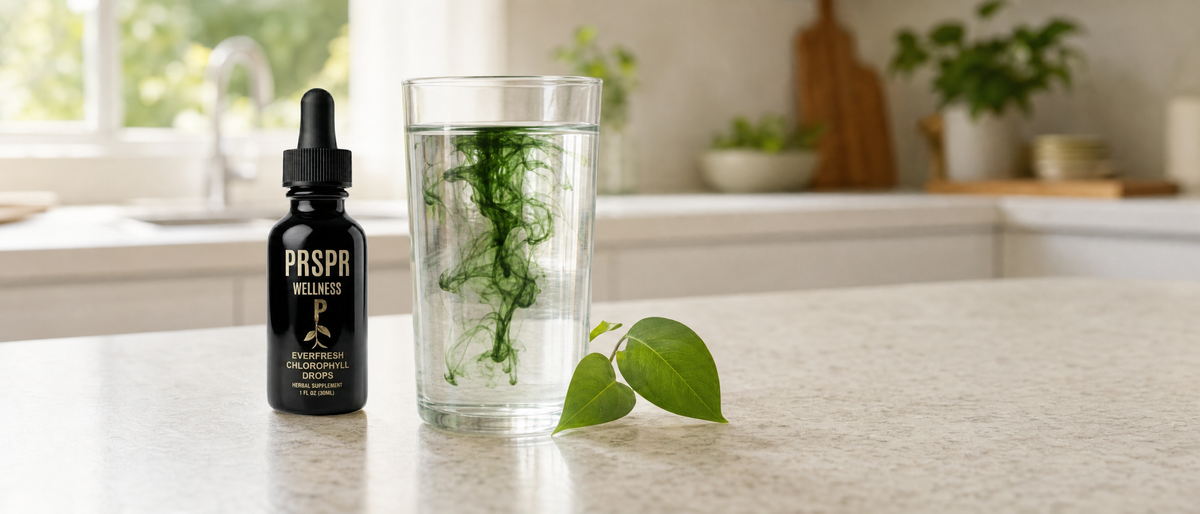
That is the actual answer to what is liquid chlorophyll. It is a liquid preparation of the pigment, made to disperse in water, sold in a dropper so it can be measured in drops rather than spoons. And chlorophyll water, the phrase driving the biggest search in this cluster, is the resulting glass: water with a measured quantity of that liquid stirred into it.
The dropper matters more than it looks. A dropper is a measuring device. It lets a product be dosed in small units and mixed into whatever you were going to drink anyway, which is a genuinely different proposition from a capsule you swallow whole or a powder you scoop. Format is not a detail on this shelf. It is most of what distinguishes one chlorophyll product from another.
One more format distinction people run into. A great deal of what is sold as liquid chlorophyll is more precisely a chlorophyll derivative rather than the intact leaf pigment, because the intact molecule is not stable or water-soluble enough for a bottle. That is standard across the category and it is a manufacturing reality rather than a shortcut. It is also why the colour of a prepared product can differ noticeably from the colour of a crushed leaf.
Our Everfresh Liquid Chlorophyll is made with chlorophyll derived from mulberry leaves, and naturally flavoured with peppermint oil. Both of those are worth pausing on, because both are the kind of specific that most of this shelf does not offer.
Mulberry is the source plant. Mulberries are trees of the genus Morus, grown across temperate and subtropical regions, and their leaves are a large-volume agricultural product in their own right, most famously as the sole food of silkworms. A broad green leaf produced at agricultural scale is a sensible source material for a pigment, and naming it tells you something a generic green label does not.
The peppermint is a flavour. Chlorophyll preparations carry a distinctly vegetal taste, and peppermint oil is there to sit on top of it. That is worth knowing before you buy rather than after.
One label word worth flagging while we are here, because organic chlorophyll liquid is a rising search of its own: organic is a certification claim about how source material is grown and handled. It is a sourcing statement, not a description of the pigment, and it is a separate thing to check on any listing rather than something to assume from a green label.
What we are not going to do is tell you what any of it does. Four of this week's nine searches in this cluster are outcome questions, and they are the biggest movers. That tells us people want an answer. It does not make us the right source for one. Those are questions for a healthcare professional who knows your situation.
The taste question deserves its own line, because it is the most common reason people abandon this format. Chlorophyll preparations taste green in a way that is difficult to describe and easy to recognise: grassy, slightly bitter, closer to raw spinach water than to anything sweet. A mint flavouring softens that. It does not erase it. Buy accordingly, and follow the directions on the label.
Chlorophyll is one of the few supplement ingredients where nearly everyone already has an accurate mental image of the raw material. You have seen it. You have eaten it. It is the colour of every green vegetable you have ever cooked. That familiarity is an advantage the category mostly wastes by talking about everything except the plant.
So the useful questions on this shelf are boring ones. What plant did the pigment come from. What form is it in. How is it measured. A product that answers those three has told you what you are buying, and a product that only shows you a photograph of a green glass has not.
What is chlorophyll? The green pigment in plants, responsible for absorbing light in photosynthesis. It is a ring-shaped molecule with magnesium at its centre, and it exists in several closely related types.
What is liquid chlorophyll? A liquid preparation of that pigment, made to disperse in water and packaged with a dropper so it can be measured in drops.
What is chlorophyll water? Simply water with liquid chlorophyll stirred into it. The phrase describes the drink, not a separate product.
What does chlorophyll do for the body, and what is chlorophyll good for? These are the most-searched questions in this cluster and they are not ours to answer. Effects on the body are a matter for a qualified healthcare professional who knows your history, not a product page.
Everfresh Liquid Chlorophyll names its source plant and its flavouring on the listing, which is the specificity this article has been asking for. It is manufactured in a GMP-certified facility and third-party batch tested, so what is on the label is what is in the bottle.
The listing is on the Everfresh Chlorophyll drops page, and it sits with the rest of that shelf on our gut and digestion page. For another look at how a mixed-into-water format is labelled, our electrolyte label piece covers the same ground from the powder side. And if you want to start from what you already take, take the quiz.
Answer all five questions to unlock a clear wellness plan made around your goal, schedule, preferred supplement format, and biggest roadblock.
Get clarity on what matters most right now.
See the product and routine connected to your goal.
Simple next steps you can use right away.
Pick the one you would fix first if you could.
This helps us make the guide easier to follow.
Consistency beats the “perfect” routine you never follow.
Be honest. We’re building something you’ll actually use.
Your guide will include one simple way around it.
Answer two more questions to unlock your product starting point, five-step plan, two-week routine, and one practical tip for your biggest roadblock.
Enter your details to open your five-step plan.
Verified PRSPR customer reviews
Expires when you close this page
*Your personal credit for completing the quiz. It's applied automatically at checkout on one-time purchases and expires when the timer runs out.
View full product detailsEverything in your plan, together — one add to cart.
Expires when you close this page
*Your personal credit for completing the quiz. It's applied automatically at checkout on one-time purchases and expires when the timer runs out.
View full product details Electrolytes
Salt is having a comparison week. Searches for celtic sea salt vs himalayan pink salt are up about 70 percent, pink himalayan salt vs table salt is...
 Kids
KidsPick up a box of children's snacks and somewhere on the front there is a number with the letter g after it, next to the word fiber. It looks like o...
 Label Reading
It is printed on the front of a lot of mineral bottles and it is one of the least understood words in the supplement business. Chelated. Search int...