
◎
Get clear
Get clarity on what matters most right now.

What is creatinine? A lot of people are asking right now, and they are asking it next to two other words that look almost identical. This week, what is creatine kinase carries a volume score of 83, what is creatinine 71, ck 38, creatine 33, creatinine meaning 19, and creatinine vs creatine kinase 7.
Read those together and you can see the confusion forming in real time. Three terms share the same first seven letters. One of them is a compound. One is a different compound made from it. One is an enzyme. And one of them usually shows up as two capital letters with no explanation at all.
That is a vocabulary problem before it is anything else, and vocabulary is something any good reference can settle. So that is where we are staying: the chemistry and the names. Words like these often turn up on lab reports, and what any number on a lab report means for a person is a question for a qualified healthcare professional. We are not going to read lab values in either direction.
Creatine is the root word, so start there.
Creatine is a compound. PubChem, the National Library of Medicine's chemistry database, lists its molecular formula as C4H9N3O2 and describes it as a glycine derivative, meaning it is built on the frame of the amino acid glycine, with extra groups of atoms attached.
The name is older than most people guess. According to the Online Etymology Dictionary, creatine was discovered in 1832 by Michel-Eugène Chevreul, who also named it, and the word comes from the Greek kreas, meaning "flesh, meat," plus the chemical suffix "-ine." The dictionary describes it as an organic substance obtained from muscular tissue, which is where the meat in its name comes from.
Keep that "-ine" in mind. It is about to happen twice.
If you want the label side of this compound, our explainer on what the word "monohydrate" means on a creatine label picks up where this section stops.
Creatinine is a different compound. It is made from creatine, and its name is creatine with one more suffix bolted on.
MedlinePlus, the National Library of Medicine's consumer health site, describes creatinine as a normal waste product in your body, made when you use your muscles and some of the muscle tissue breaks down. In plain vocabulary, it is a breakdown product, and the compound it comes from is creatine.
PubChem's chemistry description is more precise. It calls creatinine a lactam obtained by "formal cyclocondensation" of creatine, and a metabolite of creatine. Unpack those two words and the chemistry gets simple. "Cyclo" means ring: the molecule folds back and closes into a ring shape. "Condensation" is the chemist's word for a reaction in which a small molecule, often water, leaves.
You can see it in the formulas. PubChem gives creatine as C4H9N3O2 and creatinine as C4H7N3O. Subtract one from the other and the difference is two hydrogens and one oxygen. That is the makeup of one water molecule, which is exactly what "condensation" predicts.
If you searched creatinine meaning, the word hands you the answer. The Online Etymology Dictionary dates creatinine to 1847 and describes it as a substance "obtained by the action of acids on creatine." The word is formed from creatine plus the chemical suffix "-ine" again. Creatine, then creatinine: the same root, extended once, for the compound made from it.
Now the third word, which is not a compound like the other two. It is an enzyme.
MedlinePlus says it directly: CK is an enzyme, and an enzyme is a protein that speeds up certain chemical reactions. It also notes that creatine kinase is also called creatine phosphokinase, or CPK. So when you see CK or CPK on a page, both are abbreviations for the same enzyme.
Where it sits is part of its definition too. According to MedlinePlus, most of the CK in the body is in the skeletal muscles, with some in heart muscle and small amounts in the brain.
What it does, in chemistry terms, is move a phosphate group. PubChem's entry for the human muscle form of creatine kinase describes it as reversibly catalyzing the transfer of phosphate between ATP and phosphogens, with creatine phosphate given as the example. Put simply, it is the enzyme that attaches a phosphate group to creatine, or takes it back off. If ATP is an unfamiliar term, our piece on ATP, spelled out covers the molecule piece by piece.
The name describes the job. According to the Online Etymology Dictionary, kinase dates to 1902 and comes from the Greek kinein, "to move," plus the suffix "-ase," which it describes as the word-forming element used in naming enzymes. So "creatine kinase" reads, word by word, as an enzyme that moves something on creatine. The something is a phosphate group.
The two-letter search, ck, is the one that causes the most trouble, because it looks like it could mean anything.
In a chemistry or lab context, CK is simply the short form of creatine kinase, per MedlinePlus. It is not a separate compound and it is not an abbreviation for creatine or for creatinine. That is worth saying plainly, because "CK" sitting next to "creatinine" can look like two versions of one thing. They are not.
Outside that context, of course, CK is used for plenty of unrelated things. When it appears next to creatine or creatinine, it means the enzyme.
Here is where this stops being chemistry and becomes a reading skill.
The creatinine vs creatine kinase search makes sense once you line up the three words. All of them begin "creatin." All of them are connected to the same compound. And this week's search data puts them side by side, often with one abbreviated and one spelled out. It is easy for your eye to treat them as one family of the same thing.
They are three different kinds of thing:
A useful shortcut: the "-ine" ending signals a compound, and the "-ase" ending signals an enzyme. That rule of thumb, taken from how chemists name things, will sort most of the "creatin" words you run into.
Many people searching these terms want to know what their own numbers mean, or whether anything they take changes them. Those are exactly the questions to bring to a qualified healthcare professional, not to a naming guide.
Three words with one root deserve three separate definitions.
Creatine, creatinine and creatine kinase get blurred together because they look alike, and the blur makes every one of them harder to understand. Separate them and each becomes simple. A compound. A second compound made from the first. An enzyme that works on the first. That is the whole map.
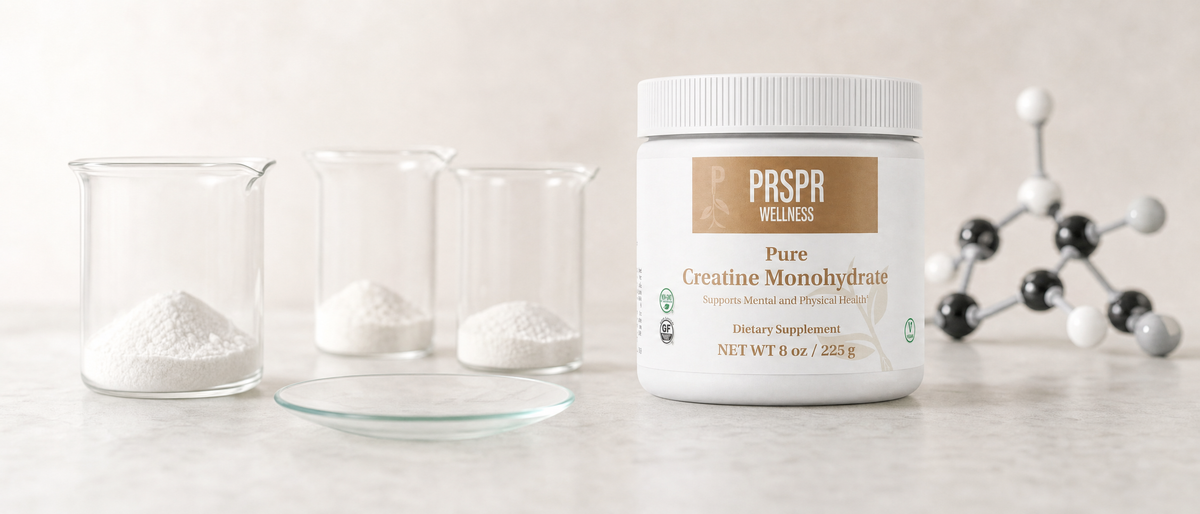
We also think product pages carry some responsibility here. A creatine listing should tell you what the compound is and what form it comes in, and it should not leave you guessing which "creatin" word it means. Ours names creatine monohydrate and describes creatine as a compound. We think that is the right size for a label, and we say nothing beyond it.
So here is the habit to keep. When you see a word starting "creatin," check the ending before anything else. It will tell you what kind of thing you are reading about.
Pure Creatine Monohydrate is, in its listing's words, "a single-ingredient dietary supplement made with creatine monohydrate." The listing also says: "Creatine is a naturally occurring compound found in the body and in certain foods." One ingredient, named plainly. That is the whole of what we say the product is.
What we will add in our own voice is how it is made. Pure Creatine Monohydrate is manufactured in a GMP-certified facility and third-party batch tested, so what's on the label is what's in the bottle.
If you want to read that single ingredient line for yourself, open the Pure Creatine Monohydrate page, browse the rest of the vitamins and supplements collection, or take the build-your-stack quiz to see where it fits alongside everything else we carry.
Answer all five questions to unlock a clear wellness plan made around your goal, schedule, preferred supplement format, and biggest roadblock.
Get clarity on what matters most right now.
See the product and routine connected to your goal.
Simple next steps you can use right away.
Pick the one you would fix first if you could.
This helps us make the guide easier to follow.
Consistency beats the “perfect” routine you never follow.
Be honest. We’re building something you’ll actually use.
Your guide will include one simple way around it.
Answer two more questions to unlock your product starting point, five-step plan, two-week routine, and one practical tip for your biggest roadblock.
Enter your details to open your five-step plan.
Verified PRSPR customer reviews
Expires when you close this page
*Your personal credit for completing the quiz. It's applied automatically at checkout on one-time purchases and expires when the timer runs out.
View full product detailsEverything in your plan, together — one add to cart.
Expires when you close this page
*Your personal credit for completing the quiz. It's applied automatically at checkout on one-time purchases and expires when the timer runs out.
View full product details Mind vocabulary
What is cognition? You have probably seen the word "cognitive" printed on a label, in a headline, or in a product name, and kept scrolling. It is o...
 Biology vocabulary
What is metabolism? You see the word on labels, in gym talk and in nutrition headlines, almost always used as if it were a single setting. Read eno...
 Sleep vocabulary
What are sleep cycles? You hear the phrase on podcasts, see it on sleep trackers, and read it in articles that assume you already know what it mean...