
◎
Get clear
Get clarity on what matters most right now.

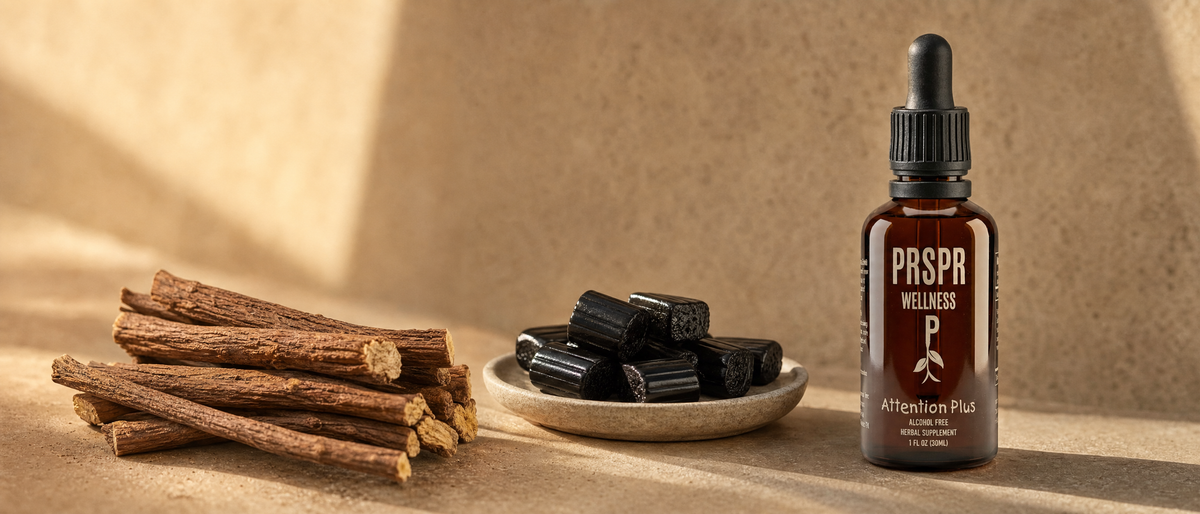
Deglycyrrhizinated licorice root is up about 70 percent this week, which is remarkable for a nineteen-letter word almost nobody can pronounce. Around it: licorice root tea maxed out at a relative interest score of 100, what is licorice root at 54, licorice root extract at 46, black licorice at 27. Also rising, where can i buy licorice root up about 90 percent and what does licorice root do up about 60.
That last one is a use question and we will name it rather than answer it. What interests us is the shape of the rest. A plant name, a preparation, a confection, and a chemistry term that is longer than most sentences people type. Those four things are being searched together because they are genuinely tangled, and untangling them is what this article does.
This is plant and food identification. It makes no claim about the root and nothing here is guidance about anyone taking anything.
Licorice is a plant. Glycyrrhiza glabra is the species most commonly meant, a perennial legume, which puts it in the same family as peas and beans. It grows to a metre or more, with compound leaves and small pale flowers, and it is native to parts of southern Europe and western Asia.
The commercial part is underground. The plant produces a root system with long horizontal runners, and it is those roots and runners that are harvested, washed and dried. Dried licorice root looks like woody sticks, fibrous and pale yellow inside, and it is sold that way as well as milled into powder.
The reason it has been used for so long is the taste. The root contains glycyrrhizin, a compound that is intensely sweet, considerably sweeter than sugar by weight, and with a lingering flavor quite unlike sugar's. The genus name gives it away: glycyrrhiza comes from the Greek for sweet root. The English word licorice descends from the same Greek through Latin and Old French, gradually mangled along the way.
So the plant is a sweet-tasting legume root, and the sweetness is the reason anyone noticed it in the first place.
Here is the confusion at the center of this cluster, and it goes in a direction most people do not expect.
Black licorice, the confection, is a candy: sugar, a binder such as flour or gelatin, coloring, and a flavoring. In traditional European licorice, that flavoring genuinely is licorice root extract, and those products taste of the plant because the plant is in them.
But a great deal of what is sold as black licorice, particularly in the United States, is flavored with anise oil or star anise instead. Anise is Pimpinella anisum, an umbellifer related to carrot and parsley. Star anise is Illicium verum, an entirely unrelated evergreen tree. Neither is licorice. They are used because the dominant aroma compound in both, anethole, produces a flavor most people cannot distinguish from licorice.
So there are three separate plants in circulation here from three unrelated botanical families, producing a similar taste by different chemistry. And the candy in your hand may contain any of them, or a combination, and the ingredient list is the only way to find out.
This is the thing worth taking away. Black licorice the flavor and licorice the plant are not the same category of fact, and a black licorice candy frequently contains no licorice at all.
Now the tongue-twister, which is actually the most straightforward word in this article once you cut it up.
Take it in pieces. Glycyrrhizin is the sweet compound named above. Glycyrrhizinated would mean containing it. The prefix de means removed. So deglycyrrhizinated means the glycyrrhizin has been taken out. It is usually abbreviated DGL on labels, which is how most people encounter it, and DGL is a great deal easier to type than the full form, which is why the abbreviation exists.
The processing itself is a separation: the compound is removed from the extract, leaving the rest of the plant material behind. That produces a preparation that is chemically different from whole licorice root, and it is sold as its own distinct product category rather than as a variant.
Why anyone would remove the sweet compound is a question about physiology and regulation, and it is not one we are going to answer. What we can say is the label fact: DGL and whole licorice root are two different preparations, they are not interchangeable, and a product carrying the DGL abbreviation is telling you something specific about how it was made.
It also explains why the word is rising in search. It appears on labels, it is unpronounceable, and people are looking it up. That is exactly the behavior that makes an unfamiliar word useful: it stops the skim.
The two preparation terms in the cluster are worth a paragraph each, because they are different objects.
Licorice root tea, the largest term here at 100, is dried root steeped in hot water. Because the root is hard woody material, it is usually simmered rather than steeped, which is technically a decoction. What ends up in the cup is whatever transferred into water, and given how water-soluble the sweet compound is, the answer is a noticeably sweet drink.
Licorice root extract at 46 is concentrated. Plant material is extracted with a solvent and the solvent removed, leaving a thick residue or a dried powder. Extracts are what go into confectionery, into flavorings, and into capsules, and a concentration ratio on the label tells you how much raw root produced a given amount of extract.
Where can i buy licorice root, up about 90 percent, is worth noting as a search behavior rather than a preparation: people looking for the raw dried root itself rather than a finished product, which is a slightly unusual thing to want and suggests the tea and the cooking uses are driving part of this cluster.
Our favorite thing about this plant is that the confusion runs the opposite way from how people assume.
Everybody expects the situation to be that a supplement borrows a name from a familiar food. Here the food frequently does not contain the plant it is named after, while the supplement aisle does. The candy is the imposter and the capsule is the literal one, which is not the usual arrangement.
The general lesson is one we keep running into. A flavor name and an ingredient name are different kinds of claim. Vanilla, almond, licorice and mint all name flavors that are routinely produced by something other than the plant on the front of the packet, and the only way to know which you have is the ingredient list.
So read the list, on food as well as on supplements. It is the same skill in both aisles. We took another plant with a soft-drink twin apart in sarsaparilla is a soda flavor and a root, and looked at the hard botanical names in this product's own formula in ginkgo, gotu kola, rhodiola.
Our Attention Plus is a liquid botanical supplement, and per the live listing its blend is Ginkgo, Gotu Kola, Rhodiola, Licorice Root and Lobelia. Five botanicals, named individually, which is the composition as the listing states it.
Licorice root is named as licorice root, the plant, rather than as a flavor. Given everything above, that distinction is not pedantry. It is the difference between naming an ingredient and naming a taste, and in this particular case the two are separated by three different plant families.
The one thing we state in our own voice is manufacturing: GMP-certified facility, third-party batch tested, so the panel and the bottle agree.
If the flavor-versus-ingredient distinction is what you take from this, use it on your next grocery shop as well as here. The Attention Plus page lists the botanicals, the women's and children's health collection has more panels to read, and the build-your-stack quiz is there if you would rather start from a routine.
Answer all five questions to unlock a clear wellness plan made around your goal, schedule, preferred supplement format, and biggest roadblock.
Get clarity on what matters most right now.
See the product and routine connected to your goal.
Simple next steps you can use right away.
Pick the one you would fix first if you could.
This helps us make the guide easier to follow.
Consistency beats the “perfect” routine you never follow.
Be honest. We’re building something you’ll actually use.
Your guide will include one simple way around it.
Answer two more questions to unlock your product starting point, five-step plan, two-week routine, and one practical tip for your biggest roadblock.
Enter your details to open your five-step plan.
Verified PRSPR customer reviews
Expires when you close this page
*Your personal credit for completing the quiz. It's applied automatically at checkout on one-time purchases and expires when the timer runs out.
View full product detailsEverything in your plan, together — one add to cart.
Expires when you close this page
*Your personal credit for completing the quiz. It's applied automatically at checkout on one-time purchases and expires when the timer runs out.
View full product details Mind vocabulary
What is cognition? You have probably seen the word "cognitive" printed on a label, in a headline, or in a product name, and kept scrolling. It is o...
 Biology vocabulary
What is metabolism? You see the word on labels, in gym talk and in nutrition headlines, almost always used as if it were a single setting. Read eno...
 Sleep vocabulary
What are sleep cycles? You hear the phrase on podcasts, see it on sleep trackers, and read it in articles that assume you already know what it mean...