
◎
Get clear
Get clarity on what matters most right now.

Ginkgo biloba pronunciation is a breakout search this week. Not ginkgo biloba benefits, which is maxed out on the volume chart and has been for years. Not ginkgo biloba uses, up 120 percent. The single fastest-moving query attached to this plant right now is people trying to work out how to say it out loud.
That is not a trivial search and it is not an embarrassing one. It is the sound of a lot of people encountering a name in print, on an ingredient panel or a screen, and having no idea what to do with it. The same thing is happening one shelf over: gotukola, spelled as a single word, is up 130 percent, which is what a name looks like when someone is typing it phonetically because they have never seen it written properly.
So this article is about three hard names. What each plant is, where the names came from, and how to say them. It is a botany and etymology piece and it makes no claim about what any of them do.
Start with the sound, since that is what the search is asking for. Ginkgo is generally said GINK-oh. The second g is silent, which is the part that trips everyone. Biloba is bye-LOH-buh. Put together: GINK-oh bye-LOH-buh.
The spelling is genuinely strange and there is a good story behind it. The name entered European scientific writing through a transcription of a Japanese reading of the Chinese characters for the tree, and somewhere in that chain a letter appears to have been miscopied, producing ginkgo rather than a form closer to the original ginkyo. The error was printed, then inherited, and it is now the formal name. So if the word looks like a typo, that is because it more or less is one, preserved for three centuries.
Biloba is the easier half. It is Latin for two-lobed, and it describes the leaf, which is a distinctive fan shape usually notched in the middle so that it reads as two lobes joined at the stem. Once you have seen the leaf the epithet is self-explanatory.
The tree itself is remarkable independent of anything on a shelf. Ginkgo biloba is the only surviving species of an ancient lineage, with no close living relatives, which is why it gets called a living fossil. It is widely planted as a street tree because it tolerates urban conditions well.
Gotu kola is two words, said roughly GOH-too KOH-luh. The single-word spelling driving that rising search is a phonetic guess, and a reasonable one, but the conventional spelling separates them.
The plant is Centella asiatica, a small creeping herb in the same broad family as carrots and parsley. It grows low to the ground in wet or marshy conditions across parts of Asia, with rounded, scalloped leaves on slender stalks. The name gotu kola comes from Sinhala, from Sri Lanka, and despite the second word it has no relationship to the kola nut, which is a completely different plant. That is a coincidence of transliteration and a common source of confusion.
Rhodiola is roh-dee-OH-luh. The full binomial is Rhodiola rosea, which the search data has scrambled into rosea rhodiola, a maxed-out term that is simply the two halves in the wrong order. Both parts of the name are descriptive: rhodiola derives from the Greek for rose, and rosea repeats the idea in Latin. The reason is the root, which is reported to smell faintly of roses when cut, and which gives the plant its other common name, roseroot.
It is an arctic and alpine succulent, growing in cold, high, rocky places across the northern hemisphere, including Scandinavia, Siberia, and the mountains of central Asia and North America. A plant that thrives on a Siberian cliff is a genuinely different kind of organism from a marsh herb in Sri Lanka or a street tree in Tokyo, which is worth remembering when three such different things share one ingredient panel.
Here is the bridge. These three names are difficult for three different reasons, and each reason is a small lesson in how botanical labelling works.
Ginkgo is hard because of a transcription error frozen into formal nomenclature. Gotu kola is hard because it is a transliteration from a non-European language into an alphabet that does not quite fit it. Rhodiola is hard because it is straightforward classical Latin, and classical Latin is now unfamiliar to most people reading a supplement label.
Add them up and you get the actual problem: an ingredient panel is written in a naming system built by botanists for botanists, and handed unchanged to a shopper in a shop. None of these names is trying to be difficult. They are just from somewhere else.
Which is why the pronunciation search deserves more respect than it gets. Someone who can say a name can ask about it, look it up confidently, and mention it to a pharmacist without hedging. Being able to pronounce what is in your bottle is a small thing that makes every other question easier to ask.
What we are not doing on this page is telling you what any of these plants do. Ginkgo biloba benefits and gotu kola benefits are both maxed out on the chart, and ginkgo biloba uses and what is rhodiola rosea used for are both rising fast. Those are outcome questions, and with our approved claims list still empty they are not ours to answer in our own voice. They belong with a qualified healthcare professional who knows your situation.
We would like the industry to print pronunciations. Dictionaries do it, wine lists do it, and there is no reason a botanical panel could not carry a short phonetic guide next to an unfamiliar name. It would cost a line of type and it would remove a genuine barrier for a lot of shoppers.
Short of that, our position is the usual one. Name the plants properly, use the botanical names, and do not hide five botanicals behind a proprietary blend label. A panel that names Centella asiatica is harder to read than one that says herbal complex, and it is infinitely more useful, because a name you can look up is a name you can check.
What is ginkgo biloba? A tree, Ginkgo biloba, the only living species of an ancient lineage, recognisable by its fan-shaped two-lobed leaves and widely planted in cities.
What is gotu kola? A small creeping wetland herb, Centella asiatica, native to parts of Asia, with rounded scalloped leaves. It is unrelated to the kola nut.
What is rhodiola rosea used for? This is a uses question rather than an identity question, and it is not one we will answer here. We can tell you that it is an arctic and alpine succulent whose root is the part used and whose name refers to that root's rose-like scent. What it is used for, and whether it belongs in your routine, is a conversation for a doctor or pharmacist.
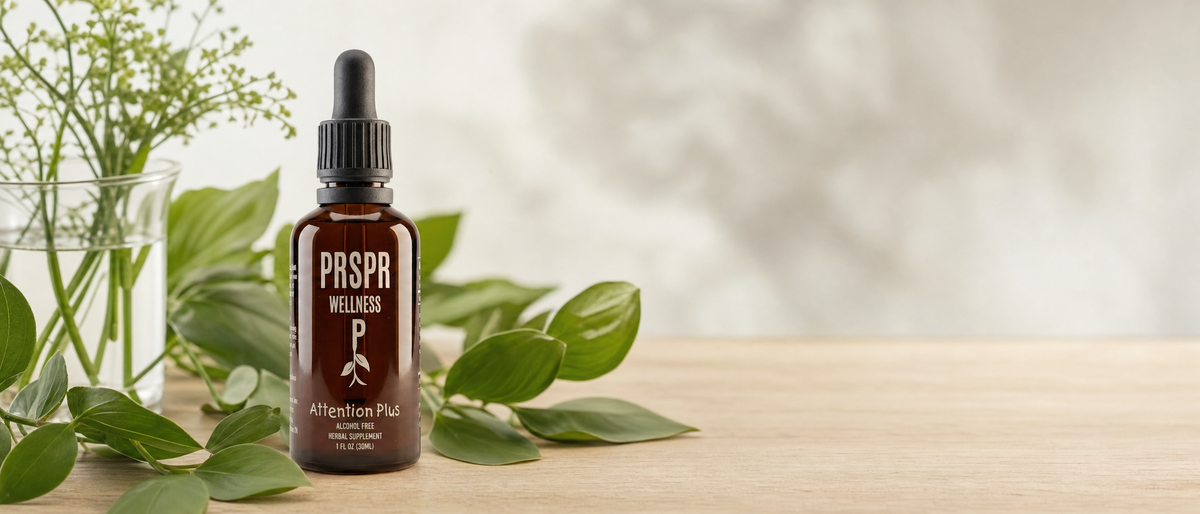
Attention Plus is a liquid botanical supplement made with a blend of Ginkgo, Gotu Kola, Rhodiola, Licorice Root and Lobelia. Five botanicals, all named individually on the listing rather than folded into a blend name, which is the disclosure this article has been arguing for. It is manufactured in a GMP-certified facility and third-party batch tested, so what is on the label is what is in the bottle.
The full listing is on the Attention Plus page, and you can see the rest of that shelf on our women's and children's health page. For another plant whose common name causes more trouble than it solves, our elderberry piece covers similar ground. And if you want help placing a botanical liquid next to what you already take, take the quiz.
Answer all five questions to unlock a clear wellness plan made around your goal, schedule, preferred supplement format, and biggest roadblock.
Get clarity on what matters most right now.
See the product and routine connected to your goal.
Simple next steps you can use right away.
Pick the one you would fix first if you could.
This helps us make the guide easier to follow.
Consistency beats the “perfect” routine you never follow.
Be honest. We’re building something you’ll actually use.
Your guide will include one simple way around it.
Answer two more questions to unlock your product starting point, five-step plan, two-week routine, and one practical tip for your biggest roadblock.
Enter your details to open your five-step plan.
Verified PRSPR customer reviews
Expires when you close this page
*Your personal credit for completing the quiz. It's applied automatically at checkout on one-time purchases and expires when the timer runs out.
View full product detailsEverything in your plan, together — one add to cart.
Expires when you close this page
*Your personal credit for completing the quiz. It's applied automatically at checkout on one-time purchases and expires when the timer runs out.
View full product details Electrolytes
Salt is having a comparison week. Searches for celtic sea salt vs himalayan pink salt are up about 70 percent, pink himalayan salt vs table salt is...
 Kids
KidsPick up a box of children's snacks and somewhere on the front there is a number with the letter g after it, next to the word fiber. It looks like o...
 Label Reading
It is printed on the front of a lot of mineral bottles and it is one of the least understood words in the supplement business. Chelated. Search int...