
◎
Get clear
Get clarity on what matters most right now.

What is an elderflower? That question is climbing, and it is bringing a whole cluster of searches with it. "What is an elderflower" is up +80% this week. The shorter "what is elderflower" carries a volume score of 19, "elderflower drink" also sits at 19, "elderflower syrup" at 18, "elderflower tea" at 9, "elderberry" at 9, and "elderflower taste" at 8.
Look at that list and one thing jumps out. Elderberry is sitting right in the middle of the elderflower searches. That is not an accident. The flower and the berry come from the same plant, and a lot of people are working out how the two connect.
So this piece is a plant explainer: what the elder is, what its flowers and berries look like, how each turns up in food and drink, and what elderflower tastes like. Questions about eating any part of the plant raw, or about what elderberry does in the body, are questions for a qualified healthcare professional. We are not going to answer them here.
An elderflower is the blossom of the elder, a shrub or small tree in the genus Sambucus. According to Britannica, Sambucus is a genus of about 10 species of shrubs and small trees in the family Adoxaceae, and the black, or common, elderberry, Sambucus nigra, is the most important species horticulturally.
So the short answer to "what is elderflower" is this: it is the flower of the same plant that gives you elderberries. Same shrub, different part, different time of year.
The name is old. According to the Online Etymology Dictionary, the tree name elder goes back to the Old English ellæn or ellærn. Its origin is unknown, and the dictionary notes it may be related to alder, which could explain where the d came from.
Elderflowers do not come one at a time. They come in big, flat heads made of many tiny blossoms. Britannica describes flat to roundish clusters of tiny yellowish white, saucer-shaped flowers. NC State Extension describes the flowers of Sambucus nigra as tiny and yellowish white to cream.
The clusters are large. Penn State Extension, writing about the elderberry grown in North America, calls them cymes and says each cluster can reach a diameter of 10 inches. When people picture an elderflower, they are usually picturing that whole creamy plate of blossoms, not a single flower.
Here is the part that clears up most of the confusion. The flowers come first, and the berries come from the flowers.
Penn State Extension explains that after the flowers fade, berry-like fruit form in clusters, and the berries turn deep purple as they ripen. Britannica notes that across the genus, the berries can be red, blue-black, black or yellow, and NC State Extension describes the fruit of Sambucus nigra as lustrous, glossy black.
The timing splits the year in two. According to UF/IFAS Extension, northern varieties begin to flower in May or June, and their fruit ripens from July through August. NC State Extension puts the fruit of Sambucus nigra in late summer to fall.
That gives you the two harvests in the title. Early summer is flower season. Late summer is berry season. And because each berry cluster forms where a flower cluster was, a flower head picked in June is a flower head that will not become berries in August. Anyone with an elder in the yard is choosing, cluster by cluster, which harvest they want.
If the growing side interests you, our piece on elderberry as a shrub you can plant goes deeper into the plant itself.
The flower and the berry end up in different parts of the kitchen.
The flowers are mostly about flavor and scent, and syrup is their classic form. Britannica notes that the flowers are made into a flavoring syrup. Penn State Extension describes the home method: the flowers are infused in a sugar syrup and left for one to three days while the flavors infuse. It also advises against rinsing the flowers, because that removes much of the flavor.
When people search "elderflower drink," they usually mean something built on that syrup, mixed into another drink. The flower can also be the base of the drink itself. The University of Wisconsin's Uncommon Fruit project notes that elderberry flowers can be made into a sparkling wine.
Then there is the simplest format. The same University of Wisconsin source notes that a sweet tea is made from the dried flowers. Drying is what turns a seasonal blossom into something that can sit in a tin.
The berries go a different way. Britannica says the juice is traditionally fermented into wine in some areas, and that the berries may be mixed with grapes for jelly or combined with apples as a pie filling. NC State Extension notes that the berries can be made into jam and syrup. So both harvests can end up as a syrup, but they are two different syrups, one from a flower and one from a fruit.
That is the elderberry side of the plant. For a plain-English introduction to the berry on its own, start with our elderberry explainer.
The elderflower taste question is really a scent question, because so much of the flower's character is aroma.
Penn State Extension describes elderflowers as having a delicate and sweet floral flavor. The University of Wisconsin's Uncommon Fruit project says the flowers are used to add a muscatel flavor to stewed fruits, jellies and jams, and singles out gooseberry jam. NC State Extension describes the flowers of Sambucus nigra as smelling musky.
Put those together and you get the usual description: floral, sweet and delicate, with a grape-like, muscat note and a musky edge in the scent. That is also why elderflower tends to be a flavoring rather than the main event. It shows up as a note in a syrup, a jam or a drink.
The berry is a different story, which is the point. Nobody describes an elderberry pie the way they describe an elderflower syrup. Two harvests, two flavors.
Now take that to the supplement shelf.
Because the flower and the berry are two different parts of the plant, a label that says "elderberry" and a label that says "elderflower" are naming two different ingredients. They share a plant, and they share the "elder" in their names, but they are not interchangeable words. One is a blossom picked in early summer. The other is a fruit that forms after the blossom is gone.
So when you read an ingredient panel, read the second half of the word. Berry means the fruit. Flower means the blossom. If you want to see how many forms the berry itself comes in, our piece on the formats in the elderberry aisle walks through syrups, teas and more.
The elder is one of the more generous plants in the hedgerow. It gives you a creamy, fragrant harvest in early summer and a dark, glossy one a couple of months later, and the two could hardly be more different on the plate.
We think the useful thing to take away from the elderflower searches is the distinction itself. What is an elderflower? It is the blossom. What is an elderberry? It is the fruit that comes after. Same shrub, two harvests, two words.
Keep those two words apart and a lot of labels, menus and recipes get easier to read.
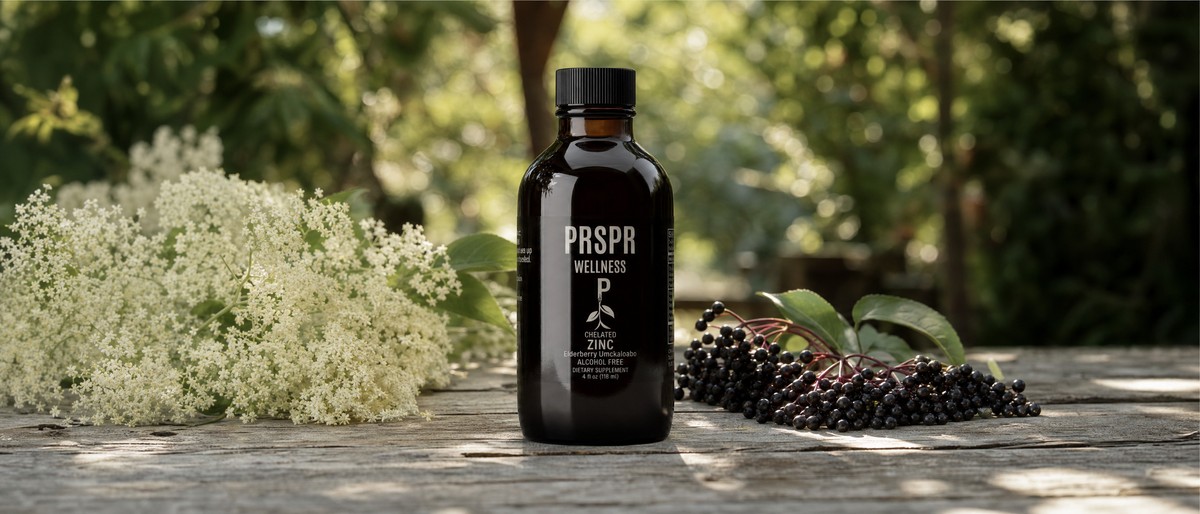
Here is the plain version for our own product. Elderberry w/ Zinc contains elderberry, not elderflower. The listing names the berry, and the flower does not appear in it.
In the listing's own words, it is "a dietary supplement that combines zinc with a blend of botanical ingredients including elderberry, echinacea, and umckaloabo root." The zinc is chelated, and if that word is new to you, it is a label word with a specific meaning of its own.
What we will add in our own voice is how it is made. Elderberry w/ Zinc is manufactured in a GMP-certified facility and third-party batch tested, so what's on the label is what's in the bottle.
To read the full ingredient list for yourself, open the Elderberry w/ Zinc page, browse the rest of the vitamins and supplements collection, or take the build-your-stack quiz to see where it fits alongside everything else we carry.
Answer all five questions to unlock a clear wellness plan made around your goal, schedule, preferred supplement format, and biggest roadblock.
Get clarity on what matters most right now.
See the product and routine connected to your goal.
Simple next steps you can use right away.
Pick the one you would fix first if you could.
This helps us make the guide easier to follow.
Consistency beats the “perfect” routine you never follow.
Be honest. We’re building something you’ll actually use.
Your guide will include one simple way around it.
Answer two more questions to unlock your product starting point, five-step plan, two-week routine, and one practical tip for your biggest roadblock.
Enter your details to open your five-step plan.
Verified PRSPR customer reviews
Expires when you close this page
*Your personal credit for completing the quiz. It's applied automatically at checkout on one-time purchases and expires when the timer runs out.
View full product detailsEverything in your plan, together — one add to cart.
Expires when you close this page
*Your personal credit for completing the quiz. It's applied automatically at checkout on one-time purchases and expires when the timer runs out.
View full product details Mind vocabulary
What is cognition? You have probably seen the word "cognitive" printed on a label, in a headline, or in a product name, and kept scrolling. It is o...
 Biology vocabulary
What is metabolism? You see the word on labels, in gym talk and in nutrition headlines, almost always used as if it were a single setting. Read eno...
 Sleep vocabulary
What are sleep cycles? You hear the phrase on podcasts, see it on sleep trackers, and read it in articles that assume you already know what it mean...