
◎
Get clear
Get clarity on what matters most right now.

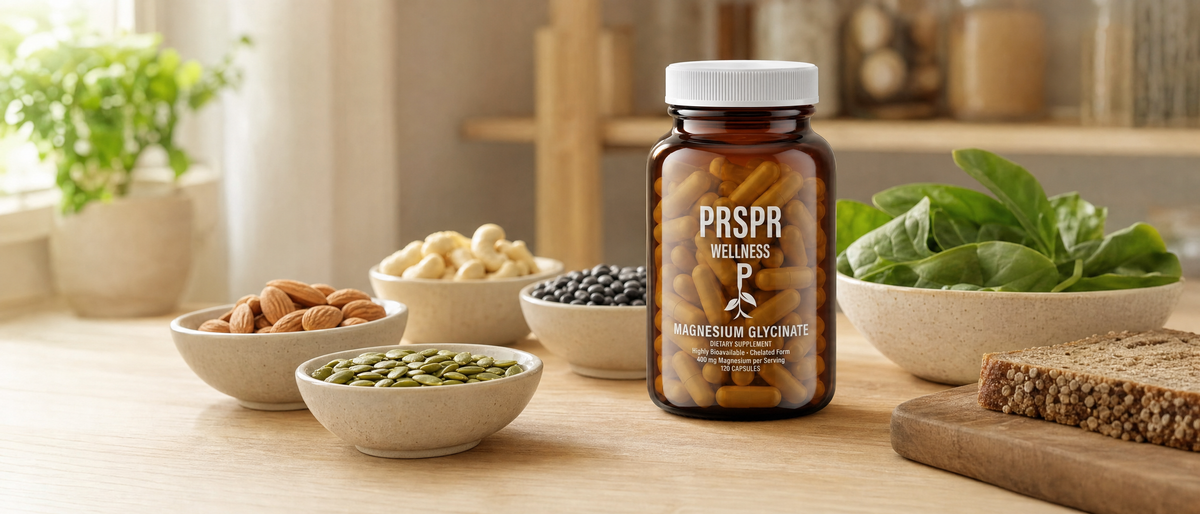
Search for foods rich in magnesium and you get a wall of lists that rarely agree. One puts spinach first. Another leads with almonds. A third opens with a seed most people only buy in October. The lists disagree for a boring reason: they are measuring different things, in different amounts, from different sources.
This week the search data says a lot of people are trying to sort that out. On Google Trends this week (US, past seven days), "foods rich in magnesium" holds the top relative volume score of 100 in its cluster. "What foods are rich in magnesium" scores 24, "magnesium rich foods list" and "high magnesium foods" each score 18, "foods that are rich in magnesium" scores 9, "most magnesium rich foods" scores 7 and "magnesium rich foods chart" scores 5. Two searches are climbing fast: "foods rich in magnesium list" is up +80%, and "pumpkin seeds" is up +50%.
So this piece is a list, built the careful way. Every number below comes from one named food-composition database, measured on the same basis, so the foods can actually be compared. Then we show you how to read a food chart yourself, so the next list you find makes sense. Magnesium is a mineral before it is a capsule, and the grocery store is where the word starts.
A food list is only as good as its source. The figures in this article come from USDA FoodData Central, the food-composition database run by the U.S. Department of Agriculture. Specifically, they come from its SR Legacy data set, which reports nutrients per 100 grams of the edible portion of a food.
That "per 100 grams" detail matters more than anything else on a chart. It puts every food on the same scale. A seed and a leaf are weighed the same way, so the number tells you how concentrated the magnesium is in that food, not how much of it you would eat in one sitting.
It also explains why lists online disagree. Some charts report per 100 grams. Some report per "serving," and each chart picks its own serving: a tablespoon, an ounce, half a cup, one medium piece. Some use raw foods, some cooked. Change any one of those and the ranking reshuffles, even when the underlying data is identical.
Here is a magnesium rich foods chart built from USDA FoodData Central. Each row names the food exactly as the database describes it, the magnesium it reports per 100 grams, and the FoodData Central ID so you can look the entry up yourself.
| Food (USDA FoodData Central description) | Magnesium, mg per 100 g | FDC ID |
|---|---|---|
| Seeds, pumpkin and squash seed kernels, dried | 592 | 170556 |
| Seeds, chia seeds, dried | 335 | 170554 |
| Nuts, almonds, dry roasted, without salt added | 279 | 170158 |
| Nuts, cashew nuts, dry roasted, without salt added | 260 | 170571 |
| Peanuts, all types, dry-roasted, without salt | 178 | 173806 |
| Spinach, cooked, boiled, drained, without salt | 87 | 168463 |
| Bread, whole-wheat, commercially prepared | 75 | 172688 |
| Beans, black, mature seeds, cooked, boiled, without salt | 70 | 173735 |
| Edamame, frozen, prepared | 64 | 168411 |
Read top to bottom, that is a foods rich in magnesium list sorted by concentration. Every figure in the table is from USDA FoodData Central, and nothing in it has been rounded, converted or estimated by us.
Look at the table again and a pattern jumps out. The foods fall into a handful of families. If you are asking what foods are rich in magnesium, it helps to think in those families rather than in single items.
Pumpkin seeds are the rising search this week, and the database backs up the attention. According to USDA FoodData Central, dried pumpkin and squash seed kernels carry 592 mg of magnesium per 100 grams, the highest figure on our chart. Dried chia seeds come next at 335 mg per 100 grams, according to the same database.
Notice the wording: "seed kernels." That is the shelled seed, sometimes sold as pepitas. A whole seed in its hull is a different entry in the database, with a different weight profile, which is exactly the kind of detail that makes two lists disagree.
USDA FoodData Central lists dry-roasted almonds without salt at 279 mg per 100 grams and dry-roasted cashews without salt at 260 mg. Dry-roasted peanuts without salt come in at 178 mg per 100 grams in the same database.
Peanuts are botanically a legume, not a tree nut, but most charts group them with nuts because that is how people shop for them. The database files them under their own name, which is a useful reminder that a chart's categories are a choice someone made.
Spinach shows up on nearly every list of high magnesium foods. USDA FoodData Central reports 87 mg of magnesium per 100 grams of spinach that has been boiled and drained. That is the cooked entry. Raw spinach has its own separate entry in the database, and because cooking drives off water and shrinks leaves, raw and cooked figures for the same plant are not interchangeable. Always check which one a chart is quoting.
According to USDA FoodData Central, boiled black beans carry 70 mg of magnesium per 100 grams, and prepared frozen edamame carries 64 mg per 100 grams. Beans are usually listed cooked, since almost nobody eats them dry, so these entries reflect the food as it lands on a plate, water and all.
Whole grains round out most magnesium rich foods lists. USDA FoodData Central reports 75 mg of magnesium per 100 grams of commercially prepared whole-wheat bread. The "whole" is the key word. The database carries separate entries for breads made from refined flour, and the two are listed as different foods for a reason: they are made from different parts of the grain.
The next time you land on a chart, run it through four quick questions. They take seconds, and they explain most of the disagreement between lists.
You can also do simple arithmetic with a per-100-gram figure. If a food lists 300 mg per 100 grams, a 50 gram portion carries half of that, 150 mg. The math is just proportion. The hard part is knowing what your portion actually weighs, which is why a kitchen scale beats guessing.
People searching for the most magnesium rich foods usually want a single winner. A per-100-gram chart gives you one, and on ours it is pumpkin seeds. But concentration and portion size are different questions. Seeds are dense and eaten by the handful. Spinach is mostly water and eaten by the bowl. A chart that ranks by concentration will always favor dry, dense foods like seeds and nuts, and a chart that ranks by a large serving will lift foods people eat in bigger amounts.
Neither ranking is wrong. They answer different questions. The fix is to read the column header before you read the numbers.
Some charts add a percent Daily Value column. We left it off on purpose. This piece is about what is in food, not about how much of anything a person should have. Questions about your own intake belong with a qualified healthcare professional who knows your situation.
Everything above describes magnesium as it sits inside food: part of a seed, a nut, a leaf, a bean. Supplement labels describe magnesium differently. On a label, magnesium is paired with a second word that names the compound it is delivered in, such as citrate, oxide or glycinate.
That second word is its own vocabulary lesson. If you want to see how "magnesium" and "magnesium glycinate" differ as label terms, our guide to reading magnesium versus magnesium glycinate on a label walks through it. And the other half of the name has its own story in our explainer on glycine, the amino acid in magnesium glycinate.
If you like this format, we built the same kind of cited food list for a different mineral in our piece on potassium-rich foods. Same method, same database, different element.
We like food lists that show their work. A foods rich in magnesium list without a source, a basis and an exact food name is a guess dressed up as a chart. A list that names USDA FoodData Central, states "per 100 grams" and gives the database ID is something you can check in two minutes.
So here is our standard, and it is the one we used above: one database, one basis, exact food names, every number traceable. If a chart cannot meet that bar, treat its ranking as decoration. Food and labels are both worth reading carefully, and neither one replaces the other.
Our Magnesium Glycinate is, in the words of its listing, a dietary supplement "providing magnesium in glycinate form," listed as a 30-serving product. That second word, glycinate, is the compound name we covered above, written right into the product name.
Magnesium Glycinate is manufactured in a GMP-certified facility and third-party batch tested, so what's on the label is what's in the bottle.
You can see the full listing on the Magnesium Glycinate product page, or browse it alongside other minerals and vitamins in our Essential Nutrients collection. Not sure where it fits with everything else you use? Take the PRSPR Wellness quiz and build a stack around your own routine.
Answer all five questions to unlock a clear wellness plan made around your goal, schedule, preferred supplement format, and biggest roadblock.
Get clarity on what matters most right now.
See the product and routine connected to your goal.
Simple next steps you can use right away.
Pick the one you would fix first if you could.
This helps us make the guide easier to follow.
Consistency beats the “perfect” routine you never follow.
Be honest. We’re building something you’ll actually use.
Your guide will include one simple way around it.
Answer two more questions to unlock your product starting point, five-step plan, two-week routine, and one practical tip for your biggest roadblock.
Enter your details to open your five-step plan.
Verified PRSPR customer reviews
Expires when you close this page
*Your personal credit for completing the quiz. It's applied automatically at checkout on one-time purchases and expires when the timer runs out.
View full product detailsEverything in your plan, together — one add to cart.
Expires when you close this page
*Your personal credit for completing the quiz. It's applied automatically at checkout on one-time purchases and expires when the timer runs out.
View full product details Mind vocabulary
What is cognition? You have probably seen the word "cognitive" printed on a label, in a headline, or in a product name, and kept scrolling. It is o...
 Biology vocabulary
What is metabolism? You see the word on labels, in gym talk and in nutrition headlines, almost always used as if it were a single setting. Read eno...
 Sleep vocabulary
What are sleep cycles? You hear the phrase on podcasts, see it on sleep trackers, and read it in articles that assume you already know what it mean...