
◎
Get clear
Get clarity on what matters most right now.

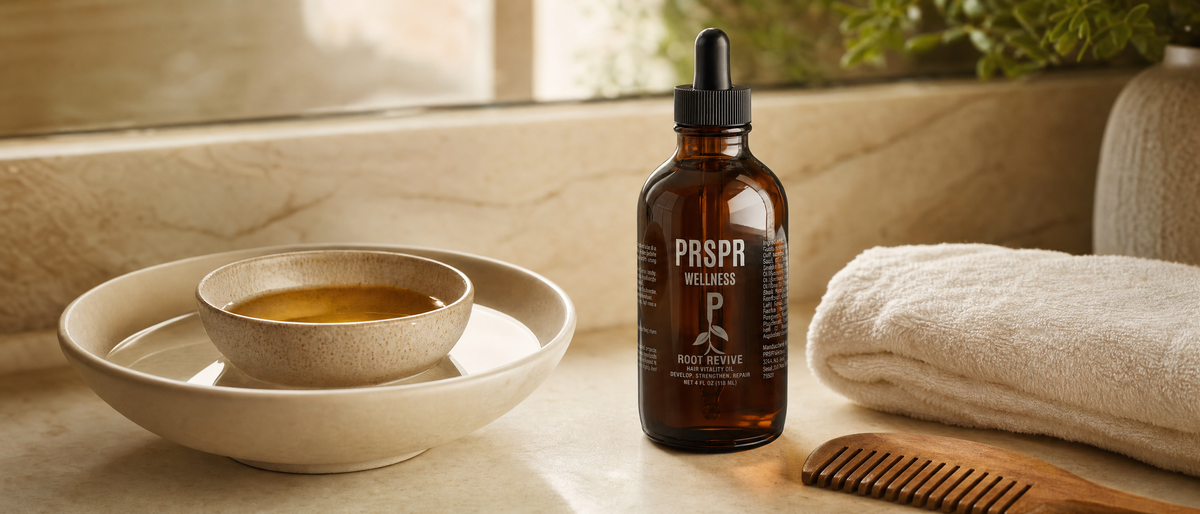
Hot oil hair treatment carries a volume score of 100 in search right now, the top of its cluster. Right behind it, hot oil treatment for hair sits at 64. Then the questions get specific: how to do a hot oil treatment at 10, hot oil treatment for black hair at 10, hot oil treatment for locs at 3, and hot oil treatment for hair at home at 2.
Look at the shape of that list. The biggest terms are just the name of the thing. The smaller ones are people who already know the name and want the method, or want to know whether the method fits their own hair and their own routine.
That tells you what this moment is. It is not a new ingredient going viral. It is an old routine with a plain name getting looked up by people who want to do it themselves, in their own bathroom, with a towel over their shoulders.
So we are going to do the useful thing: define the practice, walk through how it is usually done, and then put a real product's own usage directions next to it so you can see where they line up and where they don't. What any oil does to your hair or scalp is a question we are going to leave alone. That one belongs to a qualified healthcare professional or a stylist who can see your hair in person.
A hot oil treatment is a routine, not a product. You take an oil, warm it, work it through your hair and onto your scalp, leave it in place for a stretch of time, and then wash it out. That is the whole definition. Everything else is variation.
It lives in two places at once. Salons offer it as a menu service, usually tacked onto a wash. Plenty of people do it at home, which is why hot oil treatment for hair at home shows up as its own search. The steps are the same in both settings. The difference is who is holding the bottle.
The name is worth reading slowly, because every word in it is doing a job. "Hot" describes the temperature of the oil going in. "Oil" names the category of ingredient, and only the category: it does not tell you which oil. "Treatment" is salon vocabulary for a step that sits between washing and styling. Put together, the phrase describes a method. It is silent about ingredients.
That is the most important thing to understand about the term. Two people can both say they did a hot oil treatment last night and have used completely different oils. One used a single kitchen oil straight from the pantry. The other used a blended botanical oil with a long ingredient list. Same name, same method, different bottles.
It also means the word "hot" is a little misleading as a description. The practice is about warming. The name stuck because it is short and memorable, not because it is a precise temperature instruction.
Here is the routine as it is usually described, laid out in order. This is a description of the practice, not a prescription for your hair.
Notice where the variation lives. The steps barely change from guide to guide. What changes is the oil, the temperature, and the wait. All three of those are set by the bottle you pick, which brings us back to reading labels.
The two most specific terms in the cluster are hot oil treatment for black hair and hot oil treatment for locs. They tell you who is doing a lot of this searching.
Oil routines have a long, established place in natural and textured hair care, and hot oil treatments are part of that vocabulary. When someone adds "for black hair" to the search, they are usually looking for guides written by people with hair like theirs, because the sectioning, the wash day and the styling that follows all look different depending on texture.
Locs add another layer. Locs are washed, dried and maintained differently from loose hair, and anything applied to them has to come back out cleanly on wash day. That is why the loc search exists as its own term. It is less about whether to do a hot oil treatment and more about how the steps adapt to a style that holds onto whatever goes into it. A loctician, a stylist who specializes in locs, is the right person to ask about your own.
We are not going to tell you which oil suits which hair type. We will tell you that the name of the practice doesn't change based on who does it, and the label on the bottle doesn't either.
This is where it gets practical. A lot of oils sold for the scalp are not sold as hot oil treatment oils at all. They come with their own usage directions, and those directions are worth comparing against the traditional routine rather than assuming the two are the same thing.
Take the oil we carry. The How to Use section on the Root Revive 3 Pack listing says to dispense a few drops into clean hands or directly onto the scalp or beard with the included pipette, massage gently into the scalp, and leave the oil on for at least 30 minutes, or overnight. The listing's FAQ also mentions using it as a pre-shampoo treatment.
Lay that next to the traditional routine:
So here is the straight answer. Our oil's directions describe a scalp oil routine, left on for a set time and usable before shampoo. They do not describe heating it. If you want to follow the product, follow the product's directions as written, and treat the warming step as something the label has not asked you to do.
The quantity is different too. A few drops from a pipette is a very different amount from the bowlful of oil people picture when they hear "hot oil treatment." That is another reason to read the directions on the bottle in front of you instead of borrowing them from a salon menu.
A method name is not an ingredient list. Read the bottle, not the buzzword.
"Hot oil treatment" tells you how something is done. It tells you nothing about what is in it. The same goes for plenty of words on the hair aisle, and we have written about this pattern before: our piece on castor oil and the other oils in the same bottle made the case that the famous name on the front is rarely the whole story. Our look at amla, the sour green fruit behind a hair oil traced a traditional oiling practice back to the plant it starts from.
We would also rather you follow a product's own directions than a generic routine. Directions are specific to what is in the bottle. A generic routine was written for every oil at once, which means it was written for none of them in particular. If a label says nothing about heat, we think the honest reading is that the label says nothing about heat.
And if the words on the ingredient list trip you up, look them up. We did the legwork on one of the most commonly confused ones in fenugreek versus fennel, because a name you can't place is a name you can't judge.
Root Revive Hair Growth Oil is an organic botanical hair oil. The Root Revive listings name Castor, Pumpkin Seed, Black Seed, Avocado, Olive and Grapeseed oils, plus Amla, Brahmi and Fenugreek extracts, and state that it is free from parabens, sulfates and artificial fragrances. That is what the listing says the product is made with, and it is what we will say about it.
What we will add in our own voice is how it is made. Root Revive Hair Growth Oil is manufactured in a GMP-certified facility and third-party batch tested, so what is on the label is what is in the bottle. No guessing, no filler, no cutting corners.
If you are planning a hot oil hair treatment night, start with the bottle. Open the Root Revive Hair Growth Oil page and read the full ingredient list and How to Use directions as written, browse the rest of the hair, skin and health collection, or take the build-your-stack quiz to see where it fits alongside the rest of your routine.
Answer all five questions to unlock a clear wellness plan made around your goal, schedule, preferred supplement format, and biggest roadblock.
Get clarity on what matters most right now.
See the product and routine connected to your goal.
Simple next steps you can use right away.
Pick the one you would fix first if you could.
This helps us make the guide easier to follow.
Consistency beats the “perfect” routine you never follow.
Be honest. We’re building something you’ll actually use.
Your guide will include one simple way around it.
Answer two more questions to unlock your product starting point, five-step plan, two-week routine, and one practical tip for your biggest roadblock.
Enter your details to open your five-step plan.
Verified PRSPR customer reviews
Expires when you close this page
*Your personal credit for completing the quiz. It's applied automatically at checkout on one-time purchases and expires when the timer runs out.
View full product detailsEverything in your plan, together — one add to cart.
Expires when you close this page
*Your personal credit for completing the quiz. It's applied automatically at checkout on one-time purchases and expires when the timer runs out.
View full product details Mind vocabulary
What is cognition? You have probably seen the word "cognitive" printed on a label, in a headline, or in a product name, and kept scrolling. It is o...
 Biology vocabulary
What is metabolism? You see the word on labels, in gym talk and in nutrition headlines, almost always used as if it were a single setting. Read eno...
 Sleep vocabulary
What are sleep cycles? You hear the phrase on podcasts, see it on sleep trackers, and read it in articles that assume you already know what it mean...