
◎
Get clear
Get clarity on what matters most right now.

Fennel vs fenugreek is up 110 percent in search this week, the fastest-rising term in the whole fenugreek cluster. Define fenugreek is up 70 percent, and fenugreek smell is up 40 percent. On the steadier side, fenugreek seeds is sitting at a volume score of 79, what is fenugreek at 50, fenugreek leaves at 26, fenugreek for hair at 21 and fenugreek oil at 18.
Read those together and a picture forms. People are not sure what fenugreek is, they are not sure it is different from fennel, and something about the way it smells has caught their attention. Those are three good questions, and all three have clean, checkable answers.
Fenugreek for hair is the one search on that list we are not going to answer. What any botanical does on a scalp is a question for a board-certified dermatologist rather than for the company selling the bottle. Everything else here is about a plant, a name and a smell, and that is what this article covers.
To define fenugreek plainly: it is Trigonella foenum-graecum, an annual herb in the Fabaceae, the legume or pea family. North Carolina State Extension's plant database gives its native range as southeastern Europe and western Asia. Feedipedia, the animal-feed database run by the French research bodies INRAE and CIRAD with AFZ and the UN Food and Agriculture Organization, describes it as an annual herbaceous legume whose straight or sickle-shaped pods each hold 10 to 20 seeds.
That legume detail is the one most people miss. Fenugreek seeds, the biggest term this week at 79, come out of a pod. In family terms the plant sits with peas and beans, which surprises almost anyone who has only ever met it as a seed in a spice jar.
The plant gives the kitchen two ingredients. The seeds are used as a spice. The leaves, which is what fenugreek leaves at 26 is after, are used as a green herb; Feedipedia notes that the green parts are highly aromatic and used as a pot herb and spice. The same database records the plant's name in Hindi, Gujarati and Marathi as methi, so a recipe calling for methi leaves is calling for fenugreek leaves.
The Latin name has a history of its own. Feedipedia points out that fenugreek was historically grown as livestock fodder, and that its Latin name means "Greek hay." North Carolina State Extension lists Greek hay, Greek clover and goat's horn among its English common names. Hold onto the hay. It matters in the next section.
Fenugreek oil, at 18, is a less settled phrase than it looks. On its own it does not say whether you are looking at an oil pressed from the seed, an extract, or seed material steeped into a different oil. Those are different preparations, and a good label tells you which one you have. We walked through that exact distinction with a fruit in how amla becomes an oil without being pressed.
Start with the plants, because they are not relatives. Fennel is Foeniculum vulgare, in the Apiaceae, the carrot family. North Carolina State Extension gives its native range as southern Europe and the Mediterranean and describes a plant up to six feet tall with feathery, needle-like leaves and a sweet, mildly anise or licorice flavor. Fenugreek is an annual legume in the pea family. Two different families, two different native ranges, two different plants.
The confusion is mostly about words, and here the words turn out to be genuinely linked. According to the Online Etymology Dictionary, fenugreek comes from the Latin faenum graecum, literally "Greek hay." Fennel comes from the Latin feniculum or faeniculum, a diminutive of faenum, the same word for hay, a name the dictionary connects to the hay-like look of fennel's feathery leaves.
So the two names really do share a root. The plants do not. One name means "little hay" and the other means "Greek hay," and English ended up with two plant words that start with the same three letters.
Then there is the jar. Both are sold as small dried seeds, and "fenn" and "fenu" differ by a single letter. Put the two side by side on a shelf and a shopper reaching quickly can pick up the wrong one without noticing until the lid comes off.
That is where the practical test comes in, and it is not close. Fennel smells sweet and anise-like. Fenugreek smells like something else entirely, which brings us to the third rising term.
Fenugreek smell is up 40 percent, and the curiosity is well founded. North Carolina State Extension describes the green parts of the plant as having a flavor similar to maple syrup, and the seeds as carrying a strong, spicy odor.
The compound usually named for that maple note is sotolon, also spelled sotolone. McGill University's Office for Science and Society describes it as a compound that at low concentrations has a distinct maple syrup-like odor, notes that it can be isolated from fenugreek seeds, and says it is used as one of the flavor components in artificial maple syrup. That last detail is the whole story in one line: imitation maple flavor borrows from the same chemistry fenugreek already has.
The best-known demonstration happened in New York City. Starting in 2005, residents periodically reported a sweet maple syrup smell drifting through Manhattan. As Scientific American reported in February 2009, city officials traced it to a facility across the Hudson in North Bergen, New Jersey, that processed fenugreek seeds. The seeds, the report explained, contain sotolone, a compound also found in maple syrup, which is why they are sometimes used to make imitation syrup flavoring.
One compound, one seed, one city that spent years sniffing the air. It is hard to think of a more memorable way to learn that fenugreek and fennel are not the same thing.
Fenugreek is not the only name on that extract line with a naming story. Brahmi, listed right beside it on the Root Revive listing, is a name an Ayurvedic text applies to more than one plant, which we untangle in brahmi oil and the two plants that share the name.
We think fenugreek is a small, perfect case for putting the Latin name on the label.
Common names drift. Fennel and fenugreek share a Latin root and a spice aisle, and a busy shopper can confuse them. Methi is the same plant under another language's name. Greek hay, Greek clover and goat's horn are all the same plant again, each name recording something a different group of people noticed about it. None of that is anyone's fault. It is what happens when a plant travels through farming, cooking, trade and translation for a very long time.
A binomial does not drift. Trigonella foenum-graecum means one plant, in the pea family, and Foeniculum vulgare means another, in the carrot family. When a bottle lists thirteen botanicals, the names are the part of the story you can actually check. We would rather you learned to check them than took any label's word for it, including ours. If you want another example of one plant wearing several names, we unpacked black seed, black cumin and Nigella sativa the same way.
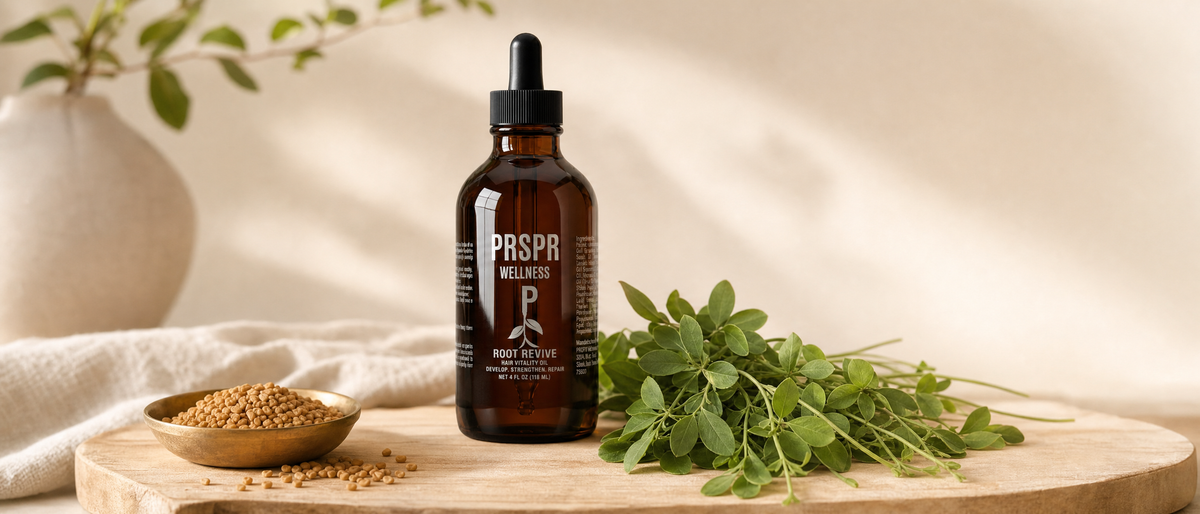
Root Revive Hair Growth Oil is an organic hair oil made with 13 botanical oils and extracts, applied to the scalp or beard with the included pipette. Across the live Root Revive listings, the named botanicals include Castor, Pumpkin Seed, Black Seed, Avocado, Olive and Grapeseed Oil, along with Amla, Brahmi and Fenugreek extracts. That is the composition as the listings state it, and fenugreek appears there as an extract.
What we will add in our own voice is the quality story alone. It is made in a GMP-certified facility and third-party batch tested, so what is on the label is what is in the bottle.
If you want the base of the bottle explained, start with castor oil and the carrier-oil question. Otherwise open the Root Revive page and read the ingredient list for yourself, browse the hair and skin health collection, or take the build-your-stack quiz.
Answer all five questions to unlock a clear wellness plan made around your goal, schedule, preferred supplement format, and biggest roadblock.
Get clarity on what matters most right now.
See the product and routine connected to your goal.
Simple next steps you can use right away.
Pick the one you would fix first if you could.
This helps us make the guide easier to follow.
Consistency beats the “perfect” routine you never follow.
Be honest. We’re building something you’ll actually use.
Your guide will include one simple way around it.
Answer two more questions to unlock your product starting point, five-step plan, two-week routine, and one practical tip for your biggest roadblock.
Enter your details to open your five-step plan.
Verified PRSPR customer reviews
Expires when you close this page
*Your personal credit for completing the quiz. It's applied automatically at checkout on one-time purchases and expires when the timer runs out.
View full product detailsEverything in your plan, together — one add to cart.
Expires when you close this page
*Your personal credit for completing the quiz. It's applied automatically at checkout on one-time purchases and expires when the timer runs out.
View full product details Mind vocabulary
What is cognition? You have probably seen the word "cognitive" printed on a label, in a headline, or in a product name, and kept scrolling. It is o...
 Biology vocabulary
What is metabolism? You see the word on labels, in gym talk and in nutrition headlines, almost always used as if it were a single setting. Read eno...
 Sleep vocabulary
What are sleep cycles? You hear the phrase on podcasts, see it on sleep trackers, and read it in articles that assume you already know what it mean...