
◎
Get clear
Get clarity on what matters most right now.

Bacopa is up 60 percent in search this week, and it is climbing right alongside a cluster of brahmi searches. Brahmi oil is holding a volume score of 63, what is brahmi is at 53, brahmi herb at 33, brahmi plant at 26, and gotu kola sits at 13.
That combination is the whole story in miniature. Two different plant names, bacopa and gotu kola, keep surfacing next to one Sanskrit word. That is not a search engine being sloppy. It reflects a naming question that has been argued over in Ayurvedic literature for a long time, and it is one of the clearest examples we know of why the common name is the least reliable word on a botanical label.
One thing this article will not cover is what brahmi does, for hair or for anything else. That is a question for a qualified healthcare professional rather than for the company selling the bottle. What we can cover is what the word refers to, how one name came to point at two plants, and what a bottle of brahmi oil actually is.
What is brahmi, as a plant? The honest answer is that it depends on which reference you are working from.
A 2011 paper in AYU, a journal of Ayurveda research, sets the problem out directly. Its authors write that a dispute over the identity of the exact species of Brahmi has existed in Ayurvedic literature for many years. They trace it to a Sanskrit verse in the Bhavaprakasha Nighantu, a classical Ayurvedic text, that gives Brahmi as a synonym for both Jalabrahmi, identified as Bacopa monnieri, and Mandookaparni, identified as Centella asiatica, the plant known in English as gotu kola.
The same paper notes that some Ayurvedic practitioners and pharmacies accept the use of both plants as Brahmi when making formulations. So the ambiguity is not only a matter of old texts. It carries straight through into how things are made.
The two plants are not close relatives. Bacopa monnieri is a creeping herb of wet places, and North Carolina State Extension's plant database lists its common names as brahmi, herb of grace, Monnier's water-hyssop, smooth water hyssop and water hyssop. Centella asiatica is a low, creeping plant with rounded leaves in the Apiaceae, the carrot family, and the same database lists it as Asiatic pennywort, gotu kola, Indian pennywort and spadeleaf, among others.
Even the family name for bacopa depends on which reference you open. The AYU paper places it in the Scrophulariaceae. The North Carolina State database files it under the Plantaginaceae. Brahmi herb, brahmi plant, bacopa and gotu kola are, in effect, four searches circling two species, one of which has two family names of its own.
Brahmi is not unusual. It is simply an unusually well-documented case of something that happens to plant names everywhere.
Common names are given by people, in a particular language, for a particular use or look. When two plants are used in similar ways, grow in similar places or resemble each other, a name can slide from one to the other. Once a single word carries two meanings in one tradition, texts, trade and translation carry both meanings further.
Bacopa shows how far that can go. The garden-center plant sold as bacopa, the trailing, white-flowered plant you see spilling out of hanging baskets, is a different species altogether. North Carolina State Extension lists that ornamental as Chaenostoma cordatum, native to South Africa, and notes that the common name bacopa is confusing because there is a separate genus, Bacopa, of mostly aquatic plants known as water hyssop.
So a person typing bacopa this week could mean a creeping herb of wet ground or a basket plant from a nursery. A person typing brahmi could mean either of two plants from different families. The words are doing a lot of work with very little precision.
We have written about this pattern before: gotu kola as one of three hard plant names in ginkgo, gotu kola and rhodiola, and the naming tangle around a fan palm in saw palmetto and Serenoa repens.
Brahmi oil, the biggest term here at 63, is not oil pressed out of brahmi. It is an herbal oil: a base oil that herb material has been cooked into.
Ayurvedic medicated oils, called taila, follow a general method. A 2009 study in the Indian Journal of Pharmaceutical Sciences describes the traditional process. An herb paste, called kalka, and a water decoction of the herbs are combined with a base oil, sesame oil in that study, and boiled on a mild fire with stirring until all the water has evaporated. The oil is strained while warm. The paper cites the Ayurvedic Formulary of India for the standard proportions, in which the oil is four parts to one part herb paste, so the base oil makes up the bulk of the finished product.
It is the same basic logic as the infusion we described in how amla becomes an oil: the named herb gives the oil its identity, while the carrier gives it most of its volume.
That process is why a brahmi oil label is worth reading closely, because the herb named on the front is whichever plant the maker decided brahmi means. Commercial brahmi oils we looked at do not agree. One sesame-based product lists water hyssop leaf, Bacopa monnieri, as its brahmi. Another lists gotu kola, Centella asiatica, and bacopa, Bacopa monnieri, together. Both are sold as brahmi oil, and both labels are easy to read correctly, because both print the Latin names.
Here is how to read one in practice. Look for a Latin name printed next to the word brahmi. If it says Bacopa monnieri, the maker means water hyssop. If it says Centella asiatica, the maker means gotu kola. If it says both, the maker has used both. If it says neither, the label has left the question open, and the word on its own cannot close it.
Brahmi sits on the Root Revive extract line right next to fenugreek, a plant with the opposite problem: one clearly identified species, but a name people keep confusing with fennel. That story is in fenugreek is not fennel.
We think brahmi is the clearest argument there is for printing binomials on botanical labels.
A common name is a local convention. Brahmi points to bacopa in one reading and to gotu kola in another, and the neighboring word bacopa points to yet another plant entirely once you walk into a garden center. None of those uses is wrong in its own setting. They just cannot all be meant on one label at the same time.
Bacopa monnieri and Centella asiatica each mean exactly one plant. That is the whole job of a binomial, and it is why we read an ingredient list for the Latin before anything else. When a label gives you only the common name, the most useful thing you can do is notice that the question of which plant is still open.
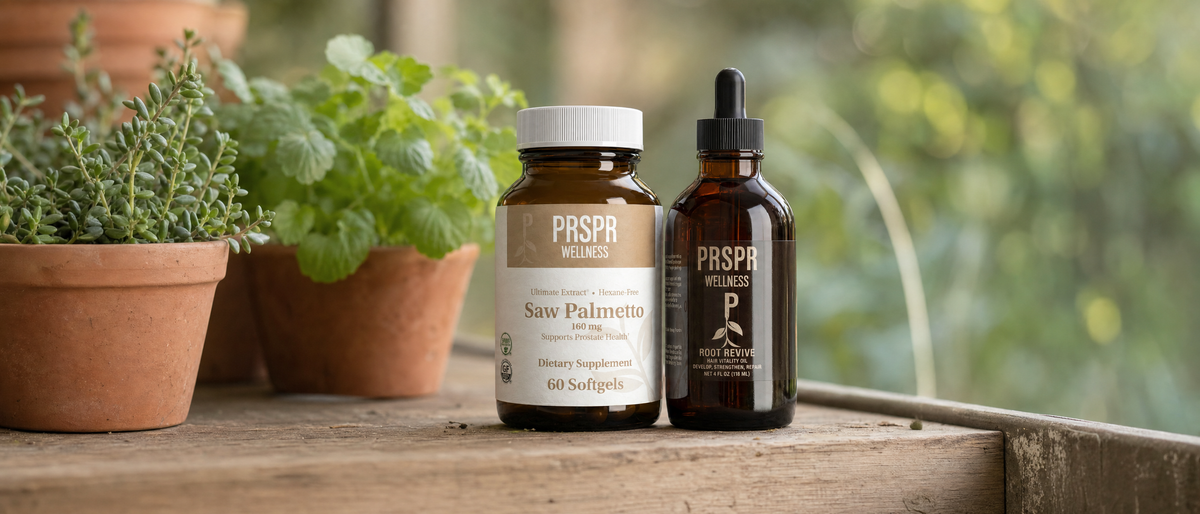
The Hair Harmony Kit pairs two products: Root Revive, an organic hair oil, and Saw Palmetto. The kit listing describes Root Revive as made with 13 botanicals, naming Castor, Pumpkin Seed, Black Seed, Amla and Fenugreek, and the Root Revive 3 Pack listing names Brahmi among its extracts alongside Amla and Fenugreek. The listing names Brahmi by its common name, and we will not guess at a binomial it does not print.
What we will add in our own voice is the quality story alone. It is made in a GMP-certified facility and third-party batch tested, so what is on the label is what is in the bottle.
If the other half of the kit is your question, topical or swallowed, the two routes the same aisle sells covers the format split. Otherwise open the Hair Harmony Kit page and read both labels, browse the rest of the bundles collection, or take the build-your-stack quiz.
Answer all five questions to unlock a clear wellness plan made around your goal, schedule, preferred supplement format, and biggest roadblock.
Get clarity on what matters most right now.
See the product and routine connected to your goal.
Simple next steps you can use right away.
Pick the one you would fix first if you could.
This helps us make the guide easier to follow.
Consistency beats the “perfect” routine you never follow.
Be honest. We’re building something you’ll actually use.
Your guide will include one simple way around it.
Answer two more questions to unlock your product starting point, five-step plan, two-week routine, and one practical tip for your biggest roadblock.
Enter your details to open your five-step plan.
Verified PRSPR customer reviews
Expires when you close this page
*Your personal credit for completing the quiz. It's applied automatically at checkout on one-time purchases and expires when the timer runs out.
View full product detailsEverything in your plan, together — one add to cart.
Expires when you close this page
*Your personal credit for completing the quiz. It's applied automatically at checkout on one-time purchases and expires when the timer runs out.
View full product details Mind vocabulary
What is cognition? You have probably seen the word "cognitive" printed on a label, in a headline, or in a product name, and kept scrolling. It is o...
 Biology vocabulary
What is metabolism? You see the word on labels, in gym talk and in nutrition headlines, almost always used as if it were a single setting. Read eno...
 Sleep vocabulary
What are sleep cycles? You hear the phrase on podcasts, see it on sleep trackers, and read it in articles that assume you already know what it mean...