
◎
Get clear
Get clarity on what matters most right now.

The phrasing changed and almost nobody noticed. For years the search was DHT blocker. Then two newer constructions started climbing: topical DHT, rising 70 percent in the past week's related queries, and DHT shampoo at 31. Those two phrases are not asking about an ingredient. They are asking about a route.
The wider cluster is still dominated by the older framing. DHT hair ran at 96, dht hair loss at 39, block dht at 26, dht blockers at 25, and blocking dht at 18. But the fastest-moving phrase in the group is the one that describes how something is applied rather than what it contains, and that shift is worth explaining.
Before going further: nothing in this article says that any product blocks, reduces, or affects DHT. The blocking phrasings above are recorded as search terms people type. This is a piece about delivery routes, which is a formulation subject, and anything to do with hair loss itself belongs with a qualified healthcare professional.
Every product in this part of the aisle is one of two things, and the split is absolute.
A topical is applied to the outside of the body. Oils, serums, shampoos, foams. The formulation problem for a topical is entirely about the surface: what the base is, how it spreads, whether it rinses off or stays, and how it behaves against skin and hair. Almost every design decision follows from that.
An ingestible is swallowed. Capsules, tablets, softgels, liquids taken by mouth. The formulation problem is completely different: what compound the active is in, what the capsule shell is made of, what the serving size is, and how the amounts are declared on a supplement facts panel. Topicals do not carry a supplement facts panel at all, which is the fastest way to tell the two apart when you are holding them.
They are regulated differently, labelled differently, and manufactured under different standards. Two products can sit next to each other in the same kit and belong to two different product classes entirely.
There is a practical consequence to that split. A topical and an ingestible cannot be compared on the same terms, because there is no shared unit between them. You can compare two capsules by the milligram figure on their panels. You cannot compare a capsule to an oil that way, because an oil declares its ingredients in order of quantity rather than in weighed amounts per serving. Anyone telling you one route is better than the other is comparing two things that do not share a scale.
Now the search phrasing makes more sense. When someone types topical DHT, they are not looking for a substance called topical DHT. They are looking for the topical half of a category they already know from its ingestible half.
DHT shampoo at 31 does the same thing more concretely. It names a specific format, and it is a format that only exists as a topical: a rinse-off, surfactant-based liquid. Nobody swallows a shampoo. So that phrase carries its route in the word itself, which is why it works as a search term at all.
Compare that with the older phrases. DHT blockers at 25, block dht at 26, blocking dht at 18. Those describe a purported mechanism and say nothing about how you would use the thing. A person searching them could end up looking at a capsule, an oil, a shampoo, or a prescription medication, because the phrase does not narrow the format at all.
That is the shift. The category is moving from mechanism vocabulary to format vocabulary, and format vocabulary is more useful to a shopper because it tells you what the object is. We defined the older phrase itself in our piece on what a DHT blocker means as a label term, which covers the words rather than the routes.
Here is the bridge, and it is a design point rather than a claim.
When a category splits cleanly into two routes, kits tend to contain one of each. That is not because someone has demonstrated that the combination does something neither does alone. It is because the two routes are genuinely different objects that get used at different moments, in different places, on a different schedule, and a person who wants both would otherwise buy them separately.
DHT hair at 96 is the biggest phrase in this whole cluster, and it is completely route-neutral. It tells you nothing about what someone wants to buy. The fact that the volume sits there, in the vaguest phrasing available, while the fastest growth sits in the most format-specific phrasing, tells you where this category is heading. People start with the mechanism word because that is what the internet taught them, then narrow to a format once they work out that a format is what they are actually shopping for.
We would rather meet you at the second step than the first. What we can tell you about a product is what it is, what is in it, and how it is applied. What it does to a hormone is not something we are going to assert.
There is also a plain scheduling reason kits are built this way. A topical is used where you keep your bathroom things, on whatever rhythm suits your washing habits. An ingestible is used wherever you keep the rest of your supplements, usually once a day with food. Those are two different habits in two different rooms, and a person maintaining both is running two routines rather than one. Selling them together does not merge the routines. It just removes one shopping decision.
The route split is the single most useful thing to understand in this aisle, and it gets almost no coverage because it is not exciting.
Mechanism words are exciting. They sound like an explanation. The trouble is that a mechanism word attached to a product implies the product does the mechanism, and that implication does a lot of unearned work. Route words do not have that problem. Topical means you put it on. Ingestible means you swallow it. Neither one promises anything, and both tell you something true about the object in your hand.
If more of this category were described by route rather than by mechanism, shoppers would be better informed and brands would have less room to imply things they cannot state. We are aware that is an unusual position for a brand to argue for. We are arguing for it anyway.
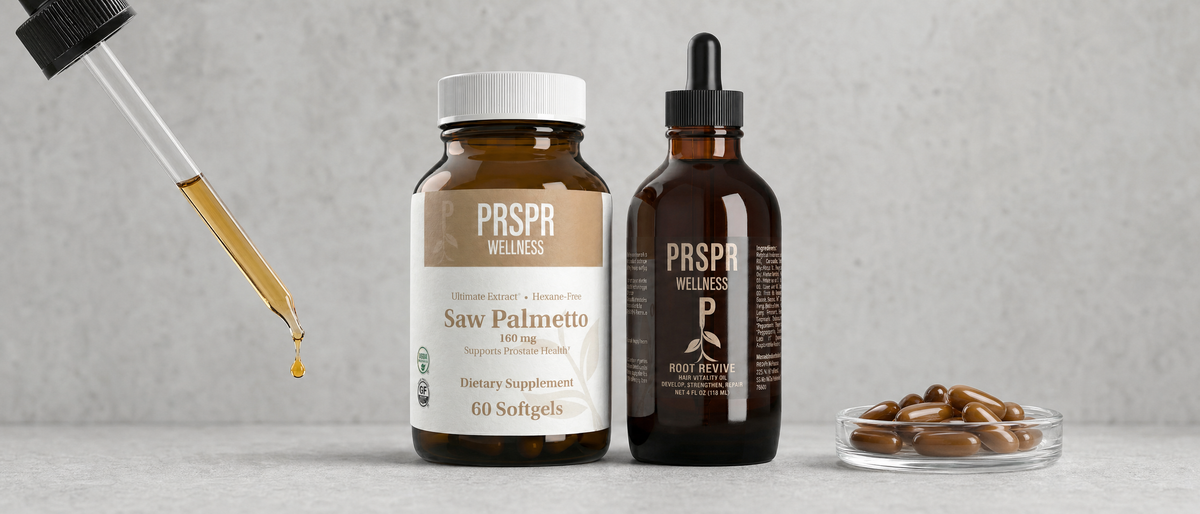
The Hair Harmony Kit is exactly the two-route pairing described above: Root Revive, a topical botanical oil blend, and our Saw Palmetto capsules, an ingestible. It sits in our bundles collection.
What we will state about it is verifiable. The capsules are manufactured in a GMP-certified facility and third-party batch tested, and the panel prints the amount per serving rather than hiding it inside a blend name. Clear amounts, no guesswork, on the half of the kit that carries a panel at all.
If you are not sure whether a topical, an ingestible, both or neither belong in your routine, take the quiz and build your own stack rather than working it out from a mechanism word.
Answer all five questions to unlock a clear wellness plan made around your goal, schedule, preferred supplement format, and biggest roadblock.
Get clarity on what matters most right now.
See the product and routine connected to your goal.
Simple next steps you can use right away.
Pick the one you would fix first if you could.
This helps us make the guide easier to follow.
Consistency beats the “perfect” routine you never follow.
Be honest. We’re building something you’ll actually use.
Your guide will include one simple way around it.
Answer two more questions to unlock your product starting point, five-step plan, two-week routine, and one practical tip for your biggest roadblock.
Enter your details to open your five-step plan.
Verified PRSPR customer reviews
Expires when you close this page
*Your personal credit for completing the quiz. It's applied automatically at checkout on one-time purchases and expires when the timer runs out.
View full product detailsEverything in your plan, together — one add to cart.
Expires when you close this page
*Your personal credit for completing the quiz. It's applied automatically at checkout on one-time purchases and expires when the timer runs out.
View full product details Electrolytes
Salt is having a comparison week. Searches for celtic sea salt vs himalayan pink salt are up about 70 percent, pink himalayan salt vs table salt is...
 Kids
KidsPick up a box of children's snacks and somewhere on the front there is a number with the letter g after it, next to the word fiber. It looks like o...
 Label Reading
It is printed on the front of a lot of mineral bottles and it is one of the least understood words in the supplement business. Chelated. Search int...