
◎
Get clear
Get clarity on what matters most right now.

What is Lactobacillus? It is one of the most searched words on a probiotic label this week, and it is easy to see why. Turn a probiotic bottle around and most of what you read is Latin: two-word names, sometimes three, with an odd little "subsp." tucked in the middle.
Those names follow rules. Once you know the rules, the list stops looking like a wall of italics and starts reading like an address: which group, which member of the group, and sometimes which branch of that member. This piece covers the vocabulary only. Every naming fact below names the reference it came from.
First, the search data. According to Google Trends, for US searches over the past seven days related to the seed term "lactobacillus," the top related query was "probiotic lactobacillus" at 100. "Lactobacillus rhamnosus" and "what is lactobacillus" each scored 69, followed by "lactobacillus probiotics" at 53, "lactobacillus reuteri" at 46, "lactobacillus bacteria" at 40 and "lactobacillus plantarum" at 36. "Bifidobacterium lactobacillus" and "bifidobacterium" each scored 34, and "lactobacillus species" came in at 21.
A quick note on those numbers. Google Trends scores are relative within the seed term: 100 marks the most searched query in that set, and everything else is scaled against it. A score is not a count of searches. What the list shows is the shape of the curiosity, and almost every query on it is a naming question.
The bacteria on a probiotic label are written in a fixed two-part format. The List of Prokaryotic names with Standing in Nomenclature (LPSN), the reference database for bacterial names, describes it in its glossary as binary nomenclature "established by Carl von Linné": a genus name plus a species epithet, always used together.
The first word is the genus, and it names the group. The LPSN glossary puts the rule plainly: each prokaryotic species "must be included in a genus," and the genus name forms part of the species name. The second word is the species epithet, and on its own it is not a name. You can see the convention in every LPSN entry: genus capitalized, epithet lowercase. "Plantarum" is not a name. "Lactobacillus plantarum" is.
So the short naming answer to "what is Lactobacillus" is this: it is a genus name, the first half of a two-part label. LPSN gives its etymology as "milk rodlet," from Latin lac (milk) and bacillus (a small rod), and credits the name to Beijerinck in 1901. The second genus you will see on many labels, Bifidobacterium, is credited by LPSN to Orla-Jensen in 1924, and its etymology there is "a cleft rodlet," from Latin bifidus, meaning cleft or divided.
The second words usually carry their own small story, and LPSN records it. A few that show up on probiotic labels:
Those three show the range: a plant word, a person and a sugar, each turned into Latin and attached to the genus.
Some names on a label have three parts. Bifidobacterium animalis subsp. lactis is the common example. "Subsp." is short for subspecies, and the LPSN glossary calls it the category "of the lowest rank" covered by the ICNP, the code under which LPSN records bacterial names as validly published.
That three-part name has a history of its own. LPSN records that it began as a separate species, Bifidobacterium lactis, named by Meile and colleagues in 1997. In 2004, Masco and colleagues, writing in the International Journal of Systematic and Evolutionary Microbiology, moved it under Bifidobacterium animalis as a subspecies. The old species name, lactis, survived as the subspecies name.
Subspecies can also move the other way. LPSN lists the original name of today's Lacticaseibacillus rhamnosus as Lactobacillus casei subsp. rhamnosus, from Hansen in 1968. A former subspecies became a species in its own right, and then, as the next section explains, it changed genus too.
Here is the part that confuses most label readers. In April 2020, fifteen researchers, with Zheng as first author, published "A taxonomic note on the genus Lactobacillus" in the International Journal of Systematic and Evolutionary Microbiology. According to the paper's abstract, the genus then held 261 species, which the authors described as "extremely diverse at phenotypic, ecological and genotypic levels."
Working from whole genome sequences, the authors proposed splitting Lactobacillus into 25 genera: a narrower, emended Lactobacillus, the existing genus Paralactobacillus, and 23 new genera. Three of the new genus names matter for anyone reading a probiotic lactobacillus label. The International Scientific Association for Probiotics and Prebiotics (ISAPP), which published a conversion list after the change, gives them as:
Notice what stayed the same. The species epithet did not change, only the genus. LPSN's glossary has a term for exactly this: a "new combination," where the specific epithet remains the same when a species moves from one genus to another. LPSN even spells out the new genus for plantarum: Lactiplantibacillus, from lactis (milk), planta (plant) and bacillus (a rod).
ISAPP also points out a convenient detail. All of the new genera begin with the letter L, so the "L." abbreviation may still be used. "L. reuteri" reads correctly under the old name and the new one.
The Zheng paper itself kept a place for the older vocabulary. Its abstract says the generic term "lactobacilli" will remain useful for all organisms classified as Lactobacillaceae until 2020. In practice, plenty of labels, including ours, still print the pre-2020 genus. When you see Lactobacillus reuteri on a bottle, you are looking at the same organism the current literature calls Limosilactobacillus reuteri.
The same thing happened outside the lactobacilli. LPSN records that Bacillus coagulans, a name from Hammer in 1915, was moved to the genus Weizmannia by Gupta and colleagues in a 2020 paper in the same journal. LPSN now lists Weizmannia coagulans as a synonym, with Heyndrickxia coagulans as the correct name. Names can keep moving after a reclassification.
We think the 2020 renaming is the single most useful thing to know about Lactobacillus probiotics labels, because it explains most of the confusion in this week's searches. Two bottles can name the same organism with two different first words. The species epithet is the stable part, so that is the word we read first.
We also think the Latin rewards a little patience. A genus tells you the group. A species epithet narrows it. "Subsp." narrows it again. None of those words, on their own, is a promise about anything. They are an address, and an address is useful precisely because it is specific.
A probiotic label rarely stops at bacteria, either. Ours also names Saccharomyces boulardii, a phage blend and a fiber, and we have written about each: the -biotic words and Saccharomyces boulardii in our guide to prebiotic, probiotic and postbiotic, the phage in what a bacteriophage is, and the fiber in our acacia fiber explainer. Questions about whether any of it fits your own situation are for your clinician.
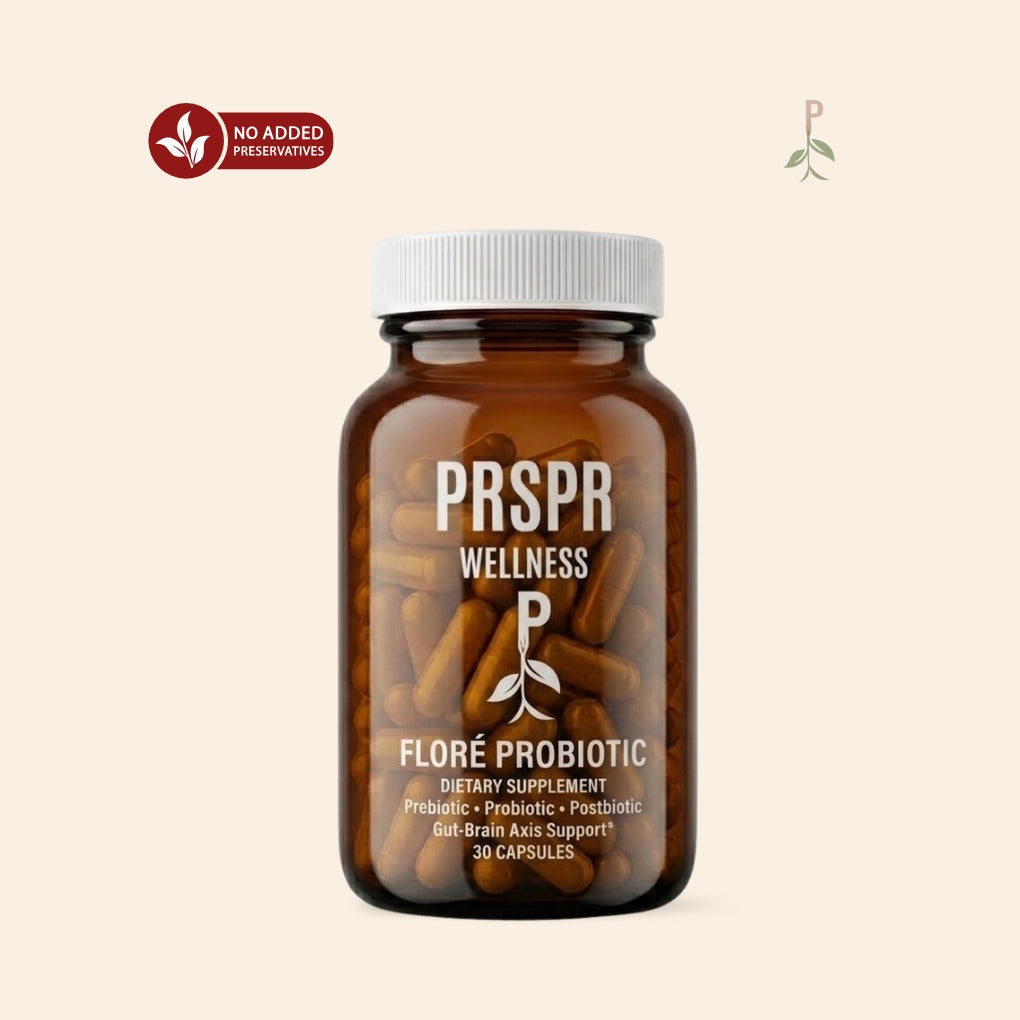
This topic comes straight off our own label. FLORÉ Probiotic is a once-daily capsule, listed as FLORÉ Daily Synbiotic + Saffron. Its ingredient list names seven organisms: Saccharomyces boulardii, Bifidobacterium longum, Bifidobacterium animalis subsp. lactis, Lactobacillus plantarum, Lactobacillus reuteri, Weizmannia coagulans and Lactobacillus rhamnosus, the last one marked heat-treated/postbiotic. The listing also names a PreforPro® bacteriophage blend, acacia fiber and Affron® saffron stigma extract.
Read with this article in hand, that list holds two Bifidobacterium names, one of them a subspecies, three species that carry the pre-2020 Lactobacillus genus, and one name from the 2020 Bacillus split. Like everything we carry, it is made in a GMP-certified facility and third-party batch tested, so what's on the label is what's in the bottle. It is listed at $61.36 and sits in our Vitamins & Supplements collection.
If you want to read the Latin for yourself, see FLORÉ Probiotic at PRSPR.
As a word, it is a genus name. LPSN gives its meaning as "milk rodlet" and credits it to Beijerinck in 1901; in a probiotic name it is the capitalized first word, followed by a species epithet.
Yes, as names. ISAPP lists Lacticaseibacillus rhamnosus as the post-2020 name for Lactobacillus rhamnosus, following the reclassification Zheng and colleagues published in the International Journal of Systematic and Evolutionary Microbiology.
Per ISAPP, Lactobacillus reuteri is now Limosilactobacillus reuteri and Lactobacillus plantarum is now Lactiplantibacillus plantarum. In both cases only the genus changed; the species epithet stayed the same.
On a label, they are two different genus names. LPSN credits Bifidobacterium to Orla-Jensen in 1924, with the meaning "a cleft rodlet," and Lactobacillus to Beijerinck in 1901, with the meaning "milk rodlet."
According to Zheng and colleagues, the genus held 261 species as of March 2020, before their paper split it into 25 genera.
Answer all five questions to unlock a clear wellness plan made around your goal, schedule, preferred supplement format, and biggest roadblock.
Get clarity on what matters most right now.
See the product and routine connected to your goal.
Simple next steps you can use right away.
Pick the one you would fix first if you could.
This helps us make the guide easier to follow.
Consistency beats the “perfect” routine you never follow.
Be honest. We’re building something you’ll actually use.
Your guide will include one simple way around it.
Answer two more questions to unlock your product starting point, five-step plan, two-week routine, and one practical tip for your biggest roadblock.
Enter your details to open your five-step plan.
Verified PRSPR customer reviews
Expires when you close this page
*Your personal credit for completing the quiz. It's applied automatically at checkout on one-time purchases and expires when the timer runs out.
View full product detailsEverything in your plan, together — one add to cart.
Expires when you close this page
*Your personal credit for completing the quiz. It's applied automatically at checkout on one-time purchases and expires when the timer runs out.
View full product details Mind vocabulary
What is cognition? You have probably seen the word "cognitive" printed on a label, in a headline, or in a product name, and kept scrolling. It is o...
 Biology vocabulary
What is metabolism? You see the word on labels, in gym talk and in nutrition headlines, almost always used as if it were a single setting. Read eno...
 Sleep vocabulary
What are sleep cycles? You hear the phrase on podcasts, see it on sleep trackers, and read it in articles that assume you already know what it mean...