
◎
Get clear
Get clarity on what matters most right now.

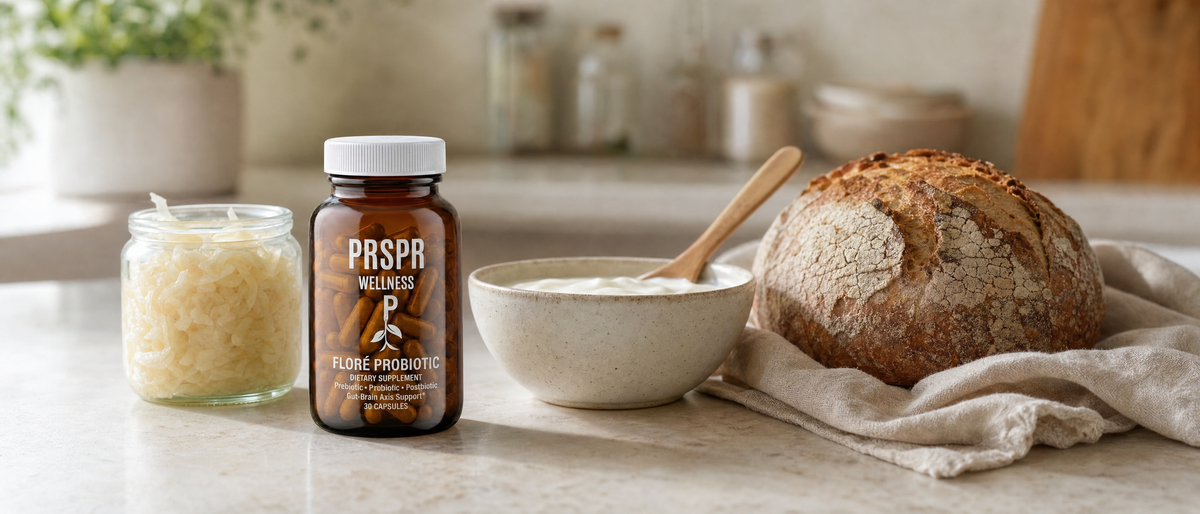
Pre pro and postbiotics: three words that differ by a single syllable and name three different things. If you have read a probiotic label lately and wondered why it needs all three, you are not alone, and the search data shows it.
On Google Trends this week (US, past seven days), searches related to "postbiotics" were led by "probiotics" at a volume score of 100, followed by "what are postbiotics" at 56, "pre pro and postbiotics" at 54 and "what is postbiotics" at 53. Searches related to "saccharomyces boulardii" were led by "saccharomyces boulardii probiotic" at 100, with "what is saccharomyces boulardii" at 45, and "saccharomyces cerevisiae" was rising at +120%. Each score is relative within its own seed, so read them as a ranking of what people ask, not a head count.
So this piece is a label-vocabulary lesson. We will define each -biotic word as a category, show where each one sits on a real label, and explain why a yeast, of all things, keeps appearing next to the bacteria. Anything about what these ingredients might do for you personally is a conversation for a qualified healthcare professional. This is about what the words mean.
These are not marketing words that each brand defines for itself. The International Scientific Association for Probiotics and Prebiotics (ISAPP), a scientific nonprofit, has convened expert panels to write a consensus definition for each one. According to ISAPP's 2021 consensus statement on postbiotics, published in Nature Reviews Gastroenterology & Hepatology, the current definitions date to 2014 for probiotics, 2017 for prebiotics, 2020 for synbiotics and 2021 for postbiotics.
Each full definition also ends with a clause about documented effects in the host. That clause is a matter for clinical research, not for a vocabulary guide, so below we focus on the part of each definition that tells you what kind of thing the ingredient is.
ISAPP defines probiotics as "live microorganisms that, when administered in adequate amounts," followed by the evidence clause described above. The load-bearing word for label reading is live. ISAPP's own explainer adds that to count as a probiotic, a microorganism "must be alive when administered."
So "probiotic" names a category of living microbes. On most labels that means bacteria, usually from a handful of familiar groups. It can also mean a yeast, which is where the saccharomyces searches come in (more on that below).
If you compare an older probiotic label with a newer one, some names seem to have changed. They have. According to a 2020 ISAPP explainer summarizing the taxonomic paper by Zheng and colleagues, the old genus Lactobacillus was reorganized into 25 genera. Lactobacillus plantarum became Lactiplantibacillus plantarum, Lactobacillus reuteri became Limosilactobacillus reuteri, and Lactobacillus rhamnosus became Lacticaseibacillus rhamnosus. The new genera were chosen to begin with the same letter, so the short form "L. plantarum" still reads the same.
A second example: the organism listed on some labels as Weizmannia coagulans has been renamed twice. The List of Prokaryotic names with Standing in Nomenclature (LPSN) records it as originally Bacillus coagulans, moved to Weizmannia in 2020 and then to Heyndrickxia coagulans in 2023, which LPSN lists as the current correct name. One organism, three names on three generations of labels.
ISAPP defines a prebiotic as a "substrate that is selectively utilized by host microorganisms." Put plainly, a prebiotic is not a microbe at all. It is material that microbes use, and the word "selectively" means only certain microbes use it.
That makes prebiotics the easiest of the three to picture: most are types of fiber. If fiber as a food category is new to you, our guide to which everyday foods are the high-fiber ones covers what fiber is and where it lives in plants.
This is the newest word of the three, and the one this week's searches keep circling. ISAPP's 2021 consensus defines a postbiotic as "a preparation of inanimate microorganisms and/or their components." Inanimate means no longer alive.
The same consensus paper breaks the word apart: "biotic" relates to living organisms and "post" means after, so the name points to microbes after life. It lists heat-based processing such as pasteurization among the ways microbes are inactivated, alongside non-thermal methods like high pressure.
The paper also draws a firm line: substantially purified metabolites with no cell material do not qualify as postbiotics, and should be called by their chemical names instead. So a postbiotic, by this definition, still includes microbial cells or their parts.
Notice what the definition does not say. It does not rank postbiotics against live cultures. "Postbiotic" describes a different state of the material. It does not rank one category above another.
You will also see "synbiotic" on labels that combine categories. ISAPP's 2020 definition describes a synbiotic as a "mixture comprising live microorganisms and substrates selectively utilized by host microorganisms." In other words, a probiotic-type ingredient and a prebiotic-type ingredient in one product.
Here is the surprise on many probiotic labels: a yeast. Saccharomyces boulardii is not a bacterium. It is a single-celled fungus from the same genus as the yeast in your bread.
A 2020 study in Frontiers in Nutrition states that the French scientist Henri Boulard first isolated it from lychee and mangosteen fruit in 1923. The same paper notes that earlier reports described S. boulardii as a strain of Saccharomyces cerevisiae, sharing about 99% genomic relatedness, while later analysis found differences in genetic composition and enzyme profiles between the two.
That relative is the one people are searching this week. The National Human Genome Research Institute describes Saccharomyces cerevisiae as "the yeast used by bakers and brewers," and notes that by May 1996 it became the first eukaryote to have its complete genome sequenced. Baker's yeast, brewer's yeast and the yeast on a probiotic label are close family, which is why the two Latin names so often turn up in the same search. For more on yeast's work in the kitchen, our guide to which foods are actually fermented sorts the aisle.
Here is the bridge from the dictionary to the bottle. Some newer formulas carry all three categories at once, and each word on the front maps to a specific line in the ingredient list. Our own FLORÉ label is a clear example. Its tagline reads "Prebiotic • Probiotic • Postbiotic • Saffron," and the listing lines up with the categories like this:
Read that way, the label stops looking like jargon. Each word tells you which kind of ingredient you are looking at: live, food for microbes, or no longer alive.
No. Both searches ask for the same definition, and the ISAPP consensus answers both: a preparation of inanimate microorganisms and/or their components.
No. It is a yeast, which is a fungus. It belongs in the probiotic category because the definition covers live microorganisms, and yeasts are microorganisms.
No. The listing names its ingredients and states 30 capsules, 30 servings, one capsule daily. It does not state a cell count or strain codes, so we do not either.
We like label words that do real work. Prebiotic, probiotic and postbiotic look like one word wearing three hats, but each one names a different category: food for microbes, live microbes, and microbes after life. Once you know that, a crowded label reads like a list rather than a riddle.
We also think the naming changes deserve more attention than they get. The same bacterium can appear under two genus names depending on when a label was printed, and a yeast can sit beside the bacteria with no explanation. Knowing the rename history keeps you from thinking two products contain different organisms when they do not.
So our advice is simple. Read the category word, then find the ingredient that fills it. If a label uses all three -biotic words, it should be able to point to an ingredient for each one.
Which brings us to our own bottle. FLORÉ Probiotic is described in its listing as a "Daily Synbiotic + Saffron" in one once-daily capsule, sold as 30 capsules, 30 servings. It combines probiotic bacteria, Saccharomyces boulardii, a PreforPro® bacteriophage blend, acacia fiber, heat-treated Lactobacillus rhamnosus and 28 mg of Affron® saffron stigma extract. That is how the listing describes it, and that is the description we stand behind.
What we will add in our own voice is how it is made. FLORÉ Probiotic is manufactured in a GMP-certified facility and third-party batch tested, so what's on the label is what's in the bottle.
To read the full ingredient list for yourself, open the FLORÉ Probiotic product page, browse the rest of the new arrivals collection, or take the build-your-stack quiz to see where it fits alongside everything else we carry.
Answer all five questions to unlock a clear wellness plan made around your goal, schedule, preferred supplement format, and biggest roadblock.
Get clarity on what matters most right now.
See the product and routine connected to your goal.
Simple next steps you can use right away.
Pick the one you would fix first if you could.
This helps us make the guide easier to follow.
Consistency beats the “perfect” routine you never follow.
Be honest. We’re building something you’ll actually use.
Your guide will include one simple way around it.
Answer two more questions to unlock your product starting point, five-step plan, two-week routine, and one practical tip for your biggest roadblock.
Enter your details to open your five-step plan.
Verified PRSPR customer reviews
Expires when you close this page
*Your personal credit for completing the quiz. It's applied automatically at checkout on one-time purchases and expires when the timer runs out.
View full product detailsEverything in your plan, together — one add to cart.
Expires when you close this page
*Your personal credit for completing the quiz. It's applied automatically at checkout on one-time purchases and expires when the timer runs out.
View full product details Mind vocabulary
What is cognition? You have probably seen the word "cognitive" printed on a label, in a headline, or in a product name, and kept scrolling. It is o...
 Biology vocabulary
What is metabolism? You see the word on labels, in gym talk and in nutrition headlines, almost always used as if it were a single setting. Read eno...
 Sleep vocabulary
What are sleep cycles? You hear the phrase on podcasts, see it on sleep trackers, and read it in articles that assume you already know what it mean...