
◎
Get clear
Get clarity on what matters most right now.

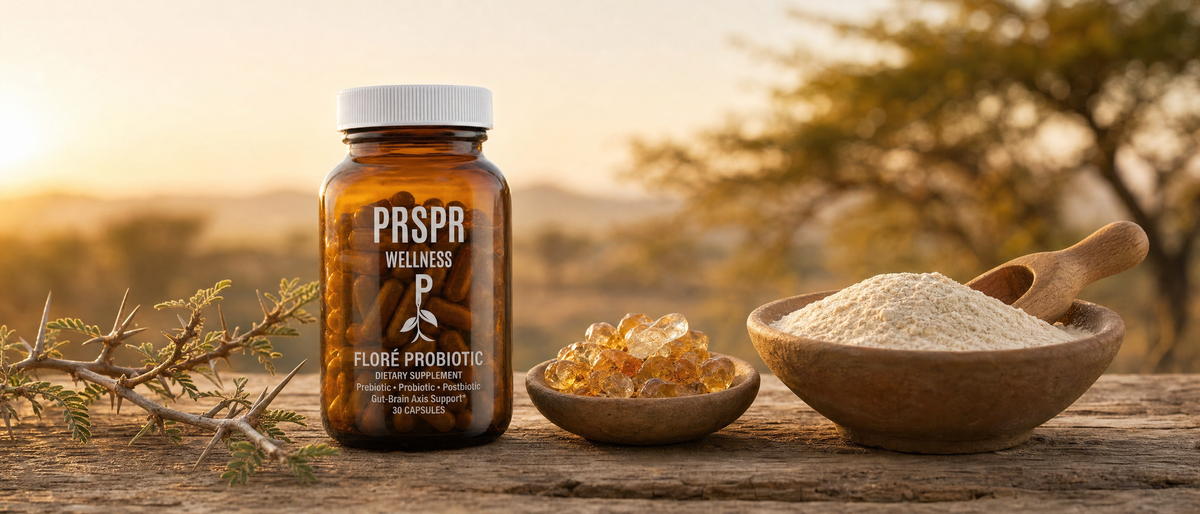
What is acacia fiber? If you have seen acacia on a probiotic bottle, a fiber tub or a candy wrapper, you may have wondered what a tree is doing there. The short answer: acacia fiber is the dried gum that seeps out of certain acacia trees, ground into a powder. It is the same material that goes by acacia gum and gum arabic, and it has been a working ingredient in kitchens, candy factories and print shops for a long time before it showed up on a supplement label.
You are not the only one asking. On Google Trends this week (US, past seven days), the related searches around "acacia fiber" were led by "acacia fiber powder" with a relative volume score of 100, followed by "what is acacia fiber" at 49, "acacia gum" at 47 and "acacia senegal fiber" at 41. Under the seed "postbiotics," the question "what are prebiotics" registered a score of 10.
So this is a botany and label piece. Where the gum comes from, which trees the name usually points to, how a tear of dried sap becomes a fine powder, and what the word "prebiotic" means as a category when it sits next to an ingredient. Questions about what any fiber does in your body are for a qualified healthcare professional. This is about the plant and the words.
Start with the regulatory definition, because it is the plainest one. The U.S. Code of Federal Regulations (21 CFR 184.1330) defines acacia, or gum arabic, as "the dried gummy exudate from stems and branches of trees of various species of the genus Acacia, family Leguminosae."
"Exudate" is the key word. It means something that oozes out. When the bark of these trees is wounded, a sticky sap flows out and hardens in the air into rounded lumps. Those lumps are called tears, and they are the raw material for everything that follows.
The name of the tree is older than the ingredient trade. The Online Etymology Dictionary dates "acacia" in English to the 1540s and traces it through Latin to the Greek akakia, a "thorny Egyptian tree," a word it describes as of uncertain origin.
The Joint FAO/WHO Expert Committee on Food Additives (JECFA) lists the ingredient as "Gum Arabic," with "Acacia gum" and "Arabic gum" as synonyms, under the international additive number INS 414. Supplement and fiber sellers tend to use a third name, acacia fiber, when the same gum is sold as a powder to stir into drinks or fill into capsules. The name changes with the shelf. The material does not.
Here is where the search for "acacia senegal fiber" comes from. The FAO/WHO committee's listing ties gum arabic to two species: Acacia senegal and Acacia seyal. Its earlier toxicological monograph, published through the WHO Food Additives Series, describes gum arabic as "the dried gummy exudate from tropical and subtropical Acacia senegal trees." So when a label or a search says acacia senegal, it is naming the classic source tree.
There is a botanical wrinkle worth knowing. According to a 2019 study in PLoS One comparing the chloroplast genomes of these trees, the species "was formerly known as Acacia senegal" and now sits in the genus Senegalia, as Senegalia senegal. The same paper reports that the 2011 International Botanical Congress in Melbourne ratified the decision to split the old, sprawling genus. Trade and food regulation still use the older names, which is why you will see "Acacia senegal" on specifications and labels even though botanists file the tree under a new genus.
FAO's report on gums, resins and latexes of plant origin (Non-Wood Forest Products 6) describes a "gum belt" running across Sub-Saharan Africa from Mauritania and Senegal in the west to Sudan, Eritrea, Ethiopia and Somalia in the east, and names Sudan as the world's biggest producer. The same report describes tapping: collectors strip a small length of bark from the stem or branch during the dry season, and the tears that form are later picked by hand.
The powder most people search for is the end of a short processing chain, and the FAO report lays out two main routes.
That fine acacia fiber powder is what ends up in tubs, drink mixes and capsules.
Chemically, gum arabic is a large sugar-based molecule rather than a single simple sugar. The WHO Food Additives Series monograph describes it as "a proteinaceous polysaccharide," with a protein content of roughly 1.5% to 3%, which on hydrolysis yields arabinose, galactose, rhamnose and glucuronic acid.
Long before the fiber aisle, acacia gum was a food-industry tool. The FAO report calls confectionery "a major use," where the gum helps keep sugar from crystallizing, and notes its wide use for encapsulating flavors and stabilizing beverage emulsions. The U.S. regulation lists its functions in food as including emulsifier, thickener, flavoring agent and formulation aid, with permitted levels that run from 1.0% in most food categories up to 85.0% in soft candy (21 CFR 184.1330). Outside food, the FAO report notes a use in printing, where the gum treats offset lithographic plates. If you have read our piece on how carrageenan got its name from Irish moss, this is the same story from a tree instead of a seaweed: a plant material that became a quiet workhorse of the ingredient list.
This is the bridge from the tree to the bottle. On a label, acacia can play two different roles, and the wording usually tells you which one.
As an additive, it appears as acacia gum or gum arabic, typically low in the ingredient list, doing a texture or stabilizing job. As a fiber ingredient, it appears as acacia fiber, often near the top, because it is the point of the product. The U.S. Food and Drug Administration's dietary fiber guidance records that in December 2021 the agency added "acacia (gum arabic)" to its list of isolated fibers it intends to propose adding to the regulatory definition of dietary fiber, and that until rulemaking is complete it intends to exercise enforcement discretion so manufacturers can count it in the dietary fiber line on Nutrition and Supplement Facts labels.
So the same tree gum can be an additive on a candy wrapper and a named fiber on a supplement bottle. For a wider look at what the word fiber covers in everyday foods, our guide to which foods are actually the high-fiber ones starts with fiber as plant structural material.
The other label word that travels with acacia is "prebiotic." It is a category, not an ingredient. In 2017, the International Scientific Association for Probiotics and Prebiotics (ISAPP) published a consensus definition in Nature Reviews Gastroenterology & Hepatology that describes a prebiotic as a substrate selectively used by host microorganisms. The full definition adds a clause about documented effects, which is a question for clinical research rather than a vocabulary guide, so here we stick to the part that tells you what kind of thing the word names. ISAPP also states plainly that "not all dietary fibers are prebiotics."
That is the useful label lesson. "Fiber" names what an ingredient is. "Prebiotic" names a category a manufacturer places it in. Our sibling piece, prebiotic, probiotic, postbiotic: the three words on a synbiotic label, walks through all three categories side by side.
It is made from the dried gum, or exudate, of acacia trees. The FAO/WHO food additive committee ties gum arabic to Acacia senegal and Acacia seyal.
Yes. JECFA lists "Acacia gum" and "Arabic gum" as synonyms of gum arabic, and the U.S. regulation names the ingredient "Acacia (gum arabic)." Acacia fiber is a retail name for the same material sold as a powder.
It is a category word defined by ISAPP's 2017 consensus statement. Whether any specific product fits it, and whether it suits you, is a question for a qualified healthcare professional.
We like ingredients with a traceable origin story, and acacia has one of the clearest. A thorny tree, a cut in the bark, a tear of sap that dries in the sun, a hammer mill or a spray dryer, and then a line of text on a label. Every name you see for it, acacia gum, gum arabic, acacia fiber, acacia senegal fiber, points back to the same few trees.
We also think the word "prebiotic" deserves the same scrutiny as any other category word. It tells you how a formula is organized. It does not replace reading the ingredient list. So read both: the category, and the named ingredient under it.
And when a listing leaves something unstated, such as the exact species or the amount, we would rather say so than fill the gap for you.
Which brings us to our own bottle. FLORÉ Probiotic is a once-daily capsule, and its listing names "prebiotic acacia fiber" as one of its components, alongside the PreforPro® bacteriophage blend. Acacia Fiber appears by name in the listing's "Inside Every Daily Serving" section, and the listing describes the format as "30 Capsules • 30 Servings • 1 Capsule Daily." The listing does not state which acacia species is used or how much acacia fiber is in each capsule, so we will not either.
What we will add in our own voice is how it is made. FLORÉ Probiotic is manufactured in a GMP-certified facility and third-party batch tested, so what's on the label is what's in the bottle.
To read the full ingredient list for yourself, open the FLORÉ Probiotic product page, browse the rest of our new arrivals collection, or take the build-your-stack quiz to see where it fits alongside everything else we carry.
Answer all five questions to unlock a clear wellness plan made around your goal, schedule, preferred supplement format, and biggest roadblock.
Get clarity on what matters most right now.
See the product and routine connected to your goal.
Simple next steps you can use right away.
Pick the one you would fix first if you could.
This helps us make the guide easier to follow.
Consistency beats the “perfect” routine you never follow.
Be honest. We’re building something you’ll actually use.
Your guide will include one simple way around it.
Answer two more questions to unlock your product starting point, five-step plan, two-week routine, and one practical tip for your biggest roadblock.
Enter your details to open your five-step plan.
Verified PRSPR customer reviews
Expires when you close this page
*Your personal credit for completing the quiz. It's applied automatically at checkout on one-time purchases and expires when the timer runs out.
View full product detailsEverything in your plan, together — one add to cart.
Expires when you close this page
*Your personal credit for completing the quiz. It's applied automatically at checkout on one-time purchases and expires when the timer runs out.
View full product details Mind vocabulary
What is cognition? You have probably seen the word "cognitive" printed on a label, in a headline, or in a product name, and kept scrolling. It is o...
 Biology vocabulary
What is metabolism? You see the word on labels, in gym talk and in nutrition headlines, almost always used as if it were a single setting. Read eno...
 Sleep vocabulary
What are sleep cycles? You hear the phrase on podcasts, see it on sleep trackers, and read it in articles that assume you already know what it mean...