
◎
Get clear
Get clarity on what matters most right now.

The phases of menstrual cycle vocabulary are having a moment. In Google Trends' related queries for the US over the past seven days, "menstrual cycle phases chart" is up +110%, "women's menstrual cycle phases" is up +70%, and "phases of menstrual cycle" holds the top volume score of 100.
A second cluster sits right beside it. "What is luteal phase" carries a volume score of 70, "luteal phase meaning" scores 20, "4 phases of menstrual cycle" scores 11 and "follicular phase" scores 7.
Read those together and a pattern shows up. People are looking for the names, the order, and a picture that puts them in sequence. Two of the four names, luteal and follicular, are Latin-built words that almost nobody learns outside a biology class, and the "meaning" searches suggest plenty of people are meeting them cold.
So this is a vocabulary piece. We will name the four phases, explain where each name comes from, and give the typical order as a named medical source lays it out. Questions about your own cycle, your health or anything you are experiencing belong with a qualified healthcare professional. We are sticking to the words.
Start with the frame. The Cleveland Clinic defines the menstrual cycle as "the time from the first day of your menstrual period until the first day of your next menstrual period." Day 1 is the first day of a period. Everything else is counted from there.
The Cleveland Clinic then lists four phases, under the heading "What are the four phases of the menstrual cycle?" In its wording they are:
On other pages you will see the same four under slightly different labels: "menstrual phase" for menses, and "ovulatory phase" for ovulation, using the adjective forms of the same words. The sequence does not change. Menstrual, follicular, ovulatory, luteal.
Notice that the Cleveland Clinic anchors its day numbers to "a 28-day menstrual cycle." That is a reference model, not a rule. The same source states that the average cycle length is 28 days, and that a cycle can range from 21 days to about 35 days. Day 14 and days 15 to 28 are landmarks on the 28-day version.
This is where the vocabulary gets interesting. Every one of the four names is a small Latin lesson.
According to the Online Etymology Dictionary, "menstrual" dates to the late 14th century and comes through Old French from the Latin menstrualis, "monthly," which traces back to mensis, "month." "Menses" arrived in the 1590s, from the Latin plural of mensis. So the first phase, and the whole cycle, are literally named "monthly."
The follicular phase is named for follicles. The Online Etymology Dictionary dates "follicle" to the early 15th century, from the Latin folliculus, "a little bag," a diminutive of follis, which meant "bellows, inflated ball, money-bag." The Cleveland Clinic refers to follicles in the ovaries, and notes that during this phase one of the developing follicles forms a fully mature egg. A little bag with an egg inside it: the name is almost a diagram on its own.
The Online Etymology Dictionary dates "ovulation" to 1848, built from the Modern Latin ovulum, "small egg," a diminutive of the Latin ovum, "egg." It defines the word as the "discharge of an ovum from the ovary." "Ovulatory" is simply the adjective. The egg is sitting right there in the word.
This is the phase people search most by name, and it has the best story.
The luteal phase is named for the corpus luteum. The Cleveland Clinic defines the corpus luteum as "a temporary collection of cells that forms on your ovary each menstrual cycle," appearing right after an egg leaves the ovary, and forming from the cells that made up the follicle the egg left. So the little bag from the previous phase becomes a new structure with a new name.
That name is two Latin words. The Online Etymology Dictionary gives corpus as, literally, "a body," and traces "luteal" to the Latin luteus, "yellow," from lutum, the name of a weed used in dyeing things yellow. Put them together and corpus luteum means "yellow body."
The same dictionary dates the adjective "luteal," meaning "pertaining to the corpus luteum," to 1906, and records the phrase "luteal phase" by 1932. So the answer to "what is luteal phase" in plain vocabulary terms: it is the phase named after the yellow body that forms after ovulation, and on the Cleveland Clinic's 28-day model it runs from about day 15 to day 28.
The fastest-rising search on the list is "menstrual cycle phases chart," up +110%. We cannot draw one here, but we can tell you what the common ones show, so you can read any chart you find.
Some charts draw a circle, some a straight timeline. The circle version makes the "cycle" part visual: day 28 runs back into day 1. Either way, a chart is a map of names and order, and the names are the part this piece is here to explain.
Here is the bridge. A chart gives you shapes and colors. The words give you the logic underneath them. Once you know that a follicle is a "little bag," that "ovulation" is built on "small egg," and that "luteal" means "yellow," the four phases stop being jargon and start reading like a short story: a monthly count, a little bag, an egg, a yellow body.
That matters because these words get borrowed everywhere, from textbooks to app screens to social posts, often without a definition. If you know the roots, you can read any of those sources and know which part of the sequence it is naming.
If you want the neighboring acronym, our explainer on what PMS stands for unpacks three more letters people use without defining.
We like vocabulary that explains itself once you know the Latin, and the menstrual cycle is full of it. Monthly. Little bag. Small egg. Yellow body. Four names, and every one of them describes something you could draw.
We also think the search trend says something useful. People are not only looking for charts. They are looking for meanings, and "luteal phase meaning" is a question with a clean, satisfying answer. That is the kind of question we want to answer well.
And we keep the line in the same place every time. The words are ours to explain. Anything about how your own cycle runs is between you and a clinician who knows you.
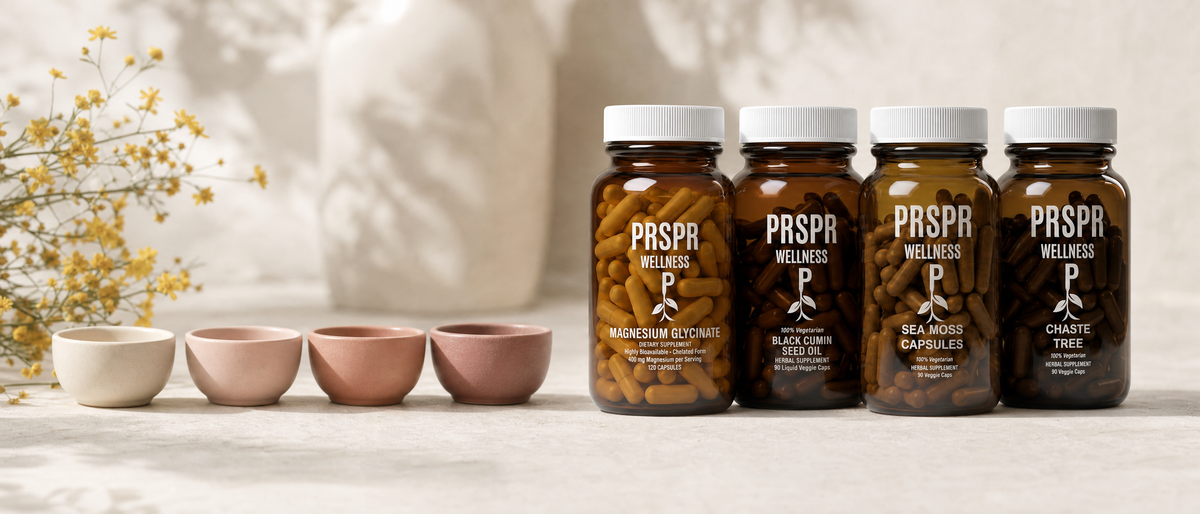
Plenty of people who look up cycle vocabulary are also browsing the women's shelf, which is why we carry Women's Daily Edge, Women's Essentials. The listing describes it plainly: it is a bundle of Seamoss Capsules, Magnesium Glycinate, Black Seed Oil and Chaste Tree (Vitex). If the plant name on the end of that list is new to you, our piece on Vitex, chasteberry and chaste tree explains why one plant goes by three names.
It is manufactured in a GMP-certified facility and third-party batch tested, so what's on the label is what's in the bottle. And if you are still sorting out the difference between a bundle like this and a single-tablet formula, our explainer on why vitamin and mineral are not the same word is a good place to start.
To read the full label, open the Women's Essentials product page, browse our bundles collection, or take the build-your-stack quiz to see how our catalog fits together.
Answer all five questions to unlock a clear wellness plan made around your goal, schedule, preferred supplement format, and biggest roadblock.
Get clarity on what matters most right now.
See the product and routine connected to your goal.
Simple next steps you can use right away.
Pick the one you would fix first if you could.
This helps us make the guide easier to follow.
Consistency beats the “perfect” routine you never follow.
Be honest. We’re building something you’ll actually use.
Your guide will include one simple way around it.
Answer two more questions to unlock your product starting point, five-step plan, two-week routine, and one practical tip for your biggest roadblock.
Enter your details to open your five-step plan.
Verified PRSPR customer reviews
Expires when you close this page
*Your personal credit for completing the quiz. It's applied automatically at checkout on one-time purchases and expires when the timer runs out.
View full product detailsEverything in your plan, together — one add to cart.
Expires when you close this page
*Your personal credit for completing the quiz. It's applied automatically at checkout on one-time purchases and expires when the timer runs out.
View full product details Mind vocabulary
What is cognition? You have probably seen the word "cognitive" printed on a label, in a headline, or in a product name, and kept scrolling. It is o...
 Biology vocabulary
What is metabolism? You see the word on labels, in gym talk and in nutrition headlines, almost always used as if it were a single setting. Read eno...
 Sleep vocabulary
What are sleep cycles? You hear the phrase on podcasts, see it on sleep trackers, and read it in articles that assume you already know what it mean...