
◎
Get clear
Get clarity on what matters most right now.

What does PMS mean? It sounds like a question with one answer, and the search data says otherwise. On Google Trends this week (US, past seven days), "what is pms" carries a volume score of 74, "pms meaning" sits at 52, "what does pms" at 39, "what is a pms" at 27, "what does pms mean" at 13, and the clipped, typed-on-a-phone "whats pms" at 8. Meanwhile "pmdd" is up +60% as a rising search.
That is a lot of people asking what three letters stand for. And the reason is simple: those three letters stand for several different things, depending on who is typing.
So this piece is about the acronym. What it spells out, where each word comes from, how PMDD differs as a term, and why a printer, a hotel manager and a person checking a calendar can all type the same three letters and mean completely different things. Anything about what someone is feeling, or what to do about it, is a conversation for a qualified healthcare professional. This is a vocabulary lesson.
In everyday speech, and in almost every health reference, PMS stands for premenstrual syndrome.
MedlinePlus, the consumer health site of the U.S. National Library of Medicine, defines it in one line: premenstrual syndrome "is a group of physical and emotional symptoms that start one to two weeks before your period." That is the definitional core of the term, and it is as far as we will go into the details. The point for our purposes is the shape of the definition: a group of things, tied to a point in time.
Both halves of that definition are hiding in the name itself. "Premenstrual" handles the timing. "Syndrome" handles the grouping. Once you take the phrase apart, the acronym starts to explain itself.
Plenty of people search "what is a pms," with the article in front. In the health sense, that phrasing is a little unusual, since people rarely say "a premenstrual syndrome." But "a PMS" makes perfect sense in the other senses of the acronym: a PMS color, a PMS system. The "a" is a small clue that some of the people searching are not asking about a calendar at all. More on them below.
Premenstrual syndrome is three pieces of Latin and Greek stacked together. Here is each one.
According to the Online Etymology Dictionary, "premenstrual" is built from the prefix pre-, meaning "before," plus "menstrual." The same prefix shows up in prenatal, preview and preheat. It simply points earlier on a timeline.
The Online Etymology Dictionary dates "menstrual" in English to the late 14th century and traces it to the Latin menstrualis, "monthly." Behind that sits the Latin mensis, "month." The same dictionary traces mensis further back to a Proto-Indo-European root meaning "to measure." The cycle got its name from the calendar, and the calendar got its name from measuring time.
The Online Etymology Dictionary records the combined adjective "premenstrual" from 1865. If you want the calendar vocabulary that sits around it (follicular, luteal and the rest), our guide to the names of the menstrual cycle phases walks through each one.
This is the word that does the most work. The Online Etymology Dictionary dates "syndrome" in English to the 1540s and traces it to the Greek syndromos, "a running together," from syn-, "with," and dromos, "a running, course." It defines the word as "a number of symptoms occurring together."
So a syndrome, by name, is a set of things that run together. That is why the word appears in so many medical terms. It describes a pattern, not a single thing.
The full phrase is younger than you might guess. The Online Etymology Dictionary notes that "premenstrual syndrome" dates to 1971, and that the earlier name was "premenstrual tension," from 1928. So the acronym most people know is roughly half a century old.
The rising search on this list is "pmdd," and it is worth being precise about what the term is, because it is not simply a longer spelling of PMS.
PMDD stands for premenstrual dysphoric disorder. The Cleveland Clinic describes it as "a more serious form of premenstrual syndrome (PMS)," and notes that PMDD is "a mental health condition listed in the DSM-5 as a 'depressive disorder.'" So PMDD is its own named condition, with its own entry, rather than a nickname for PMS.
The new word in the middle is "dysphoric." The Online Etymology Dictionary dates "dysphoria" to 1842 and traces it to a Greek word for "pain hard to be borne, anguish," built from dys-, "bad, hard," and pherein, "to carry." The same dys- appears in words like dysfunction.
Notice the swap at the end, too: "syndrome" becomes "disorder." Different term, different category, different entry. Questions about either condition belong with a qualified healthcare professional, not a vocabulary guide.
Here is the part that explains why the search box is so crowded. Type the three letters alone and the results fill up with things that have nothing to do with a calendar.
In printing and design, PMS stands for the Pantone Matching System. According to Hofstra University, the system was invented in 1963 and "became the standard for global communication of color" across printing, publishing, packaging, textiles, fashion and more. When a designer asks for "PMS 185," they mean a specific numbered ink color, not anything medical. That is why so many "pms" searches this week were strings of numbers.
In hospitality, PMS stands for property management system. The hotel technology company Canary Technologies defines it as "a software solution designed to streamline and centralize critical operations within a hotel," covering things like reservations and housekeeping. When a hotel manager says the PMS is down, they mean the booking software.
And sometimes PMS is simply a school's initials, which is why bell schedules turned up in the same search results this week. Same letters, very different Monday morning.
This is the bridge from the dictionary to the shelf. An acronym is a compression. It saves space by dropping everything but the first letters, and it trusts the reader to fill the rest back in. Most of the time that works. With PMS, the same three letters fill back in as a health term, an ink system, hotel software or a school, depending on the room you are standing in.
That is why "what does PMS mean" keeps getting searched even though most people have heard the letters all their lives. Hearing an acronym and knowing which expansion someone means are two different things.
The useful habit is the same one we recommend for every label: spell the letters out. When you see an acronym on a product, a page or a post, find the full phrase it stands for, then read the full phrase. The words carry more than the letters do.
We like acronyms that turn out to be tiny history lessons, and PMS is a good one. "Pre" is Latin for before. "Menstrual" goes back to the Latin word for month, and from there to an old root about measuring time. "Syndrome" is Greek for things that run together. Put the three back together and the phrase describes itself.
We also think precision matters most with the terms people search in a hurry. PMS and PMDD are not interchangeable, and PMS the ink code is not PMS the hotel software. Spelling each one out is the fastest way to keep them straight.
So we use full words where we can, and we would rather you read them than guess from three letters. When a label, a chart or a conversation leans on an acronym, it is worth asking which expansion is meant before going any further. That one question clears up most of the confusion this search is full of.
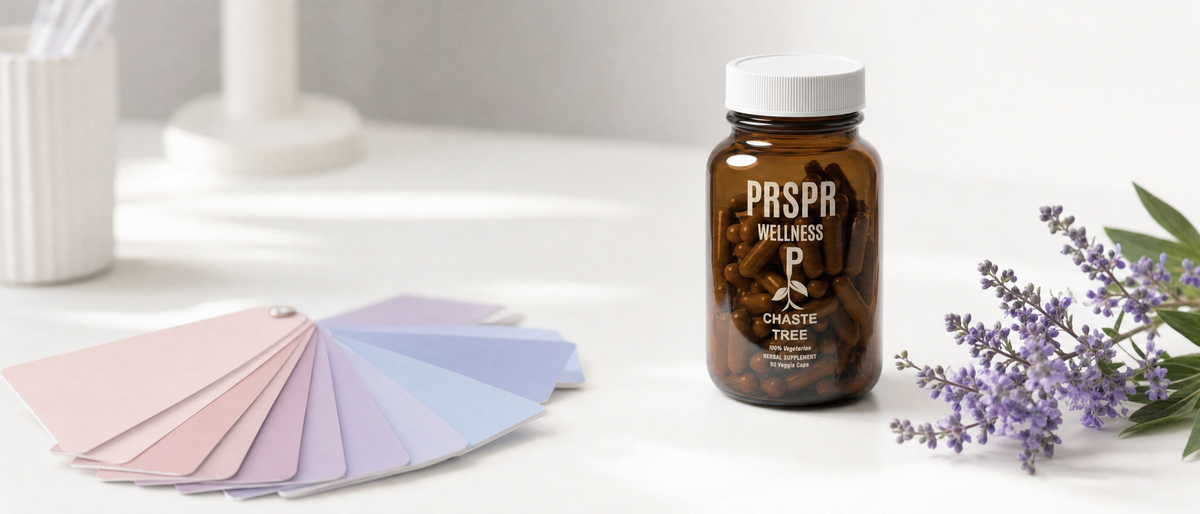
Which brings us to our own bottle. PRSPR Chaste Tree is, in the listing's own words, "a dietary supplement made with Vitex agnus-castus (chaste tree berry). It is formulated for convenient daily use." That is how the listing describes it, and that is the description we stand behind.
If the plant's many names have ever confused you, our piece on vitex, chasteberry and chaste tree sorts them out, and our guide to four ways to buy one berry lays out the tea, tincture, extract and capsule formats side by side.
What we will add in our own voice is how it is made. PRSPR Chaste Tree is manufactured in a GMP-certified facility and third-party batch tested, so what's on the label is what's in the bottle.
To read the full label for yourself, open the Chaste Tree product page, browse the rest of the women's and children's health collection, or take the build-your-stack quiz to see where it fits alongside everything else we carry.
Answer all five questions to unlock a clear wellness plan made around your goal, schedule, preferred supplement format, and biggest roadblock.
Get clarity on what matters most right now.
See the product and routine connected to your goal.
Simple next steps you can use right away.
Pick the one you would fix first if you could.
This helps us make the guide easier to follow.
Consistency beats the “perfect” routine you never follow.
Be honest. We’re building something you’ll actually use.
Your guide will include one simple way around it.
Answer two more questions to unlock your product starting point, five-step plan, two-week routine, and one practical tip for your biggest roadblock.
Enter your details to open your five-step plan.
Verified PRSPR customer reviews
Expires when you close this page
*Your personal credit for completing the quiz. It's applied automatically at checkout on one-time purchases and expires when the timer runs out.
View full product detailsEverything in your plan, together — one add to cart.
Expires when you close this page
*Your personal credit for completing the quiz. It's applied automatically at checkout on one-time purchases and expires when the timer runs out.
View full product details Mind vocabulary
What is cognition? You have probably seen the word "cognitive" printed on a label, in a headline, or in a product name, and kept scrolling. It is o...
 Biology vocabulary
What is metabolism? You see the word on labels, in gym talk and in nutrition headlines, almost always used as if it were a single setting. Read eno...
 Sleep vocabulary
What are sleep cycles? You hear the phrase on podcasts, see it on sleep trackers, and read it in articles that assume you already know what it mean...