
◎
Get clear
Get clarity on what matters most right now.

Search for a black seed oil capsule and something strange happens: half of what comes back is oregano. Oregano oil capsules is maxed out at a relative interest score of 100 on this seed. Oil of oregano sits at 58. Oregano and black seed oil capsules, the two named together, sits at 50. Oil of oregano with black seed oil sits at 42. Black seed oil capsules benefits, the only term in the top group about black seed on its own, sits at 39.
That is a peculiar result. You searched for one botanical oil and the biggest terms coming back name a completely different one. It is not a search engine error. It is an accurate reflection of how these two products are sold, and there is a real reason for it.
Before we go further: oregano oil is not in our product. Nothing in this article should be read as suggesting it is. We are writing about why the two appear next to each other on shelves and in results, which is a fact about the category. And nothing here claims anything about either oil. The benefit-shaped searches in this cluster are named as searches, and questions about what either oil does belong with a qualified healthcare professional.
The pairing is not random and it is not new. Three things put these two oils in the same place.
The first is that they are both pressed or extracted botanical oils sold in softgel capsules, which is a narrow product format. The number of things sold that way is not large, so the products that are sold that way end up as each other's nearest neighbors by default.
The second is retail history. Both have long been sold through the same channels: herbal shops, natural product retailers, and the same section of a pharmacy. Categories are shaped by where things have historically been stocked, and these two have been stocked together for a long time.
The third, and the most concrete, is that some manufacturers combine them into a single product. Oil of oregano with black seed oil at 42 is not people comparing two things. It is a product name. Once combination products exist, the two ingredient names become permanently linked in search data, because every search for one now returns products containing both.
That third factor is why the co-search is so strong. It is not shoppers associating the two. It is a shelf that literally contains both in one bottle.
Since the whole comparison hinges on it, here is what a single-ingredient capsule is as an object.
A single-oil softgel contains one oil. The panel lists that oil, an amount, and then the materials the capsule shell is made from, which is usually gelatin or a plant-derived alternative, plus glycerin and water as shell components. Some products also list an antioxidant to slow oxidation of the oil. That is the whole composition.
The practical consequence is that the amount on the panel refers to one thing, and you can compare it directly against the same figure on any other single-oil product of the same botanical. There is one variable.
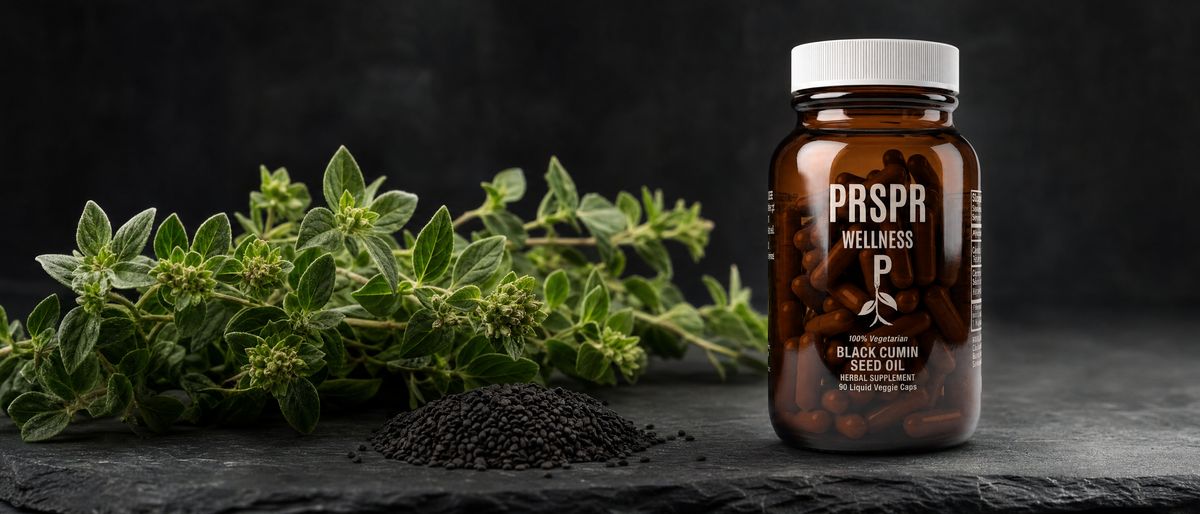
Our own bottle is that kind of product: Black Cumin Seed Oil, made with Nigella sativa, in a vegetarian veggie-cap, 90 count. One oil named, in a shell that is stated. That is a composition fact from the live listing.
A blended capsule contains two or more oils in one shell, and the difference it makes is mostly about arithmetic and about what you can compare.
The first change is that the total fill has to be divided. A softgel holds a fixed volume, so two oils share the space one would otherwise have. The panel should tell you how much of each, and if it does not, that is worth noticing.
The second change is the proprietary blend convention. Some blended products list the components and then give a single combined weight for all of them rather than a figure for each. When that happens, you know what is in the capsule but not in what proportion, and no comparison against a single-ingredient product is possible.
The third change is that you can no longer isolate anything. If you are trying to work out what a specific oil does or does not suit you, a product containing two of them cannot tell you which one is which. That is a straightforward logical point about experiments with more than one variable, and it is not a claim about either oil.
None of that makes blends bad. Combination products exist across every category and people buy them for the convenience of one capsule instead of two. It does mean a blend and a single are different purchases that should be read differently.
This sounds obvious and it is genuinely the thing people get wrong, because the front panels of the two look nearly identical.
Read the ingredient line, not the product name. A name like oil of oregano with black seed oil is explicit, but plenty of blends lead with one oil in large type and put the second in small type or only in the panel. The panel is where the truth is.
Count the oils. Then check whether each has its own amount or whether they share a combined one. Then look at what the shell is made of, because that is where a gelatin softgel and a vegetarian capsule differ and it is not always on the front.
Three checks, thirty seconds, and it tells you which of two quite different products is in your hand. We used the same approach on the naming problem for this seed in black seed, black cumin, Nigella sativa and on formats in syrup, tincture, tea.
We think shelf adjacency is one of the most underrated sources of confusion in this whole industry, and this is a clean example of it.
Two products end up next to each other for reasons that have nothing to do with the plants: a shared capsule format, a shared retail history, and a handful of manufacturers who combined them. Then the search data records that adjacency, the search data shapes what gets recommended, and a new shopper concludes there is a relationship between oregano and black seed that nobody ever actually asserted.
Our position is that a single-ingredient product should be legible as such. If a bottle contains one oil, the panel should say one oil and an amount, and you should be able to compare it against any other bottle of the same oil in about ten seconds. That legibility is the reason to sell singles at all.
Our Black Seed Oil is Black Cumin Seed Oil made with Nigella sativa, in a vegetarian veggie-cap, 90 count. One oil. No oregano, no second botanical, no blend.
Saying that plainly is the point of this article. In a category where the neighboring products are frequently combinations, knowing that a bottle contains exactly one thing is information, and it is information you should be able to get from the panel rather than from a brand's assurance.
The only thing we add in our own voice is process. GMP-certified facility, third-party batch tested, so the panel and the capsule agree.
If the single-versus-blend check is what you take from this, use it. Read the Black Seed Oil page and count the oils, run the same count across the vitamins and supplements collection, or take the build-your-stack quiz.
Answer all five questions to unlock a clear wellness plan made around your goal, schedule, preferred supplement format, and biggest roadblock.
Get clarity on what matters most right now.
See the product and routine connected to your goal.
Simple next steps you can use right away.
Pick the one you would fix first if you could.
This helps us make the guide easier to follow.
Consistency beats the “perfect” routine you never follow.
Be honest. We’re building something you’ll actually use.
Your guide will include one simple way around it.
Answer two more questions to unlock your product starting point, five-step plan, two-week routine, and one practical tip for your biggest roadblock.
Enter your details to open your five-step plan.
Verified PRSPR customer reviews
Expires when you close this page
*Your personal credit for completing the quiz. It's applied automatically at checkout on one-time purchases and expires when the timer runs out.
View full product detailsEverything in your plan, together — one add to cart.
Expires when you close this page
*Your personal credit for completing the quiz. It's applied automatically at checkout on one-time purchases and expires when the timer runs out.
View full product details Mind vocabulary
What is cognition? You have probably seen the word "cognitive" printed on a label, in a headline, or in a product name, and kept scrolling. It is o...
 Biology vocabulary
What is metabolism? You see the word on labels, in gym talk and in nutrition headlines, almost always used as if it were a single setting. Read eno...
 Sleep vocabulary
What are sleep cycles? You hear the phrase on podcasts, see it on sleep trackers, and read it in articles that assume you already know what it mean...