
◎
Get clear
Get clarity on what matters most right now.

Scroll the search results around scalp oils and one seed keeps coming up. Not castor, which is the one everybody expects. Pumpkin.
The numbers are lopsided. "Pumpkin seed oil hair growth" and "pumpkin seed oil for hair growth" both sit at 100 on the relative interest scale. "Pumpkin seed oil for hair loss" sits at 58. "Best pumpkin seed oil for hair" sits at 40 and "best pumpkin seed oil" at 39. Climbing on top of that, "organic pumpkin seed oil" is up about 90 percent, and the outcome query "pumpkin seed oil for hair growth before and after" is up about 190 percent. The castor question is still there, as "how to use castor oil for hair growth and thickness," climbing about 80 percent, but the volume has shifted to the gourd.
Two things are worth separating out of that list, and neither of them is a result. The first is what pumpkin seed oil actually is and what the word "organic" is doing next to it. The second is what buying three bottles at once changes about a routine. We are not going to show you a before and after or tell you what any oil will do to your hair, because those are claims and we do not make them.
Pumpkin seed oil is pressed from the seeds of Cucurbita squashes. The most prized version comes from a specific variety grown mainly in Austria and Slovenia whose seeds develop without the usual hard outer husk, which makes them far easier to press. That oil is a culinary product first, dark green to almost black in the bottle, with a distinctly nutty flavour, and it has been pressed in that part of Europe for a couple of centuries.
So the plant is a squash and the product is a pressed seed oil. That is the whole identity, and it is worth having because "pumpkin seed oil" sounds like a novelty and is in fact one of the older pressed oils in European kitchens.
Now the modifier, because "organic" is the part people misread most often. Organic is a certification about how the crop was farmed: which inputs were permitted, how the land was managed, and what paperwork tracks it. It is a process claim, verified by an auditing body, and it is meaningful precisely because it is checkable.
What it is not is a statement about the oil's composition, its strength, or its quality as an oil. An organic pressing and a conventional pressing of the same seed are the same substance. The certification tells you about the field, not about the bottle. That is genuinely useful information if farming practice matters to you, and it is no information at all if what you want to know is how good the oil is.
Two other words on these labels carry more weight about the oil itself. "Cold-pressed" describes a mechanical extraction done without added heat, which matters because heat changes the character of a pressed oil. "Unrefined" means it has not been through the filtering and deodorising steps that strip colour and aroma. Those two describe the process that produced what is in your hand, where "organic" describes the process that produced the seed.
The other half of this is arithmetic, and it is the half nobody discusses.
A multi-pack does not change the product. It changes your relationship with it. What you are buying is duration, and duration is the variable that decides whether a topical routine survives past the novelty phase.
Here is why that matters more for an oil than for a capsule. A capsule bottle tells you exactly how long it lasts: count divided by serving size, and the answer is a number of days. An oil cannot do that. It is dispensed by hand, in an amount you judge rather than count, and how long a bottle lasts depends on hair length, hair density, how much scalp you are covering and how often. Two people can buy the same bottle and empty it four months apart.
The consequence is that a topical is the component of any routine most likely to run out unnoticed. There is no counting down, so there is no warning. A three pack is a blunt but effective answer to that: it removes the reorder decision from the middle of a routine and pushes it to the end of a much longer stretch.
It is worth knowing the trade too, so the arithmetic is honest. More bottles means more product sitting open over a longer period, and pressed oils are the category most worth storing sensibly. Keep them closed, out of direct sun and away from heat. A bottle bought in bulk and stored on a sunlit windowsill has not been a saving.
One more thing the search list quietly tells you. Four of the nine terms are some variant of "best pumpkin seed oil," and a category where the superlative queries cluster that tightly is usually one where shoppers cannot tell the products apart. That is a labelling problem rather than a product problem, and the fix is the same as always: read the plant, the pressing method and the volume, and ignore the adjective on the front.
We would rather talk about how long a bottle lasts than about what it might do, and we know that is the less exciting conversation.
The before-and-after search climbing nearly 200 percent tells you exactly what people want, and we understand the want. But before-and-after images are the least reliable evidence in this entire industry. Lighting, styling, hair length, camera angle and time of day change an image far more than anything in a bottle does, and every one of those variables is controlled by whoever is selling. We will not produce them and we would treat anyone else's with a healthy scepticism.
What we can be useful about is the unglamorous half. What the plant is. What the certification word covers and what it does not. Why a measured product behaves differently from a counted one, and what that means for a routine you actually want to keep up. That is all checkable, none of it requires you to trust us, and it is the part that decides whether a routine is still running in three months.
If your question is about hair loss rather than about hair oil, that is a genuine question with real causes behind it, and a clinician is a much better place to take it than a product page.
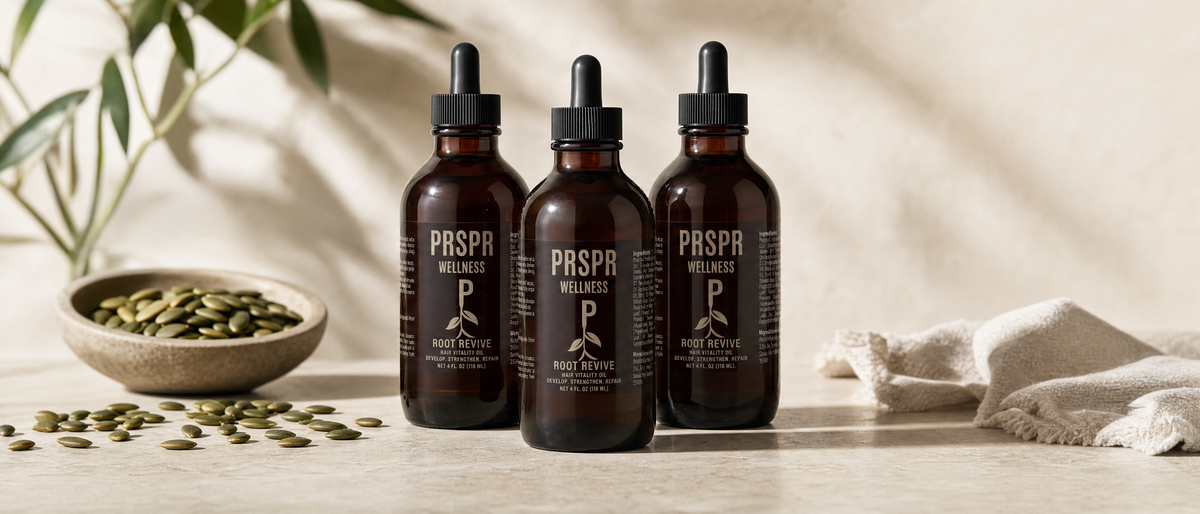
Root Revive is a botanical oil made for the scalp, and pumpkin seed oil is one of the botanicals in the blend alongside castor and black seed. The three pack exists for the duration reason above and for no cleverer one than that.
Everything we make is manufactured in a GMP-certified facility and third-party batch tested. What is on the label is what is in the bottle. No guessing, no filler, no cutting corners. With pressed botanical oils, where a customer cannot verify identity or freshness by eye, that testing is doing more work than usual.
If you want the internal side of a hair routine rather than the topical one, we wrote about what saw palmetto is and what the label phrase around it means, and about why "hair, skin and nails" is a shelf label rather than a formula. Our wellness quiz takes a couple of minutes if you are not sure where an oil fits.
Answer all five questions to unlock a clear wellness plan made around your goal, schedule, preferred supplement format, and biggest roadblock.
Get clarity on what matters most right now.
See the product and routine connected to your goal.
Simple next steps you can use right away.
Pick the one you would fix first if you could.
This helps us make the guide easier to follow.
Consistency beats the “perfect” routine you never follow.
Be honest. We’re building something you’ll actually use.
Your guide will include one simple way around it.
Answer two more questions to unlock your product starting point, five-step plan, two-week routine, and one practical tip for your biggest roadblock.
Enter your details to open your five-step plan.
Verified PRSPR customer reviews
Expires when you close this page
*Your personal credit for completing the quiz. It's applied automatically at checkout on one-time purchases and expires when the timer runs out.
View full product detailsEverything in your plan, together — one add to cart.
Expires when you close this page
*Your personal credit for completing the quiz. It's applied automatically at checkout on one-time purchases and expires when the timer runs out.
View full product details Electrolytes
Salt is having a comparison week. Searches for celtic sea salt vs himalayan pink salt are up about 70 percent, pink himalayan salt vs table salt is...
 Kids
KidsPick up a box of children's snacks and somewhere on the front there is a number with the letter g after it, next to the word fiber. It looks like o...
 Label Reading
It is printed on the front of a lot of mineral bottles and it is one of the least understood words in the supplement business. Chelated. Search int...