
◎
Get clear
Get clarity on what matters most right now.

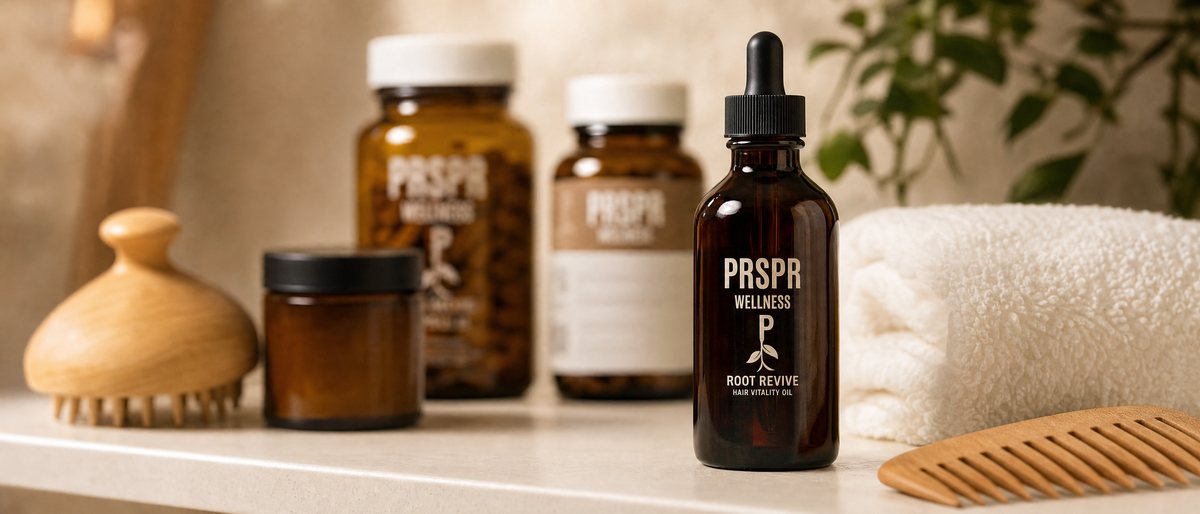
Ten years ago the shelf had shampoo and conditioner on it. Now it has a section, and the section has a name. Scalp care arrived as a retail category somewhere in the last few years, and it now contains object types that did not previously exist as separate purchases.
Search data shows the category behaving like a category. In the past week, scalp care shampoo ran at 100 and scalp care products at 41, with scalp massager at 6 and scalp scrub at 4 underneath them. Two condition shaped searches sat alongside: dry scalp at 32, and itchy scalp remedy rising 160 percent, with best oil for dandruff and dry scalp rising 80 percent behind it.
This piece is about the category as a set of physical objects. What is in the aisle, what each type of thing is, and where an oil sits among them. We make no claim here about dandruff, itch, flaking, or any scalp condition, and the condition searches above are recorded as things people type and nothing more. If something about your scalp is bothering you, see a qualified healthcare professional rather than a product page.
Four object types show up consistently, and they are genuinely different from each other.
Scalp care shampoo is the anchor product and the biggest search phrase in the group. Structurally it is a shampoo, which means a surfactant based liquid intended to be applied, worked in, and rinsed out. What distinguishes a shampoo marketed for the scalp from an ordinary one is usually formulation emphasis and marketing position rather than a different category of product.
Scalp scrub is a physical exfoliant. It contains abrasive particles, commonly salt or sugar based, suspended in a base, and it is applied with pressure and then rinsed. The category borrowed the format directly from skincare, where body and facial scrubs have existed for decades. Somebody looked at a face scrub and asked why the same object could not be sold for the head.
A scalp massager is not a formulation at all. It is a tool, usually silicone or plastic bristles on a handle or a palm grip, and it is the only item in the category that you buy once rather than repeatedly. Its presence in the aisle is the clearest sign the category has matured, because tools only get their own shelf space once the routine around them is established enough to support one.
And then there is oil, which is the oldest format of the four by a very long way and the one that arrived in the modern aisle last.
Worth noticing what the search volumes say about the shape of that aisle. Scalp care shampoo at 100 dwarfs scalp massager at 6 and scalp scrub at 4 combined. That is a category with one dominant object and a long tail of specialist ones, which is the normal shape for a young aisle: most people arrive through the format they already understand and only some go further in. Scalp care products at 41, the phrase for the whole category rather than any item in it, sits between the two, and it is the phrase you type when you know the aisle exists but not yet what is in it.
An oil is structurally the odd one out. The shampoo and the scrub are rinse off products. The massager is a tool. An oil is a leave on or wash out liquid with no surfactant in it, and its formulation logic is completely different: rather than lifting things off, it is a carrier oil or blend of carrier oils, sometimes with botanical extracts infused or blended in.
That difference in structure is why an oil does not compete with the other three so much as sit beside them. It is also why the modern scalp aisle looks less like an invention than a rediscovery. Infusing botanicals into a carrier oil and applying the result to the head is an ancient preparation. It predates the entire shampoo category by centuries, and it was in continuous use in South Asian, Middle Eastern and West African hair traditions the entire time Western retail had nothing to sell you for your scalp at all.
What is new is not the oil. What is new is the shelf that has been built around it, and the vocabulary that came with the shelf. Ten years ago you would have found the same object in a completely different part of the shop, described in completely different words.
Here is the bridge, and it is the reason we find the scalp care category interesting rather than annoying.
A retail category is a naming decision before it is anything else. Somebody has to decide that a group of products belongs together, give the group a name a shopper will type, and then put the sign above it. Scalp care won as a name because it is descriptive, neutral, and does not promise anything. Compare it with the phrases people actually search when they are worried about something, like itchy scalp remedy or best oil for dandruff and dry scalp, which are the searches of a person looking for an answer rather than browsing an aisle.
The category name and the worried search are aimed at the same shelf, and only one of them is a description. That gap is where most of the overclaiming in this part of the market happens, and it is exactly where we are choosing not to go. We wrote about a similar gap in our piece on what hair, skin and nails vitamins actually say on the label, which reads the ingestible half of the same aisle.
We think the scalp getting its own aisle is mostly a good thing, with one caveat.
The good part is specificity. Splitting scalp products out from general hair products means the objects can be described for what they are, and a shopper can tell a tool from a formulation from a rinse off product without guessing. That is more information, not less.
The caveat is that new categories attract new promises. When a shelf is young there is no established vocabulary for what is reasonable to say, and the language runs ahead of the evidence for a while before it settles. That is a predictable pattern and it is worth knowing you are inside it when you shop this aisle. Read what a thing is. Be sceptical of what a thing is said to do.
The Hair Renewal Protocol includes Root Revive Hair Growth Oil, our botanical oil blend, alongside capsules. It sits in our bundles collection with the rest of our multi product sets.
What we will state about it is what we can verify. The capsules in it are manufactured in a GMP certified facility and third party batch tested, and every label prints its amounts in a form you can read rather than burying them inside a blend name. Clear amounts, no guesswork, and no promise on this page about what any of it does to a scalp.
If you are not sure whether a topical, an ingestible, or neither belongs in your routine, take the quiz and build your own stack rather than working it out from an aisle sign.
Answer all five questions to unlock a clear wellness plan made around your goal, schedule, preferred supplement format, and biggest roadblock.
Get clarity on what matters most right now.
See the product and routine connected to your goal.
Simple next steps you can use right away.
Pick the one you would fix first if you could.
This helps us make the guide easier to follow.
Consistency beats the “perfect” routine you never follow.
Be honest. We’re building something you’ll actually use.
Your guide will include one simple way around it.
Answer two more questions to unlock your product starting point, five-step plan, two-week routine, and one practical tip for your biggest roadblock.
Enter your details to open your five-step plan.
Verified PRSPR customer reviews
Expires when you close this page
*Your personal credit for completing the quiz. It's applied automatically at checkout on one-time purchases and expires when the timer runs out.
View full product detailsEverything in your plan, together — one add to cart.
Expires when you close this page
*Your personal credit for completing the quiz. It's applied automatically at checkout on one-time purchases and expires when the timer runs out.
View full product details Electrolytes
Salt is having a comparison week. Searches for celtic sea salt vs himalayan pink salt are up about 70 percent, pink himalayan salt vs table salt is...
 Kids
KidsPick up a box of children's snacks and somewhere on the front there is a number with the letter g after it, next to the word fiber. It looks like o...
 Label Reading
It is printed on the front of a lot of mineral bottles and it is one of the least understood words in the supplement business. Chelated. Search int...