
◎
Get clear
Get clarity on what matters most right now.

You have seen the word on supplement labels, in podcast titles, in captions that blame it for a bad week. Hormones. It is one of the most used words in wellness and one of the least defined. So people look it up. If you have ever typed what are hormones into a search bar, you are in good company, and this is the plain answer: what a hormone is, what the endocrine system is, and where the main glands sit, by name.
No mood talk, no fixes. Just the vocabulary, with a source on every line.
Here is how big the question is right now. In Google Trends data for the US over the past seven days, using "hormones" as the seed term, the top related search was "what is hormones," with a score of 100. "What are hormones" scored 88. "Hormone" scored 54, "women hormones" 33, "endocrine" 25, "endocrine system" 16, "what is a hormone" 16, and "pituitary gland" 14. Two terms were rising: "adrenal medulla hormones" and "calcitonin," each up 60%.
A quick note on reading those numbers. They are relative scores within the "hormones" seed, not absolute search counts. The top term is set to 100 and everything else is scaled against it. The rising figures are percentage growth in search interest, and Google Trends labels anything above 5,000% growth as "Breakout." Nothing on this list hit that.
Read the list top to bottom and it tells you something. The biggest question is not about any single hormone. It is about the word itself. Three of the top searches are some version of "what is a hormone," asked three different ways. And "women hormones" sits right in the middle, which shows how often the word gets attached to women specifically. The definitions below are the same no matter who is searching.
Start with the plainest version. MedlinePlus, from the NIH's National Library of Medicine, puts it in two sentences: "Hormones are your body's chemical messengers. They travel in your bloodstream to tissues or organs."
The Endocrine Society, the professional body for the doctors and scientists who study this, uses nearly the same words. It calls hormones "the body's chemical messengers, sending signals into the bloodstream and tissues."
The National Cancer Institute's SEER Training Modules add the detail that makes the definition click. Per that anatomy course, the products of endocrine glands "are called hormones and are secreted directly into the blood and then carried throughout the body where they influence only those cells that have receptor sites for that hormone."
So a hormone is three things at once:
That is the whole answer to "what is a hormone." A messenger, a delivery route, and a recipient.
The word is newer than most people assume. According to the Online Etymology Dictionary, its modern scientific meaning was coined in 1905 by the English physiologist Ernest Henry Starling. He built it from the Greek hormon, "that which sets in motion," the present participle of horman, "impel, urge on."
A word that literally means "that which sets in motion," for a molecule whose job is to carry a signal somewhere else. It is a rare case of a scientific name that tells you exactly what it describes.
If a hormone is the message, the endocrine system is the network of glands that sends it. The SEER Training Modules describe it this way: "The endocrine system, along with the nervous system, functions in the regulation of body activities."
What makes a gland endocrine is a plumbing detail. Per the same course, "Exocrine glands have ducts that carry their secretory product to a surface," while "the endocrine glands do not have ducts to carry their product to a surface. They are called ductless glands." Sweat glands are exocrine. They have a duct and an exit. Endocrine glands release straight into the blood.
The name says the same thing. The Online Etymology Dictionary dates "endocrine," meaning "secreting internally," to 1914, from endo-, "inside, within," and the Greek krinein, "to separate, distinguish."
MedlinePlus names the main endocrine glands as the pituitary, pineal, thymus, thyroid, adrenal glands, and pancreas, and notes that the testes and ovaries also produce hormones. Three of those line up with this week's searches.
MedlinePlus describes the pituitary gland as "a pea-sized gland at the base of your brain" and calls it the "master control gland." The SEER Training Modules put it at about 1 centimeter in diameter, resting in the sella turcica, a depression in the sphenoid bone, and connected to the hypothalamus by a slender stalk called the infundibulum. It has two parts, an anterior lobe and a posterior lobe.
The name is a historical mistake that stuck. The Online Etymology Dictionary traces "pituitary" to the Latin pituita, "phlegm, mucus," taken as the gland's name because it was believed to channel mucus to the nose.
Per the SEER Training Modules, the thyroid sits in the neck, with two lobes, one on each side of the trachea, just below the larynx. The Online Etymology Dictionary traces "thyroid" to the 1690s and the Greek thyreoeides, "shield-shaped."
Calcitonin, one of this week's rising searches, is a clean example of the definition in action. The SEER course says it "is secreted by the parafollicular cells of the thyroid gland," and the MedlinePlus Medical Encyclopedia calls it "a hormone produced in C cells of the thyroid gland." A gland, a specific cell type, a product released into the blood.
"Adrenal" means "of or near the kidneys," from the Latin ad-, "to, near," and renalis, "of the kidneys," a word the Online Etymology Dictionary dates to 1866. The SEER Training Modules place one adrenal gland near the upper portion of each kidney, divided into an outer cortex and an inner medulla.
That answers the other rising search, "adrenal medulla hormones." Per the same course, the adrenal medulla "develops from neural tissue and secretes two hormones, epinephrine and norepinephrine."
This map is the general one. Individual hormones have their own vocabulary, and we have covered two of them separately: why estrogen is a family of hormones, not one, and what "free" and "total" testosterone mean. If you want the calendar side of the vocabulary, our post on the four phases of the menstrual cycle and their names covers that.
Here is what bothers us. "Hormones" has become a word people use to end a conversation instead of starting one. Something feels off, and the explanation is "hormones," and nobody asks which gland, which messenger, or what any of it means.
We think you should be able to say what a hormone is in one line. A chemical messenger, made by a ductless gland, carried in the blood, read by cells with the right receptor. That is it. Once you have that line, a lot of wellness copy reads differently. You start noticing how often a big word is doing the work a specific word should be doing.
The search data says people want this. The top searches in the set are definition questions. Nobody is asking for a slogan. They are asking what the word means. That is a good instinct, and it is the same instinct we want you to bring to every label, ours included.
So our standard is simple. Name things plainly. Name every component. Make the label something you can read and check, not something you have to take on faith.
Questions about your own body belong with a clinician who knows your history.
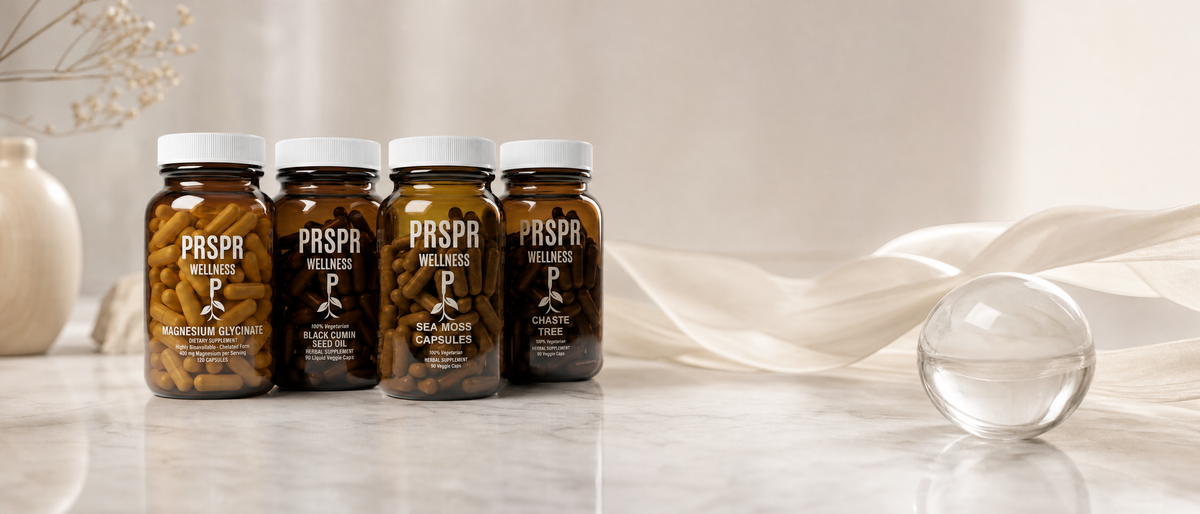
Women's Daily Edge, our Women's Essentials bundle, is built the way we just described: every piece named on the listing. The listing names its components as PRSPR Seamoss Capsules, Magnesium Glycinate, Black Seed Oil (Nigella sativa), and Chaste Tree. Each one comes with its own Supplement Facts panel on the product page, so you can read exactly what goes in.
Our products are made in a GMP-certified facility and third-party batch tested, so what's on the label is what's in the bottle. No vague blends, no mystery fillers, no hiding behind a big word.
The bundle sits in our Vitamins & Supplements collection alongside the individual products, so you can look at each component on its own page too.
If you came here to learn what a hormone is, you now know more than most labels will tell you. Read the full component list and the Supplement Facts panels for Women's Daily Edge at PRSPR.
That exact phrasing was the top search for the "hormones" seed in Google Trends this week. The answer, per MedlinePlus: hormones are the body's chemical messengers, which travel in the bloodstream to tissues or organs.
Per the National Cancer Institute's SEER Training Modules, a hormone is the secretory product of an endocrine gland, released directly into the blood and carried through the body, where it influences only cells with receptor sites for it.
The SEER Training Modules name two: epinephrine and norepinephrine, secreted by the inner part of the adrenal gland.
In the thyroid. The MedlinePlus Medical Encyclopedia describes calcitonin as a hormone produced in the C cells of the thyroid gland.
Answer all five questions to unlock a clear wellness plan made around your goal, schedule, preferred supplement format, and biggest roadblock.
Get clarity on what matters most right now.
See the product and routine connected to your goal.
Simple next steps you can use right away.
Pick the one you would fix first if you could.
This helps us make the guide easier to follow.
Consistency beats the “perfect” routine you never follow.
Be honest. We’re building something you’ll actually use.
Your guide will include one simple way around it.
Answer two more questions to unlock your product starting point, five-step plan, two-week routine, and one practical tip for your biggest roadblock.
Enter your details to open your five-step plan.
Verified PRSPR customer reviews
Expires when you close this page
*Your personal credit for completing the quiz. It's applied automatically at checkout on one-time purchases and expires when the timer runs out.
View full product detailsEverything in your plan, together — one add to cart.
Expires when you close this page
*Your personal credit for completing the quiz. It's applied automatically at checkout on one-time purchases and expires when the timer runs out.
View full product details Mind vocabulary
What is cognition? You have probably seen the word "cognitive" printed on a label, in a headline, or in a product name, and kept scrolling. It is o...
 Biology vocabulary
What is metabolism? You see the word on labels, in gym talk and in nutrition headlines, almost always used as if it were a single setting. Read eno...
 Sleep vocabulary
What are sleep cycles? You hear the phrase on podcasts, see it on sleep trackers, and read it in articles that assume you already know what it mean...