
◎
Get clear
Get clarity on what matters most right now.

What does paraben free mean? That is one of the fastest-climbing hair-care questions right now. "What does paraben free mean" is up +170%, and "why use sulfate free shampoo" is up +60%. The steady searches underneath tell the same story: "what is paraben free" carries a volume score of 26, "what is sulfate free shampoo" sits at 9, "paraben free hair products" at 7, "sulfate free hair products" at 4, and "paraben free meaning" at 3.
Those are label questions. People are reading two short phrases on the front of a bottle and asking what they actually say. That has a clean answer, and it starts with knowing what parabens and sulfates are in the first place.
So that is where we are going to stay: what a free-from phrase means, what the two ingredient families are, and how to check a label for yourself. Whether any particular ingredient suits your skin or scalp is a question for a qualified healthcare professional, and we are not going to answer it here in either direction.
Start with the family name. According to the U.S. Food and Drug Administration, parabens are a family of related chemicals that are commonly used as preservatives in cosmetic products.
"Family" is the important word. There is no single ingredient called paraben. The FDA names the ones used most commonly in cosmetics: methylparaben, propylparaben, butylparaben and ethylparaben. Each is its own ingredient with its own name on a label, and they all share the "-paraben" ending.
The FDA also says where they turn up. It lists makeup, moisturizers, hair care products and shaving products among the cosmetics that may contain parabens, and notes that parabens are used in foods and drugs as well. So when "paraben free hair products" shows up as a search, it reflects a category where parabens are a familiar ingredient family. That familiarity is exactly why the phrase gets printed on the front of hair bottles.
In plain terms, "paraben free" on a label says the formula does not include any ingredient from the paraben family. It is a statement about absence. It names what was left out, not what went in.
That is the whole answer to "what is paraben free", and it is worth reading at exactly that size. The phrase does not tell you which preservative, if any, was used instead. It does not describe the other ingredients. It is one fact about one family.
So who stands behind that fact? According to the FDA, information on cosmetic labeling, including claims, must be truthful and not misleading. The FDA also says the law does not require cosmetic labeling to have FDA approval before products go on the market, and that the agency does not keep a list of accepted claims for cosmetics. "Paraben free" is not a stamp the FDA hands out. It is a statement the company makes, and the company is responsible for it being true.
That is the practical paraben free meaning: a promise about the ingredient list, made by the brand, that you can check.
You do not have to take the front of the bottle on faith. The FDA's summary of cosmetics labeling requirements says ingredients must be declared in descending order of predominance, and that color additives and ingredients present at one percent or less may be declared without regard for that order. Small ingredients can sit anywhere near the end, but they are still declared.
The FDA also says parabens are usually easy to identify by their name. So the check is simple. Turn the bottle over, read the ingredient list, and look for any word ending in "-paraben". On a product labeled paraben free, you should not find one.
"Sulfate" is an older chemistry word than most people expect. According to the Online Etymology Dictionary, it means a salt of sulfuric acid and dates to 1790, when it appeared in an English translation of the French chemist Lavoisier. If the word looks familiar from a mineral label, it should. Our piece on why iron comes as four different salts shows the same word doing a completely different job.
In hair care, "sulfate" usually points to one kind of ingredient: a surfactant. The best-known example is sodium lauryl sulfate. A 2023 literature review in the Journal of Dentistry (Shiraz) describes sodium lauryl sulfate as an anionic surfactant, the sodium salt of lauryl alcohol, and lists shampoos, hand soaps and cosmetic products among its uses. The same review notes that it maximizes foaming action and lowers the surface tension of water.
So a sulfate in a shampoo is not a mystery additive. It is a cleansing, foaming ingredient, and the foam is the part you see in the shower.
A sulfate free shampoo is a shampoo whose formula leaves out sulfate surfactants such as sodium lauryl sulfate. It is still a shampoo, so it still uses some other ingredient to clean. The front-of-bottle phrase tells you which family is absent. The ingredient list tells you what took its place.
The sulfate check works the same way as the paraben check, with one caution. Look for ingredient names that end in "sulfate". In a shampoo or other rinse-off hair product, a name like sodium lauryl sulfate is the kind of ingredient the phrase is talking about.
The caution is that "sulfate" is a general chemistry word, so it is not a hair-care word on every label. On a supplement panel, a sulfate is often just the salt form of a mineral. Context tells you which meaning you are looking at, and on sulfate free hair products the context is cleansing ingredients.
This is the fastest-rising sulfate question, so it is worth being precise about what kind of question it is.
Part of it is a reading question, and that part has an answer. A sulfate free label tells you the formula does not use a sulfate surfactant. A paraben free label tells you it does not use a paraben preservative. People pick products for all sorts of reasons, from texture and feel to habit to simply wanting to know exactly what they are buying, and a free-from phrase is one of the quickest ways to sort a crowded shelf.
The other part is personal. How any single ingredient suits your own scalp or skin is a question for a qualified healthcare professional. A label phrase cannot settle it, and neither can a blog post.
One more thing worth holding onto: a free-from phrase is not a ranking. "Paraben free" does not grade a product against one that contains parabens, and "sulfate free" does not grade a shampoo against one that contains sulfates. It tells you one ingredient family is not in the formula. That is the whole message, and it is useful on its own. We made the same point about another popular free-from phrase in our piece on what BPA-free means on a label, and what it doesn't.
Here is where the two phrases get interesting. Both searches lean toward shampoo. But the same words also appear on hair oils, and on an oil they read a little differently.
A shampoo is built to lather and rinse, so "sulfate free" on a shampoo tells you something about how it cleans: one family of cleansers was swapped out for another. A hair oil is a different kind of product. It is a blend of oils and extracts, not a cleanser, so there is no lather to explain. On an oil, "sulfate free" is less about a swap and more about confirming the whole list: nothing from the sulfate family went into the bottle.
"Paraben free" reads the same way on either product. It is one fact about one family of preservatives, and you check it the same way, against the ingredient list.
The habit worth building is identical in both cases. Read the front-of-bottle phrase as a pointer, then turn the bottle over. The ingredient list is where the phrase gets confirmed, and where you meet the ingredients that are actually in there. If a botanical name catches your eye, castor being the most famous, our piece on what else is in a castor oil bottle is a good next read.
Paraben free and sulfate free are two of the most useful phrases on a hair-care label, as long as you read them at their real size.
Parabens are a family of preservatives with names you can spot, all ending in "-paraben". Sulfates in hair care are surfactants, with sodium lauryl sulfate the best known. A free-from phrase tells you that one family is absent. It does not grade the product, and it does not replace the ingredient list.
We think the smartest way to shop is to treat the front of the bottle as a claim and the back as the evidence. That applies to every label on the shelf, ours included.
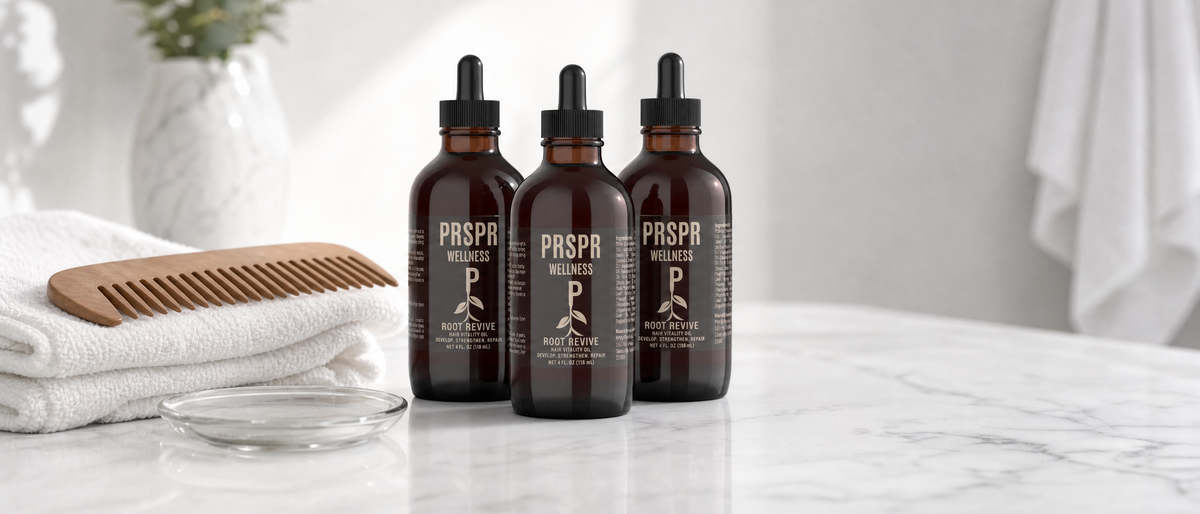
The Root Revive Hair Oil 3 Pack Bundle is three bottles of Root Revive, our hair oil. In the listing's own words, Root Revive is "free from parabens, sulfates, and artificial fragrances." Those are the two phrases this whole piece has been decoding, plus a third.
The listing also names what does go in: Castor, Pumpkin Seed, Black Seed, Avocado, Olive and Grapeseed oils, along with Amla, Brahmi and Fenugreek extracts. It comes with an included pipette, and the listing describes it as cruelty-free and vegan.
What we will add in our own voice is how it is made. Root Revive is manufactured in a GMP-certified facility and third-party batch tested, so what's on the label is what's in the bottle.
If you want to read the full listing for yourself, open the Root Revive 3 Pack page, or take the build-your-stack quiz to see where it fits alongside everything else we carry.
Answer all five questions to unlock a clear wellness plan made around your goal, schedule, preferred supplement format, and biggest roadblock.
Get clarity on what matters most right now.
See the product and routine connected to your goal.
Simple next steps you can use right away.
Pick the one you would fix first if you could.
This helps us make the guide easier to follow.
Consistency beats the “perfect” routine you never follow.
Be honest. We’re building something you’ll actually use.
Your guide will include one simple way around it.
Answer two more questions to unlock your product starting point, five-step plan, two-week routine, and one practical tip for your biggest roadblock.
Enter your details to open your five-step plan.
Verified PRSPR customer reviews
Expires when you close this page
*Your personal credit for completing the quiz. It's applied automatically at checkout on one-time purchases and expires when the timer runs out.
View full product detailsEverything in your plan, together — one add to cart.
Expires when you close this page
*Your personal credit for completing the quiz. It's applied automatically at checkout on one-time purchases and expires when the timer runs out.
View full product details Mind vocabulary
What is cognition? You have probably seen the word "cognitive" printed on a label, in a headline, or in a product name, and kept scrolling. It is o...
 Biology vocabulary
What is metabolism? You see the word on labels, in gym talk and in nutrition headlines, almost always used as if it were a single setting. Read eno...
 Sleep vocabulary
What are sleep cycles? You hear the phrase on podcasts, see it on sleep trackers, and read it in articles that assume you already know what it mean...