
◎
Get clear
Get clarity on what matters most right now.

What is sublingual? It is one of those words you meet on a label, in a pharmacy leaflet or in a dropper's directions, and it looks more technical than it is. Plenty of people stop and look it up, and right now a lot of them are doing exactly that.
According to Google Trends, for US searches over the past seven days related to the seed term "sublingual," the top related queries included "what is sublingual" at 100, "sublingual gland" at 39, "sublingual meaning" at 33, "sublingual administration" at 26, "buccal" at 18 and "sublingual route" at 15. Among rising queries, "what does sublingual mean in medical terms" was up 190%, "function of sublingual gland" was up 180%, "under tongue anatomy" was up 150% and "sublingual tablet meaning" was up 130%.
A quick note on those numbers. Google Trends scores are relative within each seed term: 100 marks the most searched query in that set, and the others are scaled against it. They are not search counts. A rising percentage measures growth in interest, not volume.
So people want two things: the meaning of the word, and a map of the place it points to. This piece covers both. It explains where "sublingual" comes from, what actually sits under your tongue, how "sublingual" differs from "buccal," and how the word turns up as a route name on labels. Every definition comes with its source.
Start with the dictionary. Dictionary.com defines sublingual as "situated under the tongue, or on the underside of the tongue." It also lists a noun sense: "a sublingual gland, artery, or the like." So the word can describe a position, or it can be shorthand for a structure in that position.
The word splits cleanly into two pieces:
Put them together and you get "under the tongue." Dictionary.com dates sublingual to 1655 to 1665 and gives its origin as New Latin sublinguālis. In other words, the English word is a near-direct borrowing of an anatomist's Latin term, which is why it still sounds clinical.
That also answers the rising question "what does sublingual mean in medical terms." In medicine the word keeps its literal meaning. It is a location word. It tells you where something is, or where something goes.
Lift your tongue and look in a mirror and you see the floor of the mouth. That is the region the word "sublingual" names, and it is busier than it looks.
Cleveland Clinic's page on salivary glands says simply, "Your salivary glands make saliva that lubricates your mouth." It lists three major glands: the parotid glands, which it places "just in front of your ears"; the submandibular glands, "below your jaw"; and the sublingual glands, which it describes as "below either side of your tongue, under the floor of your mouth."
Cleveland Clinic adds that you also have "hundreds of minor glands," and that "Minor salivary glands are mostly in your lips, palate, tongue and the inner lining of your cheeks."
For more detail, the StatPearls chapter "Anatomy, Head and Neck, Sublingual Gland" (Grewal, Bordoni, Shah and Ryan, indexed on Europe PMC) says "The sublingual gland is the smallest of the three major salivary glands." It places the gland between the muscles of the floor of the oral cavity, with the mylohyoid muscle below it and the mandible bordering it at the side.
The rising query "function of sublingual gland" has a short anatomical answer. It is a salivary gland, so its job is making saliva. The same StatPearls chapter puts a figure on its share: "The sublingual gland contributes approximately 5% of saliva in the oral cavity."
Saliva has to get out, so the gland has ducts. According to the StatPearls chapter, a group of small ducts called the ducts of Rivinus drains the sublingual gland, and the largest one, the sublingual duct of Bartholin, joins Wharton's duct near a small bump called the sublingual caruncle.
The chapter describes that caruncle as a papilla located beside the lingual frenulum, the midline fold on the underside of the tongue. So the "under tongue anatomy" people are searching for comes down to a short list: the floor of the mouth, a pair of small salivary glands, their ducts, and the frenulum in the middle.
"Buccal" shows up in the same searches because it is the neighboring word. Dictionary.com defines buccal as "of or relating to the cheek" and "directed toward the cheek," and traces it to New Latin buccālis, from Latin bucca, "cheek, mouth." It dates the English word to 1825 to 1835.
So the two words split the inside of the mouth by location:
| Word | Latin root | Points to |
|---|---|---|
| Sublingual | sub + lingua, under + tongue | The floor of the mouth, under the tongue |
| Buccal | bucca, cheek or mouth | The inside of the cheek |
| Lingual | lingua, tongue | The tongue itself |
Neither word says anything about what happens after something is placed there. They are addresses, not instructions.
Here is where the vocabulary gets formal. "Route of administration" is the standard phrase for how and where a product is meant to be taken. The U.S. Food and Drug Administration keeps an official list of route names in its Data Standards Manual, and that list defines each term in a single line.
According to the FDA's Route of Administration list:
So "sublingual administration" and "sublingual route" mean the same thing: the label is telling you the place, beneath the tongue. The FDA list keeps sublingual, buccal and oral as three separate entries, which is why you will see them as distinct words rather than synonyms.
The same logic covers "sublingual tablet meaning." The word "sublingual" in front of "tablet" (or drop, or film) is a route word attached to a format word. It names where the item goes. It does not describe the ingredient.
We like words that do one job, and sublingual is one of them. It means under the tongue. That is the whole definition.
So read it as a location. When you see "sublingual" on a label, you have learned where the directions want something placed. You have not learned anything about the ingredient, the amount or the result. Those live on other parts of the label.
Keep the neighbors straight too. Sublingual is under the tongue. Buccal is the cheek. Lingual is the tongue itself. Oral is the mouth in general. Four words, four places, and once you know the Latin you will not mix them up.
If you came here from a dropper bottle, our piece on why a dropper is a measuring instrument covers the tool, and our guide to cholecalciferol, menaquinone-7 and the other long words on a D3 + K2 label covers the ingredient names. If anatomy tours are your thing, our plain tour of the ear does for the ear what this piece does for the floor of the mouth. Questions about your own body belong with a clinician.
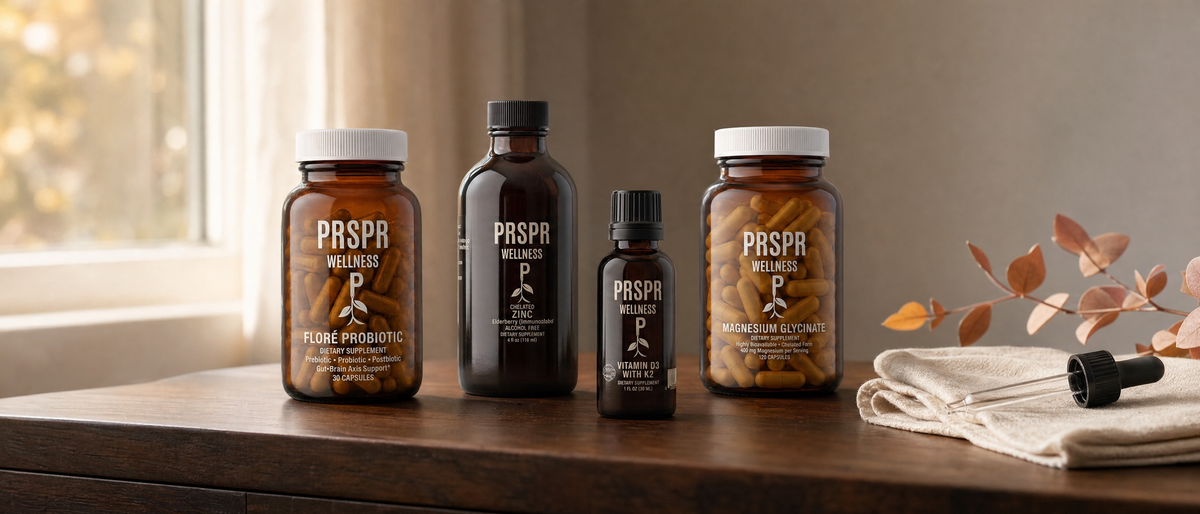
This piece started with a line of directions on our own shelf. Our Seasonal Wellness Stack brings together four PRSPR products, and the directions for one of them, Vitamin D3 + K2 Plus MK7, read: "Take 5 drops daily under your tongue or mix with food or liquids like water or juice." "Under your tongue" is the plain-English version of sublingual.
Like everything we carry, it is made in a GMP-certified facility and third-party batch tested, so what's on the label is what's in the bottle. It sits in our Bundles collection, listed at $149.99.
To read the directions for each product in full, see the Seasonal Wellness Stack at PRSPR.
Sublingual is an adjective meaning under the tongue. Dictionary.com defines it as "situated under the tongue, or on the underside of the tongue," from New Latin sublinguālis.
It keeps its literal meaning. The FDA's Route of Administration list defines SUBLINGUAL as "Administration beneath the tongue," and anatomists use it for structures in that spot, such as the sublingual gland.
According to Cleveland Clinic, the sublingual glands are "below either side of your tongue, under the floor of your mouth." The StatPearls chapter "Anatomy, Head and Neck, Sublingual Gland" calls it the smallest of the three major salivary glands.
Dictionary.com defines buccal as "of or relating to the cheek," from Latin bucca. The FDA defines the BUCCAL route as "Administration directed toward the cheek, generally from within the mouth."
Yes, as vocabulary. Both refer to the route the FDA lists as SUBLINGUAL, defined as "Administration beneath the tongue."
Answer all five questions to unlock a clear wellness plan made around your goal, schedule, preferred supplement format, and biggest roadblock.
Get clarity on what matters most right now.
See the product and routine connected to your goal.
Simple next steps you can use right away.
Pick the one you would fix first if you could.
This helps us make the guide easier to follow.
Consistency beats the “perfect” routine you never follow.
Be honest. We’re building something you’ll actually use.
Your guide will include one simple way around it.
Answer two more questions to unlock your product starting point, five-step plan, two-week routine, and one practical tip for your biggest roadblock.
Enter your details to open your five-step plan.
Verified PRSPR customer reviews
Expires when you close this page
*Your personal credit for completing the quiz. It's applied automatically at checkout on one-time purchases and expires when the timer runs out.
View full product detailsEverything in your plan, together — one add to cart.
Expires when you close this page
*Your personal credit for completing the quiz. It's applied automatically at checkout on one-time purchases and expires when the timer runs out.
View full product details Botany
You pick up a fallen leaf on a walk, or you read a product label that says a botanical comes from a leaf, and you realize you do not have the words...
 Food Science
You are fine, you just ate, and then one specific food lands in your head and will not leave. Not food in general. That food. Researchers have a na...
 Fitness Terms
You have heard it from a coach, a gym sign-up form, a friend who just bought a set of dumbbells. Strength training. Resistance training. Hypertroph...