
◎
Get clear
Get clarity on what matters most right now.

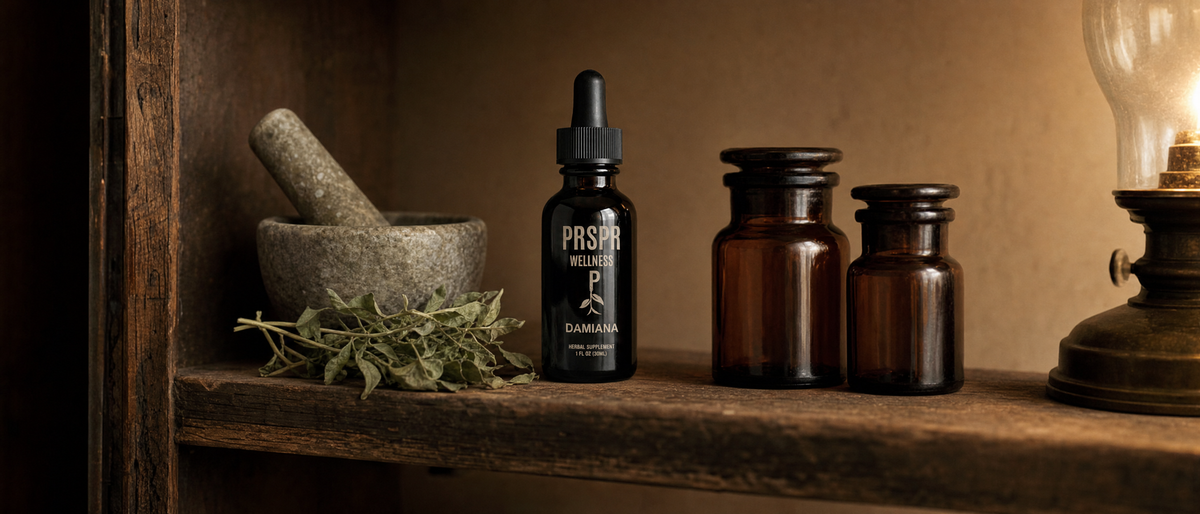
What is a tincture? A lot of people are asking right now, and they are asking in more ways than one. "Tincture pronunciation" is up +90% this week, which tells you plenty of people have read the word and are not sure how to say it out loud. The plain question "what is tincture" carries a volume score of 99, "what is a tincture" sits at 41, "tincture meaning" at 26, the plural "tinctures" at 24, and "tincture definition" at 9.
That is a vocabulary moment. The word shows up on shelf tags, in recipe blogs and in old pharmacy books, and it rarely comes with an explanation attached.
So this piece is about the word itself: where it comes from, what it has meant over six centuries, how to say it, and how it sits next to other liquid formats like glycerites and extracts. What any particular preparation does, or whether it suits you, is a question for a qualified healthcare professional. We are not going to answer that here.
Start with the modern dictionary meaning. Dictionary.com defines a tincture, in its pharmacology sense, as "a solution of alcohol or of alcohol and water, containing animal, vegetable, or chemical drugs."
Two details in that definition do most of the work. The first is the solvent. A tincture, by definition, is made with alcohol, or alcohol mixed with water. The second is the range of what goes into it. The definition is not limited to plants. It covers animal, vegetable and chemical materials alike, which is why old pharmacy shelves held tinctures of all sorts of things.
In everyday use today, though, when someone says "tincture" they usually mean the vegetable kind: plant material that has been soaked in alcohol so the liquid takes on something of the plant. That soaking step matters, and it turns out to be hiding inside the word itself.
The top search drops the article: "what is tincture," not "what is a tincture." That small change points to an older use of the word. Without "a" in front, tincture reads less like a bottle and more like a quality or a color, and that is exactly how the word started out.
Before tincture meant a medicine, it meant a color.
According to the Online Etymology Dictionary, the noun appeared in English around 1400 meaning "a coloring or dyeing agent, a dye, pigment." It came from the Latin tinctura, "act of dyeing or tingeing," which in turn comes from tinctus, the past participle of the Latin verb tingere, "to tinge, dye, soak in color."
Go back one more step and the soaking becomes literal. The Online Etymology Dictionary notes that tingere originally meant "to moisten, to wet, soak," and traces it to a Proto-Indo-European root, teng-, meaning "to soak." Dictionary.com agrees on the starting point, recording the word in Middle English between 1350 and 1400 with the meaning "dye."
That is the whole story of the word in miniature. You dip cloth in a dye and it takes on color. You soak a plant in alcohol and the liquid takes on something of the plant. Same verb, same idea: steep one thing in another until it changes.
The pharmacy sense came later. The Online Etymology Dictionary dates the meaning "solution of medicine in a mixture of alcohol" to the 1640s. Around the same period, in the 1610s, the word also picked up a figurative sense: an "infused or derived quality or tone," the way you might say a story has a tincture of sadness.
That figurative sense is still in the dictionary. Dictionary.com lists "a trace; a smack or smattering" as one meaning of tincture, alongside the pharmacy one.
If tincture sounds like tint and tinge, that is not a coincidence. The Online Etymology Dictionary traces tint back to the Latin tinctus, "a dyeing," and traces tinge to the same Latin verb, tingere. Three English words, one Latin root, all about color.
There is one more meaning worth knowing, because it surprises people. In heraldry, Dictionary.com defines a tincture as "any of the colors, metals, or furs used for the fields, charges, etc., of an escutcheon or achievement of arms." So when a heraldry book talks about tinctures, it is talking about the colors on a shield, not anything in a bottle. The dye-pot meaning never fully left.
This is the fastest-rising search on the list, and it has a short answer.
Dictionary.com gives the pronunciation as TINGK-cher, written in IPA as /ˈtɪŋk tʃər/. Two syllables. The first rhymes with "think" without the "th," and the second sounds like the ending of "picture."
That last comparison is the easiest way to remember it. Tincture and picture end the same way. If you can say picture, you can say tincture.
A lot of the confusion around the word comes from the formats sitting beside it on a shelf. Several of them are liquids, several come in small dropper bottles, and they are not the same thing. The difference, every time, is what the plant was soaked in and how the result is described.
Dictionary.com defines a glycerite as "a preparation of a medicinal substance dissolved in or mixed with glycerin," and records the word from 1870 to 1875. Swap the alcohol in the tincture definition for glycerin and you have the basic distinction. Different solvent, different name.
"Extract" is the broader word. Dictionary.com defines it in part as "a solution or preparation containing the active principles of a drug, plant juice, or the like; concentrated solution," and the kitchen example most people know is vanilla extract. An extract is a category, not a single recipe.
The older pharmacy term "fluidextract" is narrower. Dictionary.com describes it as a liquid preparation that uses alcohol as a solvent or preservative and is standardized so that each cubic centimeter carries the activity of one gram of the powdered crude drug. It records the word from 1850 to 1855. That is a very specific ratio, which is why the term is technical rather than everyday.
Oils are the format most often mixed up with tinctures, mostly because both can come in a dropper bottle. But the dictionary definition of a tincture names alcohol, or alcohol and water, as the liquid. An oil is, by the plain meaning of the word, oil. A dropper tells you how a bottle dispenses. It does not tell you what is inside.
For a worked example of how one plant can land in several bottles, our piece on four ways to buy one berry lays tea, tincture, extract and capsule side by side.
Here is the bridge from the dictionary to the shelf. Because tincture has a specific meaning, a label that uses it is telling you something about the solvent. And a label that does not use it is telling you something too.
Plenty of liquid botanical products are not described as tinctures, and that is not a gap in the label. It is a choice of words. When a product describes itself in other terms, the useful habit is to read the words it actually uses, and then read the ingredient panel for the rest, rather than filling in a format from what the bottle looks like.
That is also the honest answer to "what is tincture" in a store. It is not a shape of bottle or a dropper cap. It is a word with a definition, and the definition is about what the plant was soaked in.
We like words that carry their history in plain sight, and tincture is one of the best. It started as dye, picked up a figurative sense of a trace or tone, moved into the pharmacy, and still means the colors on a coat of arms. Underneath all of it is one Latin verb about soaking something until it changes.
We also think the word deserves to be used precisely. A tincture is a specific thing. Glycerites, extracts and oils are other things. Calling every small liquid bottle a tincture blurs a distinction that the dictionary keeps clear, and that the people reading labels deserve to see.
So we use the words our listings use, and we would rather you read those words than guess.
Which brings us to our own bottle. PRSPR Damiana is, in the listing's own words, "a liquid botanical supplement made from Turnera diffusa (damiana leaf)." That is how the listing describes it, and that is the description we stand behind. It is a liquid botanical supplement, named for the plant it is made from.
If you want to know more about the plant behind the name, our plain-English guide to damiana and Turnera diffusa is the place to start, and our piece on damiana and the Mexican liqueur explains why the name also turns up behind a bar.
What we will add in our own voice is how it is made. PRSPR Damiana is manufactured in a GMP-certified facility and third-party batch tested, so what's on the label is what's in the bottle.
To read the full label for yourself, open the Damiana product page, browse the rest of the vitamins and supplements collection, or take the build-your-stack quiz to see where it fits alongside everything else we carry.
Answer all five questions to unlock a clear wellness plan made around your goal, schedule, preferred supplement format, and biggest roadblock.
Get clarity on what matters most right now.
See the product and routine connected to your goal.
Simple next steps you can use right away.
Pick the one you would fix first if you could.
This helps us make the guide easier to follow.
Consistency beats the “perfect” routine you never follow.
Be honest. We’re building something you’ll actually use.
Your guide will include one simple way around it.
Answer two more questions to unlock your product starting point, five-step plan, two-week routine, and one practical tip for your biggest roadblock.
Enter your details to open your five-step plan.
Verified PRSPR customer reviews
Expires when you close this page
*Your personal credit for completing the quiz. It's applied automatically at checkout on one-time purchases and expires when the timer runs out.
View full product detailsEverything in your plan, together — one add to cart.
Expires when you close this page
*Your personal credit for completing the quiz. It's applied automatically at checkout on one-time purchases and expires when the timer runs out.
View full product details Mind vocabulary
What is cognition? You have probably seen the word "cognitive" printed on a label, in a headline, or in a product name, and kept scrolling. It is o...
 Biology vocabulary
What is metabolism? You see the word on labels, in gym talk and in nutrition headlines, almost always used as if it were a single setting. Read eno...
 Sleep vocabulary
What are sleep cycles? You hear the phrase on podcasts, see it on sleep trackers, and read it in articles that assume you already know what it mean...