
◎
Get clear
Get clarity on what matters most right now.

You turn a package over and the Nutrition Facts panel has two sugar lines: a bold "Total Sugars," then an indented line that starts with the word "Includes." Or the front of the package says "no added sugar" and you wonder what that rules in or out. So what is added sugar, exactly? On a US label it is a defined term with a specific meaning, set by the Food and Drug Administration, and once you know the definition, both lines on the panel make sense.
In Google Trends data for the US over the past 7 days, related searches for the seed term "added sugar" included one rising query, "is honey considered added sugar" (+40%). Top related searches were led by "what is added sugar" with a score of 100, followed by "sugar vs added sugar" (21), "is honey added sugar" (11), "what does added sugar mean" (7), "does honey have added sugar" (4), "added sugar vs total sugar" (2), "is honey an added sugar" (2), and "does honey count as added sugar" (1). A rising percentage shows growth in search interest compared with the prior period, and a "Breakout" label (none appeared in this set) marks very large growth. Top scores are relative interest scaled so the most popular term equals 100; they are not search counts. The pattern: people want the definition, and many are stuck on honey.
The legal definition lives in the federal food labeling rules at 21 CFR 101.9(c)(6)(iii), which you can read on the eCFR or through Cornell Law School's Legal Information Institute. It defines added sugars as sugars that are either added during the processing of foods or packaged as such. The rule spells out what counts:
The FDA's consumer page on added sugars draws the line on the other side, too: naturally occurring sugars, such as those found in milk, fruits, and vegetables, are not added sugars. The same regulation also lists a few narrow exclusions, mostly for certain fruit juice concentrates.
So if you have been asking "what does added sugar mean," the plain answer is this: it is a label category defined by source and process. A molecule of sucrose that was already inside a piece of fruit is not added sugar. The same molecule poured in from a bag during manufacturing is.
The "sugar vs added sugar" question is really a question about two nested numbers. Per 21 CFR 101.9(c)(6)(ii), "Total Sugars" means the sum of all free monosaccharides and disaccharides in a serving (the regulation names glucose, fructose, lactose, and sucrose as examples). That number counts every sugar in the food, whatever its source.
Added sugars are a subset of that total. The regulation requires the added sugars line to be indented under Total Sugars and prefaced with the word "Includes," as in "Includes X g Added Sugars." The FDA's added sugars page explains that the word "Includes" is there to tell you the added sugars are already counted inside the Total Sugars grams. You do not add the two lines together.
The FDA gives a worked example on that page: a container of yogurt with 7 grams of added sugars and 8 grams of naturally occurring sugars would show 15 grams of Total Sugars, with "Includes 7g Added Sugars" listed beneath it.
Once you see the nesting, "added sugar vs total sugar" becomes simple subtraction. Total Sugars minus the added sugars figure equals the sugars that were already present in the ingredients. In the FDA yogurt example, 15 minus 7 leaves 8 grams that came from the milk and other ingredients themselves.
| Label line | What it counts | Source |
|---|---|---|
| Total Sugars | All free mono- and disaccharides in a serving, from any source | 21 CFR 101.9(c)(6)(ii) |
| Includes X g Added Sugars | Only sugars added during processing or packaged as such, including honey and syrups | 21 CFR 101.9(c)(6)(iii) |
| % Daily Value | Shown for added sugars; the FDA notes Total Sugars has no Daily Value | FDA, "Added Sugars on the Nutrition Facts Label" |
One rounding detail from 21 CFR 101.9(c)(6): sugar amounts are rounded to the nearest gram, and an amount under 0.5 gram per serving is declared as zero.
This is the question the search data keeps circling, in every phrasing: "is honey added sugar," "is honey an added sugar," "does honey count as added sugar," and the rising "is honey considered added sugar." When honey is added to another food, the answer is yes. The definition in 21 CFR 101.9(c)(6)(iii) names sugars from honey and syrups directly as added sugars.
The confusing case is a jar of pure honey sold on its own. Nobody added sugar to the honey; it is the whole product. The FDA addressed this in final guidance issued June 18, 2019, after the Agriculture Improvement Act of 2018 (the Farm Bill) said labeling may not require a gram amount of added sugars for single-ingredient packages of sugar, honey, agave, and syrups such as maple syrup. Per the FDA's announcement of that guidance:
So "does honey have added sugar" depends on what you are holding. A jar of pure honey shows a Daily Value line for added sugars, maybe with the dagger. A food made with honey lists those sugars in the "Includes" line.
The phrases "no added sugar," "without added sugar," and "no sugar added" are governed by a specific federal rule, 21 CFR 101.60(c)(2). Per that regulation, a product may use those words only if all of these hold:
Read those conditions closely and the limits become clear. "Without added sugar" tells you about added sugars only. It does not mean the product contains zero total sugars, since sugars naturally present in the ingredients still count toward Total Sugars. It also does not tell you whether a sweetener that is not a sugar is in the formula. Some sweeteners fall outside the sugar definition entirely; if you want an example, our explainer on what stevia leaf extract is covers one plant-derived ingredient of that kind. For any specific product, the ingredient list is where you look.
Dietary supplements use a Supplement Facts panel instead of Nutrition Facts, but the sugar vocabulary carries over. Per 21 CFR 101.36(b)(2)(i), total sugars and added sugars are among the dietary ingredients a Supplement Facts panel must declare when they are present above the zero thresholds, listed in the order and manner set out in 101.9(c). If those amounts round to zero, the lines may not appear at all. If you want the rest of the panel decoded (serving size, "Other ingredients," proprietary blends), our guide to dietary supplement label terms walks through it line by line.
We think "added sugar" is one of the most useful label terms to learn, because it is so precise. It is not a vague word for sweetness. It is a defined category with a source rule, a set of named inclusions like honey and syrups, a few written exclusions, and a fixed place on the panel.
We also think the honey confusion clears up fast once you separate the jar from the recipe. Honey on its own carries a Daily Value line and maybe a dagger. Honey stirred into something else is added sugar, full stop. Learn that one distinction and most of the questions in the search data answer themselves.
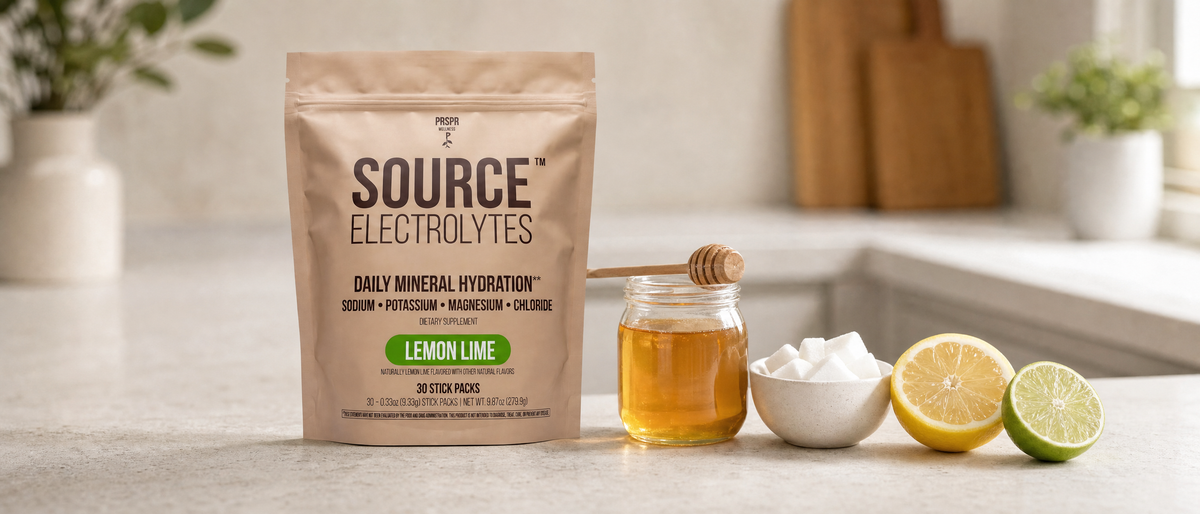
The listing for Source Electrolytes - Daily Mineral Hydration describes it as made "without added sugar." Here is what the listing and label state:
It is made in a GMP-certified facility and third-party batch tested. Now you know exactly what that phrase on its listing covers. You can see it alongside the rest of our range in Vitamins & Supplements.
See the Source Electrolytes - Daily Mineral Hydration at PRSPR
Under 21 CFR 101.9(c)(6)(iii), added sugars are sugars added during the processing of foods or packaged as such, including sugars from syrups, honey, and certain concentrated juices. The FDA notes that naturally occurring sugars in milk, fruits, and vegetables are not added sugars.
When honey is added to a food, yes: 21 CFR 101.9(c)(6)(iii) names sugars from honey as added sugars. Per FDA guidance from June 18, 2019, a single-ingredient jar of pure honey does not have to list added sugar grams but must still show the percent Daily Value for added sugars.
Per 21 CFR 101.60(c)(2), it means no sugars or sugar-containing ingredients were added during processing or packaging, among other conditions. It does not mean the product has zero total sugars.
Answer all five questions to unlock a clear wellness plan made around your goal, schedule, preferred supplement format, and biggest roadblock.
Get clarity on what matters most right now.
See the product and routine connected to your goal.
Simple next steps you can use right away.
Pick the one you would fix first if you could.
This helps us make the guide easier to follow.
Consistency beats the “perfect” routine you never follow.
Be honest. We’re building something you’ll actually use.
Your guide will include one simple way around it.
Answer two more questions to unlock your product starting point, five-step plan, two-week routine, and one practical tip for your biggest roadblock.
Enter your details to open your five-step plan.
Verified PRSPR customer reviews
Expires when you close this page
*Your personal credit for completing the quiz. It's applied automatically at checkout on one-time purchases and expires when the timer runs out.
View full product detailsEverything in your plan, together — one add to cart.
Expires when you close this page
*Your personal credit for completing the quiz. It's applied automatically at checkout on one-time purchases and expires when the timer runs out.
View full product details Botany
You pick up a fallen leaf on a walk, or you read a product label that says a botanical comes from a leaf, and you realize you do not have the words...
 Food Science
You are fine, you just ate, and then one specific food lands in your head and will not leave. Not food in general. That food. Researchers have a na...
 Fitness Terms
You have heard it from a coach, a gym sign-up form, a friend who just bought a set of dumbbells. Strength training. Resistance training. Hypertroph...