
◎
Get clear
Get clarity on what matters most right now.

What is stevia? You see the word on coffee shop counters, in ingredient lists and at the very end of supplement labels, usually with no explanation attached. Sometimes it says "stevia," sometimes "stevia leaf extract," sometimes "steviol glycosides." Those are three different phrases, and they do not mean quite the same thing.
Plenty of people are asking right now. According to Google Trends, for US searches over the past seven days related to the seed term "stevia," the top related queries included "is stevia" at 100, "what is stevia" at 30, "stevia extract" at 23, "stevia sweetener" at 22, "stevia leaf" at 21, "is stevia sugar" at 21, "stevia leaf extract" at 13 and "organic stevia" at 8. Among rising queries, "stivia" was up 350% and "organic stevia leaf extract" was up 60%.
A quick note on those numbers. Google Trends scores are relative within each seed term: 100 marks the most searched query in that set, and the others are scaled against it. They are not search counts. A rising percentage measures growth in interest, not volume.
That jump in "stivia" is worth a smile. It is the most common misspelling of the word, and it tells you people are typing it fast, straight off a label. So this piece is about the label words: the plant, the name, the extract, and the chemistry vocabulary behind "is stevia sugar." Every fact comes with its source.
Start with the plant. Dictionary.com defines stevia first as "a South American perennial shrub, Stevia rebaudiana, having small, white flowers and sweet-tasting leaves." The FDA, in its consumer page on sweeteners in food, describes Stevia rebaudiana (Bertoni) Bertoni as "a plant native to parts of South America and commonly known as Stevia."
Where does it sit on the family tree? The NCBI Taxonomy database at the National Library of Medicine places Stevia rebaudiana in the order Asterales and the family Asteraceae. The Integrated Taxonomic Information System (ITIS), a US federal reference, lists that family under the common name "sunflowers," and it lists Stevia rebaudiana (Bertoni) Bertoni as an accepted name with the common name "candyleaf." Plant names on labels often hide a story like this; our piece on which coneflower is echinacea untangles another one, for the echinacea named in the same formula we discuss below.
The name itself has a history. According to Dictionary.com, the genus name comes through New Latin "from the name of Petrus Jacobus Stevus (Pedro Jaime Esteve), died 1555, Spanish physician and botanist." So "stevia" honors a person, not a taste. That also explains the spelling: it is "Stev-," after Stevus, which is why "stivia" is a misspelling and not a variant.
Dictionary.com also gives a second sense of the word: a powdered sweetener made from extracts of the shrub's leaves. That double meaning is the root of most confusion. "Stevia" can mean the living plant, or it can mean a product made from it. The label usually tells you which.
A stevia leaf is the leaf: the green, whole plant part. A stevia leaf extract is something taken out of the leaf. The difference is the same as the difference between a tea leaf and the tea you pour.
The Joint FAO/WHO Expert Committee on Food Additives (JECFA), which writes international specifications for food additives, describes one way the sweet part is pulled out. In its 2007 specification for steviol glycosides (FAO JECFA Monographs 4), JECFA writes that "The leaves are extracted with hot water and the aqueous extract is passed through an adsorption resin to trap and concentrate the component steviol glycosides." The same text says the resin is then washed with methanol to release the glycosides, and the product is recrystallized.
So "extract" is a process word. It tells you the ingredient was drawn out of the leaf rather than left as ground leaf. It does not, on its own, tell you how far the process went. The FDA's sweeteners page draws that line in its own vocabulary: it separates "stevia leaf and crude stevia extracts" from what it calls "high purity (95% minimum purity) steviol glycosides." Same plant, different points along the extraction path.
That is why "stevia extract," "stevia leaf extract" and "steviol glycosides" can all show up on labels. They are related words for things made from one plant, and each one tells you something slightly different about form.
Here is the label vocabulary in one place, with where each term comes from.
| Label phrase | What the words describe | Source |
|---|---|---|
| Stevia | The plant Stevia rebaudiana, or a sweetener made from its leaves | Dictionary.com |
| Stevia leaf | The leaf of that plant | Dictionary.com, FDA |
| Stevia leaf extract | Material extracted from the leaves | JECFA 2007 |
| Steviol glycosides | The sweet compounds in the leaves, named as a group | FDA, JECFA 2007 |
| Stevioside, rebaudioside A (Reb A) | Individual steviol glycosides | FDA, JECFA 2007 |
| INS 960 | The international numbering code for steviol glycosides | JECFA 2007 |
The FDA says steviol glycosides "are natural constituents of the leaves" of the plant, and it names rebaudioside A ("also known as Reb A"), stevioside and rebaudioside D among them. JECFA's 2007 specification says "Stevioside and rebaudioside A are the component glycosides of principal interest for their sweetening property," and it lists the INS number, 960, as a synonym for the group.
Why does stevia show up in such small amounts on so many labels? The intensity is the reason. According to the FDA, steviol glycosides "are reported to be 200 to 400 times sweeter than table sugar." A little goes a long way, which is why it often sits near the end of an ingredient list.
One more naming point. Stevia comes from a plant, so it does not belong on a list of synthetic sweeteners. Our separate guide to what counts as an artificial sweetener covers that other vocabulary.
This is the bridge question, and it has a straight vocabulary answer. Botanically, stevia is a plant in the family Asteraceae, per NCBI Taxonomy. The FDA's sweeteners page uses "table sugar (sucrose)" as its reference point. Stevia is not sucrose. It is a different plant and a different set of compounds.
The chemistry is where it gets interesting, and where the confusion comes from. The sweet compounds are called steviol glycosides. Dictionary.com defines a glycoside as "any of the class of compounds that yield a sugar and an aglycon upon hydrolysis." In plain terms, a glycoside is a molecule with a sugar part attached to a non-sugar part. For this group, the non-sugar part is steviol, which is where the name "steviol glycosides" comes from.
You can see the sugar parts in the formal names. The chemical names JECFA prints for stevioside and rebaudioside A repeat the word "glucopyranosyl" several times, and JECFA gives their formulas as C38H60O18 and C44H70O23. Those long names describe sugar units bonded onto the steviol core.
So the precise answer to "is stevia sugar" runs in two parts. Stevia is not table sugar. Its sweet compounds are glycosides, which by definition contain sugar units attached to a non-sugar core. Both statements are true at once, and that is why the question keeps getting asked.
Read the exact phrase on the label. "Stevia," "stevia leaf extract" and "steviol glycosides" are not interchangeable. One names a plant, one names a process applied to that plant, and one names the chemistry.
When you see "organic stevia leaf extract," read it word by word. "Organic" is a word about how the plant source was produced. "Stevia leaf" names the plant part. "Extract" tells you something was drawn out of it. That is what the phrase says, and that is all it says.
Notice what the phrase does not tell you. It does not give you an amount, a purity figure or a method. If you want those details, they live on a spec sheet or with the maker, not in the ingredient name.
And if a question about your own body comes up while you read, that one belongs with a clinician.
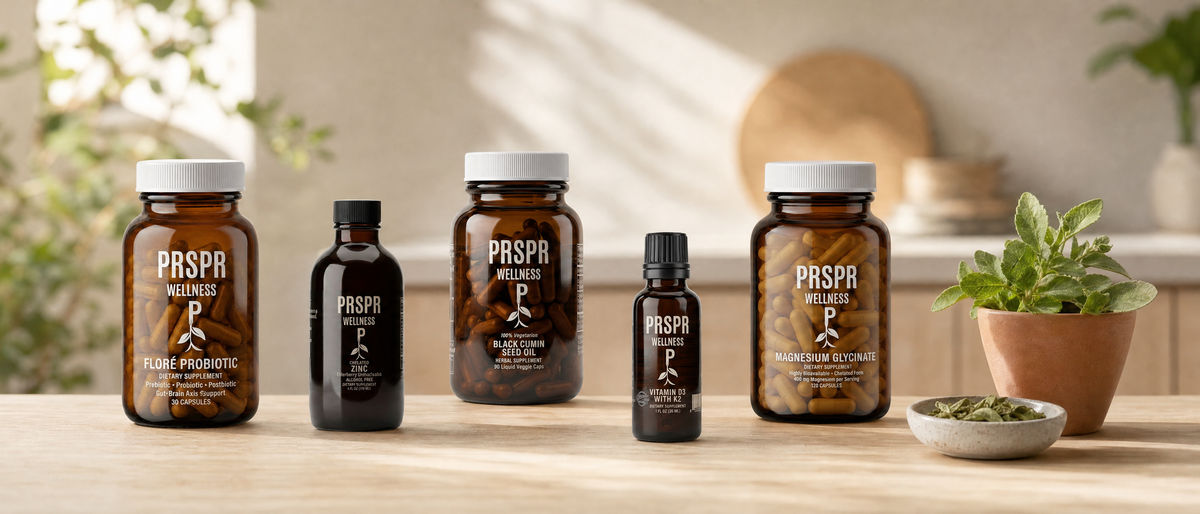
This piece started with a line on our own shelf. Our Women’s Daily Essentials Bundle brings together five products: FLORÉ Probiotic, Black Seed Oil 1000 mg, Vitamin D3 + K2, Magnesium Glycinate and Chelated Zinc + Elderberry. The listing's ingredient overview for the zinc formula reads: "Zinc as glycinate chelate, organic elderberry fruit, umckaloabo root, organic echinacea angustifolia root, and organic stevia leaf extract." Stevia is the last word in that line, and now you know what each part of the phrase means. If elderberry is the name you want next, start with our plain-English explainer on what elderberry is.
Like everything we carry, it is made in a GMP-certified facility and third-party batch tested, so what's on the label is what's in the bottle. It sits in our Bundles collection, listed at $184.99.
If you want to read each product's ingredient line for yourself, see the Women’s Daily Essentials Bundle at PRSPR.
Dictionary.com defines stevia as "a South American perennial shrub, Stevia rebaudiana, having small, white flowers and sweet-tasting leaves," and, in a second sense, a sweetener made from extracts of its leaves. NCBI Taxonomy places the plant in the family Asteraceae.
Not table sugar. The FDA uses "table sugar (sucrose)" as its reference, and stevia is a separate plant. Its sweet compounds are steviol glycosides, and Dictionary.com defines a glycoside as a compound that yields "a sugar and an aglycon upon hydrolysis."
It is material drawn out of stevia leaves. JECFA's 2007 specification describes leaves "extracted with hot water," with the steviol glycosides then trapped and concentrated on a resin.
The leaf is the whole plant part. An extract is what has been pulled out of it. The FDA's sweeteners page treats "stevia leaf and crude stevia extracts" and "high purity (95% minimum purity) steviol glycosides" as distinct forms.
S-T-E-V-I-A. "Stivia" is a common misspelling. According to Dictionary.com, the name comes from Petrus Jacobus Stevus (Pedro Jaime Esteve), a Spanish physician and botanist who died in 1555.
Answer all five questions to unlock a clear wellness plan made around your goal, schedule, preferred supplement format, and biggest roadblock.
Get clarity on what matters most right now.
See the product and routine connected to your goal.
Simple next steps you can use right away.
Pick the one you would fix first if you could.
This helps us make the guide easier to follow.
Consistency beats the “perfect” routine you never follow.
Be honest. We’re building something you’ll actually use.
Your guide will include one simple way around it.
Answer two more questions to unlock your product starting point, five-step plan, two-week routine, and one practical tip for your biggest roadblock.
Enter your details to open your five-step plan.
Verified PRSPR customer reviews
Expires when you close this page
*Your personal credit for completing the quiz. It's applied automatically at checkout on one-time purchases and expires when the timer runs out.
View full product detailsEverything in your plan, together — one add to cart.
Expires when you close this page
*Your personal credit for completing the quiz. It's applied automatically at checkout on one-time purchases and expires when the timer runs out.
View full product details Botany
You read "geranium" on a plant tag at a garden center, then read it again on an ingredient label, and the two plants look nothing alike. One is a b...
 Anatomy
You reach for a cup, stand up from a chair, or take a breath without thinking about it. Each of those moments runs on the muscular system, and if y...
 Botany
You run a hand over a green carpet on a shaded rock, pick up a bag of peat moss at the garden center, or walk under oaks draped in gray Spanish mos...