
◎
Get clear
Get clarity on what matters most right now.

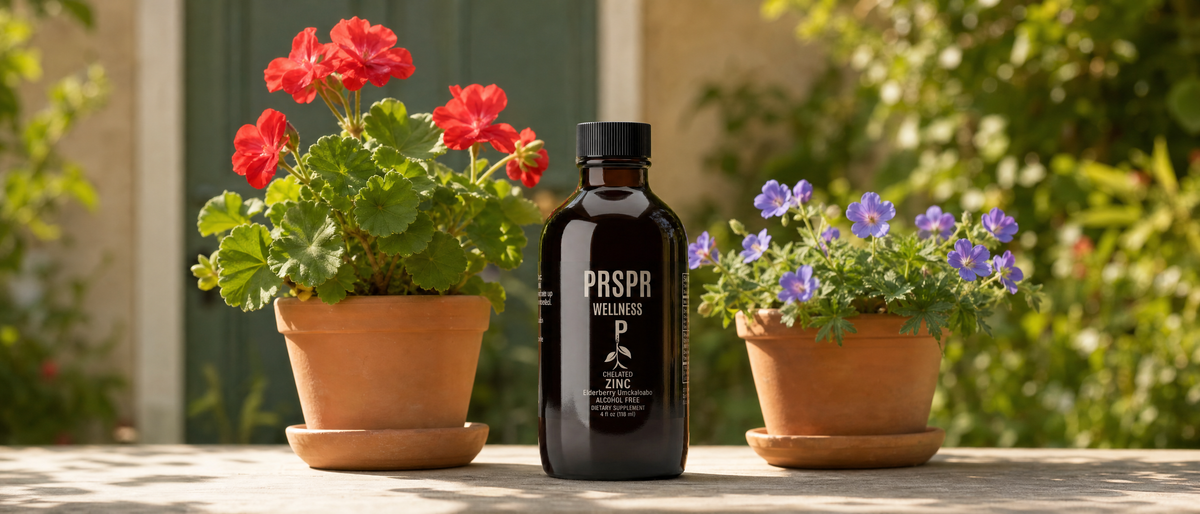
You read "geranium" on a plant tag at a garden center, then read it again on an ingredient label, and the two plants look nothing alike. One is a bright red window-box plant with round, banded leaves. The other is a low, sprawling wildflower with five even petals. So what is geranium, really? The short answer: the word names two different groups of plants, and only one of them is botanically a Geranium. This guide sorts out which is which, where the name came from, and where umckaloabo fits.
The search data says plenty of people are asking. In Google Trends data for the US over the past 7 days, top related searches for the seed term "geranium" included "what is geranium" with a score of 71, "rose geranium" (58), "wild geranium" (43), "hardy geranium" (35), "what is a geranium" (27), "perennial geranium" (23), and "cranesbill geranium" (21). Top scores are relative interest scaled so the most searched term equals 100; they are not search counts. Rising searches showed "cranes bill geranium" at Breakout, "are geraniums perennials" at +110%, and "geranium robertianum" at +90%. A rising percentage shows growth in search interest compared with the prior period, and Breakout means the growth was too large to show as a percentage.
Start with the family. Both groups belong to Geraniaceae, the geranium family. NC State Extension's Gardener Plant Toolbox places wild geranium in Geraniaceae and states plainly that pelargoniums are members of the geranium family too. Close relatives, same family, different genera.
The first genus is Geranium. These are the true geraniums, also called cranesbills or hardy geraniums. The second genus is Pelargonium. These are the plants most Americans picture when they hear "geranium": the zonal bedding plants, the trailing ivy-leaf types, and the scented-leaved kinds such as rose geranium.
So if you ask "what is a geranium," you get two honest answers. Botanically, it is any plant in the genus Geranium. In everyday speech, it is very often a Pelargonium. The Royal Horticultural Society even refers to pelargoniums as "tender geraniums" to keep the two straight.
The genus name explains the common name. According to NC State Extension, the name Geranium comes from the Greek word geranos, meaning crane, and that is where "cranesbill" comes from. The fruit is the reason. NC State Extension notes that the beaked seed capsules of wild geranium give rise to the common name crane's bill. Whether you see it spelled "cranesbill geranium" or "cranes bill geranium," it points to the same group.
Wild geranium is Geranium maculatum. NC State Extension describes it as a woodland perennial native to eastern North America, with a native range running from southeastern Canada to the central and eastern United States. Its listed common names include cranesbill, crane's bill geranium, spotted geranium, and wild geranium.
Geranium robertianum goes by herb Robert. Washington State University's HortSense fact sheet lists it in Geraniaceae and describes deeply dissected leaves with a delicate, almost fern-like look, plus small bright pink to magenta flowers with five petals, about half an inch across. That leaf shape is one of the quickest field clues. If leaf vocabulary like "dissected" and "lobed" is new to you, our guide to the types of leaves covers how botanists describe them.
Herb Robert also proves that not every true geranium is a perennial. The same WSU fact sheet calls it a winter or spring annual that reproduces only by seed.
Wave Hill, a public garden, gives the clearest field test. Cranesbills usually have five evenly sized, uniformly colored petals. Pelargoniums have two upper petals and three lower ones. Look at a single flower and you can usually name the genus.
Pelargonium has its own bird in its name. NC State Extension explains that the genus name comes from the Greek word pelargos, meaning stork, because the elongated fruit capsule has a beak resembling a stork's. The University of Oxford Botanic Garden's Plants 400 profile says the same thing. Crane for one genus, stork for the other. Both names describe a beak-shaped fruit.
Where do they come from? NC State Extension lists origins in Africa, Madagascar, the Arabian Peninsula, and Australia, and says most species are endemic to South Africa. Wave Hill places the scented kinds in southern Africa.
NC State Extension names the main garden groups:
Rose geranium is a pelargonium, not a true geranium. Wave Hill describes Pelargonium graveolens as the true rose-scented species, known for its rose-like scent and often used as a parent when breeding new cultivars. "Rose" names the scent of the leaves; "geranium" is the old label.
It depends on which genus you mean.
Hardy geraniums (genus Geranium): mostly yes. The RHS describes hardy geraniums as robust plants grown like other perennials, and notes that most geraniums are hardy apart from two island species, Geranium maderense and Geranium palmatum. "Hardy" here means the plant can take winter cold outdoors and return. A perennial geranium, in garden terms, is usually one of these. Wild geranium fits, per NC State Extension. Herb Robert is the exception, an annual by WSU's account.
Pelargoniums: technically perennial, but tender. The RHS calls them evergreen half-hardy perennials or shrubs that survive drought but not frost, and says you can simply grow them as annuals. NC State Extension describes them as annuals, tender perennials often grown as annuals, shrubs, or tuberous plants.
| Feature | Geranium | Pelargonium |
|---|---|---|
| Common names | Cranesbill, hardy geranium, wild geranium, herb Robert | Zonal, ivy-leaved, scented-leaved, rose geranium |
| Name root | Greek geranos, crane | Greek pelargos, stork |
| Flower | Usually five even petals | Two upper petals, three lower |
| Cold | Mostly hardy perennials | Tender; no frost; often grown as annuals |
| Where most species come from | Wild geranium: eastern North America | Most species: South Africa |
Sources: NC State Extension Gardener Plant Toolbox, the Royal Horticultural Society, Wave Hill, and Washington State University HortSense.
The mix-up started with Linnaeus. The University of Oxford Botanic Garden's Plants 400 profile says pelargoniums were originally included in the genus Geranium by Carolus Linnaeus. The International Plant Names Index shows what that looked like: Geranium alchemilloides was published in Linnaeus's Species Plantarum on 1 May 1753, and the same plant was later renamed Pelargonium alchemilloides by L'Héritier in 1789.
The split itself has a longer story. The Oxford profile credits Johann Jacob Dillenius, Oxford's first Sherardian Professor of Botany, with first proposing the separation and the name Pelargonium in 1732. Then, in 1789, the French botanist Charles L'Héritier separated the two genera. That is the division botanists still use.
Gardeners never fully caught up. The Oxford profile notes that pelargonium species had been grown in European gardens since the early seventeenth century, long before the split. By the time the scientific name changed, the everyday name "geranium" had already stuck. That is why the word on a plant tag and the word in a botany key can point to different genera.
Umckaloabo is a common name for Pelargonium sidoides. The Stellenbosch University Botanical Garden in South Africa lists the species in Geraniaceae, with common names that include umckaloabo, kalwerbossie, South African geranium, and fancy-leaf geranium. It records the native range as South Africa and Lesotho, and describes it as a herbaceous perennial of dry, stony places in short grassland.
So umckaloabo is a pelargonium. In everyday language it is one more plant called a "geranium" that is not in the genus Geranium. Its root is the part named on our label.
We think common names are useful and also slippery. "Geranium" proves it. One word covers a North American woodland wildflower, an annual with fern-like leaves, a red window-box plant, and a South African root. The scientific name is the fix.
We like this rule of thumb: when a label or a search says "geranium," ask which genus. If the answer is Geranium, think cranesbill, crane, five even petals, mostly hardy. If the answer is Pelargonium, think stork, two-and-three petals, tender, mostly South African. You will rarely mix them up again.
We hold every ingredient name to that standard, including echinacea, which our post on which coneflower is echinacea covers.
This article sits alongside Elderberry w/ Zinc in our Learn library. It is about how geraniums and pelargoniums got their names, nothing more. Here is what the listing states about the product itself:
It is made in a GMP-certified facility and third-party batch tested. You can find it with the rest of our range in the Vitamins & Supplements collection.
See Elderberry w/ Zinc at PRSPR
Botanically, Geranium is a genus in the family Geraniaceae, the true geraniums or cranesbills. In everyday speech, "geranium" often means a Pelargonium, a related genus in the same family.
Yes, both names refer to the genus Geranium. NC State Extension ties "cranesbill" to the beaked seed capsule and the Greek geranos, crane. The RHS uses "hardy geranium" for the same group.
Most true geraniums are hardy perennials, according to the RHS, though herb Robert is an annual per Washington State University. Pelargoniums are tender perennials that the RHS says can be grown as annuals because they do not survive frost.
No. Wave Hill identifies the true rose-scented geranium as Pelargonium graveolens, a scented-leaved pelargonium from southern Africa.
The University of Oxford Botanic Garden says Dillenius first proposed the split in 1732 and Charles L'Héritier separated the genera in 1789. Linnaeus had grouped them together in Geranium in his 1753 Species Plantarum, as records in the International Plant Names Index show.
Answer all five questions to unlock a clear wellness plan made around your goal, schedule, preferred supplement format, and biggest roadblock.
Get clarity on what matters most right now.
See the product and routine connected to your goal.
Simple next steps you can use right away.
Pick the one you would fix first if you could.
This helps us make the guide easier to follow.
Consistency beats the “perfect” routine you never follow.
Be honest. We’re building something you’ll actually use.
Your guide will include one simple way around it.
Answer two more questions to unlock your product starting point, five-step plan, two-week routine, and one practical tip for your biggest roadblock.
Enter your details to open your five-step plan.
Verified PRSPR customer reviews
Expires when you close this page
*Your personal credit for completing the quiz. It's applied automatically at checkout on one-time purchases and expires when the timer runs out.
View full product detailsEverything in your plan, together — one add to cart.
Expires when you close this page
*Your personal credit for completing the quiz. It's applied automatically at checkout on one-time purchases and expires when the timer runs out.
View full product details Anatomy
You reach for a cup, stand up from a chair, or take a breath without thinking about it. Each of those moments runs on the muscular system, and if y...
 Botany
You run a hand over a green carpet on a shaded rock, pick up a bag of peat moss at the garden center, or walk under oaks draped in gray Spanish mos...
 Parenting
It is 7:40 on a school morning. One shoe is on, the backpack is somewhere, and you have said "go brush your teeth" three times. A kids routine char...