
◎
Get clear
Get clarity on what matters most right now.

It is 7:40 on a school morning. One shoe is on, the backpack is somewhere, and you have said "go brush your teeth" three times. A kids routine chart takes the list out of your head and puts it on the wall, where your child can see what comes next without asking you. This guide shows you how to build one: picture charts versus word charts, how to break a morning or bedtime routine into small steps, and simple ways to display and update the chart as your child grows.
You are not the only one searching for this. In Google Trends data for the US over the past 7 days, the seed term "kids routine" showed two rising related searches: "morning routine chart for kids" (+70%) and "kids morning routine chart" (+60%). The top related searches were led by "kids routine chart" with a score of 100, followed by "routine chart for kids" (67), "bedtime routine for kids" (35), "kids daily routine chart" (33), and "daily routine chart for kids" (25). Top scores are relative interest scaled so the top term equals 100; they are not search counts. A rising percentage shows growth in search interest compared with the prior period, and a "Breakout" label, when one appears, means growth too large to show as a percentage. None of the terms in this cluster carried that label. The pattern is plain: parents want a chart, and mornings are the part of the day they are planning for first.
A routine chart is a short, ordered list of the steps in one part of the day, shown in a way your child can read on their own. That is it. It is not a reward system, a schedule for the whole day, or a list of rules. It answers one question: "What do I do next?"
Keep that definition tight and the rest of the decisions get easier. One chart covers one routine. A morning chart ends when your child walks out the door. A bedtime chart ends at lights out. If you try to fit the whole day on one sheet, it turns into a poster nobody reads.
A common setup is two charts: a morning routine chart for kids and a bedtime routine chart. Start with the one that feels most rushed in your house, build it well, and add the second once the first is up and in use.
The biggest design choice is whether each step is shown as a picture, a word, or both. Match it to what your child can read today, not what they will read next year.
A picture chart uses one simple image per step: a toothbrush, a shirt, a backpack, a book. Use this format when your child is not reading yet, or is just starting to sound out words. Keep the images plain. A clean drawing of a toothbrush on a white background reads faster than a busy cartoon scene.
Good sources of pictures: drawings you make together, photos of your child doing each step in your own home, or simple clip art printed from your computer.
A word chart lists the steps as short phrases: "Brush teeth." "Get dressed." "Pack bag." Use this format once your child reads comfortably. Keep each step to two to four words, start each with a verb, and use the same words you say out loud. If you always say "shoes on," write "Shoes on," not "Put on your footwear."
For early readers, combine them: a small picture on the left, the word on the right. As reading gets stronger, you can shrink the pictures or drop them entirely when you remake the chart.
This is where most charts go wrong. "Get ready for school" is not a step. It is ten steps wearing a coat. Here is how to break it down.
Involve your child in the process. Let them pick the pictures, choose the colors, or draw one of the icons. It is their chart, so let it look like theirs.
Use this as a starting point and change it to fit your house. Every family's morning looks a little different.
Notice what is missing: signing permission slips and finding the car keys. Those are your steps, not your child's. Keep every line something your child finishes.
The bedtime version works the same way. Short steps, one action each, in the real order.
"Lay out clothes for tomorrow" is a useful bridge step. It connects the bedtime chart to the morning chart, so the first few morning steps have less to search for.
Where the chart lives matters as much as what is on it. Put it where the routine happens, at your child's eye level, not yours.
Make it interactive, so each step can be marked as done. A few simple options:
Lamination or a clear sheet protector keeps a paper chart from wearing out in a bathroom.
A chart is not a one-time project. Plan to update it whenever the routine changes. Common times to revisit it:
About times: you do not have to put them on the chart at all. Order is usually enough. If you do add times, put them only on the steps that are fixed, like "out the door," rather than on every line.
We think the best routine chart is the boring one. Plain pictures, short words, the real order of your house, hung where the routine happens.
We also think the chart belongs to your child. You set the steps, but let them own the look and the check-off. Your job shifts from saying every step out loud to pointing at the wall.
And we think you should expect to remake it. Kids change fast. A chart that fit in September might be out of date by spring. Treat each new version as a sign that your child has outgrown the old one.
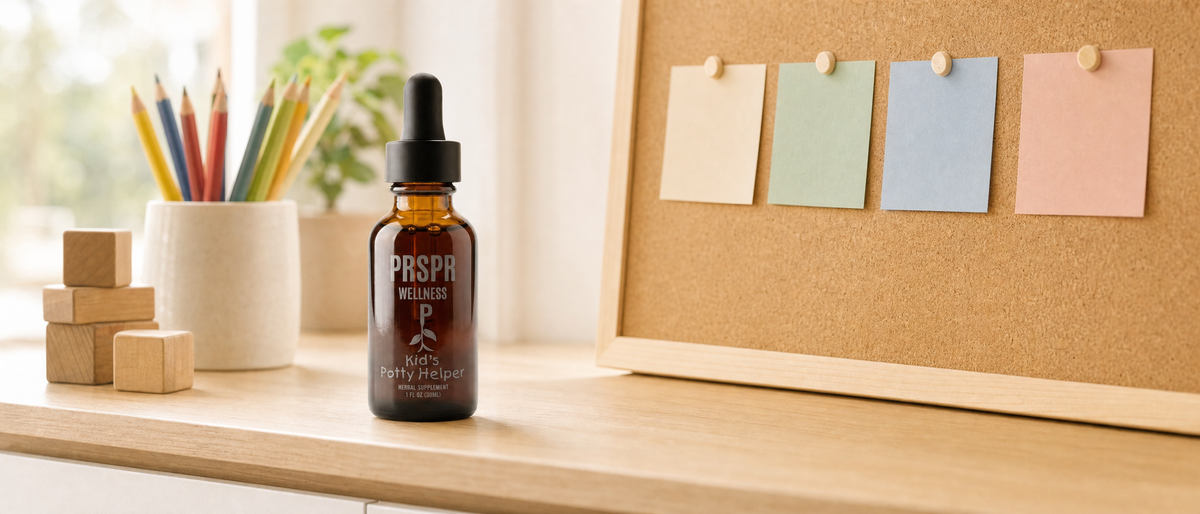
We wrote this parenting guide as part of our Learn library, and it sits alongside the Kids Potty Helper. This article is about making a routine chart for kids, nothing more. Here is what the listing states about the product itself:
If you want to know how the phrase on that label is used, our explainer on what plant-based means walks through it. It is made in a GMP-certified facility and third-party batch tested. You can see it with related products in the women's and children's health collection.
See Kids Potty Helper at PRSPR
Only the steps your child does, one action per step, in the order they actually happen. Brushing teeth, getting dressed, packing a bag, pajamas, picking a book, and lights out are common examples.
Use pictures if your child is not reading yet, words if they read comfortably, and a picture next to each word for early readers.
Keep it short enough to scan at a glance. If the list feels long, combine tiny steps and drop the ones your child no longer needs a reminder for.
Where the routine happens, at your child's eye level. A bathroom or bedroom door works for most morning and bedtime steps.
Whenever the routine changes: a new school year, a new wake-up time, a clock change, or a step your child has mastered.
Answer all five questions to unlock a clear wellness plan made around your goal, schedule, preferred supplement format, and biggest roadblock.
Get clarity on what matters most right now.
See the product and routine connected to your goal.
Simple next steps you can use right away.
Pick the one you would fix first if you could.
This helps us make the guide easier to follow.
Consistency beats the “perfect” routine you never follow.
Be honest. We’re building something you’ll actually use.
Your guide will include one simple way around it.
Answer two more questions to unlock your product starting point, five-step plan, two-week routine, and one practical tip for your biggest roadblock.
Enter your details to open your five-step plan.
Verified PRSPR customer reviews
Expires when you close this page
*Your personal credit for completing the quiz. It's applied automatically at checkout on one-time purchases and expires when the timer runs out.
View full product detailsEverything in your plan, together — one add to cart.
Expires when you close this page
*Your personal credit for completing the quiz. It's applied automatically at checkout on one-time purchases and expires when the timer runs out.
View full product details Anatomy
You see an anatomy chart on a classroom wall, a model in a doctor's office, or a diagram in a textbook: a long coiled tube packed into the middle o...
 Chemistry
You are reading a label, and the word "betaine" shows up. Maybe it is on the back of a shampoo bottle as part of a long ingredient list. Maybe it i...
 Botany
You see it in a Mediterranean travel photo: a squat, twisted trunk, silvery leaves, and a branch heavy with small green fruit. Or you see it at the...