
◎
Get clear
Get clarity on what matters most right now.

Plant-based is one of the most common words on a label and one of the least precise. People search it every week, usually without the hyphen: plant based food, plant based diet, plant based meals. On a package it reads like a definition. In the US it works more like a description: it tells you, in broad strokes, where a product's ingredients came from, and not much else. Below is where the phrase came from, what the FDA has and has not said about it, how it differs from "vegan," "vegetarian" and "plant-forward," and what a parent can actually learn from it on a label.
The searches keep coming. According to Google Trends, for US searches over the past seven days related to the seed term "plant based," the top related queries included "plant based food" at 47, "plant based diet" at 40, "plant based foods" at 25, "plant based meals" at 8 and "plant based food diet" at 7.
Those numbers are relative, not counts. Within each seed term, 100 marks the most searched related query and everything else is scaled against it. This week that top spot went to a protein-related search, which this article does not cover. A score of 47 means "plant based food" was searched a little under half as often as that leader, not that 47 people searched it. When Google Trends shows rising terms, their percentages measure growth compared with the previous period; none are used here.
This piece is label vocabulary only. The main sources are the Dictionary.com entry for "plant-based," the US Food and Drug Administration's January 2025 draft guidance "Labeling of Plant-Based Alternatives to Animal-Derived Foods," the USDA National Organic Program regulations at 7 CFR Part 205, and the 2018 Menus of Change Annual Report from The Culinary Institute of America and the Harvard T.H. Chan School of Public Health.
The word is plain English: plant, plus based, on the same pattern as "water-based" paint. What it describes depends on what it is attached to.
Dictionary.com gives two senses for the adjective. The first is about food: "relating to or being a food consisting entirely or mainly of whole or minimally processed plant parts." The second is broader, covering a medicine, fuel or similar product "made from plants or plant matter." So the same word can describe what is on a dinner plate and what is in a fuel tank.
For the origin, Dictionary.com says the term was "coined in 1980 by Thomas Colin Campbell," a US biochemist. Today the phrase does two jobs at once: it can describe a whole eating pattern, the sense people search as "plant based diet," or a single product described by its ingredients.
Notice the hedge built into the first definition: "entirely or mainly." That small "or" is the reason the word causes so much confusion. One reader hears "only plants." Another hears "mostly plants." Both are using the word the way a major dictionary describes it.
Notice, too, what the food sense says about processing: "whole or minimally processed plant parts." On a package, the word on its own does not tell you how much processing happened between the field and the bottle or box. The dictionary describes how people use the word; it does not set a standard anyone has to meet.
The clearest federal statement about the word comes from the FDA's January 2025 draft guidance, "Labeling of Plant-Based Alternatives to Animal-Derived Foods." Its scope is foods that stand in for eggs, seafood, poultry, meat and dairy, and it sets aside plant-based milk alternatives, which the agency addresses separately. Every page is marked "Contains Nonbinding Recommendations" and "Draft-Not for Implementation."
Three points in it matter for anyone reading a label.
There is no standard of identity. The draft says plant-based alternative foods are "non-standardized foods" because no definition and standard of identity has been set for them by regulation.
The word signals a source, broadly. In the FDA's words, "plant-based" or "plant" are terms that "convey to the consumer that the food is derived from plants rather than animals."
The word alone is not enough. The agency recommends naming the plant source as part of the name, with examples such as soy, lentil and walnut. It says a name like "plant-based [animal derived food]" by itself "does not help ensure" shoppers have what they need to make informed purchasing decisions. For blends, it recommends naming the primary plant sources.
Compare that with "organic." Under 7 CFR 205.300, part of the USDA National Organic Program, the term "organic" may only be used on labels of products "produced and handled in accordance with the regulations in this part." That is a defined program with requirements behind the word. The FDA draft on "plant-based" is a set of naming recommendations for one category of food.
| Label word | Where the meaning comes from (per the sources here) | What it tells you |
|---|---|---|
| Plant-based | Common usage; FDA 2025 draft guidance (nonbinding) for alternatives to animal foods | Derived from plants rather than animals, in broad terms |
| Organic | USDA National Organic Program, 7 CFR Part 205 | Produced and handled under that program's regulations |
| Vegetarian | Not currently defined in FDA regulations; common usage | No meat, fish or poultry; may contain dairy or eggs |
| Vegan | Not currently defined in FDA regulations; common usage | No animal-derived products, such as dairy or eggs |
| Plant-forward | Menus of Change (CIA and Harvard T.H. Chan School of Public Health) | A cooking style that emphasizes plant-based foods but may include animal foods |
These four words get used as if they were interchangeable. They answer different questions.
The FDA's draft notes that its regulations do not currently define "vegetarian" or "vegan," and describes the common meanings: vegetarian means no meat, fish or poultry but possibly dairy or eggs, while vegan means no animal-derived products at all. "Plant-based" sits beside them as a description of where ingredients come from, with the "entirely or mainly" ambiguity from the dictionary still attached.
"Plant-forward" is the one of the group that was defined on purpose. The 2018 Menus of Change Annual Report, from The Culinary Institute of America and the Harvard T.H. Chan School of Public Health, Department of Nutrition, says Menus of Change published its first formal definition the year before, describing a style of cooking and eating that "emphasizes and celebrates, but is not limited to, plant-based foods." The same report draws the line between the two words directly: "plant-based" refers to foods and ingredients made entirely from plants, while "plant-forward" refers to recipes, menus and concepts that may contain poultry, fish, dairy or small amounts of meat.
Put the two sources side by side and you can see the problem. The report uses "plant-based" to mean entirely plants. Dictionary.com allows "entirely or mainly." Both are reasonable, and they do not match. That is why plant based foods from two different makers can be built on two different ideas of the word.
The searches show the same split. "Plant based meals" points to the menu and recipe sense, which the Menus of Change report would often call plant-forward. A phrase like "plant based food diet" blends the ingredient sense and the eating-pattern sense into one search. Neither phrase tells you how strictly the word is being used. The only way to know is to read what is actually in the product or on the plate.
If you are standing in an aisle with a product for your child, here is what the word does and does not settle.
What it tells you: by the FDA's own description, that the ingredients are derived from plants rather than animals, in a broad sense.
What it does not tell you:
The practical move is simple. Treat "plant-based" as a starting point, then read the ingredient list and the rest of the label for the details the word leaves out. If a plant source matters to you and the package does not name it, ask the seller.
We like this question because the word looks more official than it is. "Plant-based" has a dictionary origin in 1980, and the firmest federal word on it is a nonbinding draft that tells food makers to name their plants. Compare that with "organic," which may only go on products that meet the National Organic Program's regulations. "Plant-based" is a useful first signal and a poor final answer.
If you want the neighboring words sorted out, our guide to what vegan and vegetarian mean on a label covers those two in full. For another sourcing word that often sits next to "plant-based," read what non-GMO means. And for the label term that does come with a federal program behind it, see what USDA Organic means.
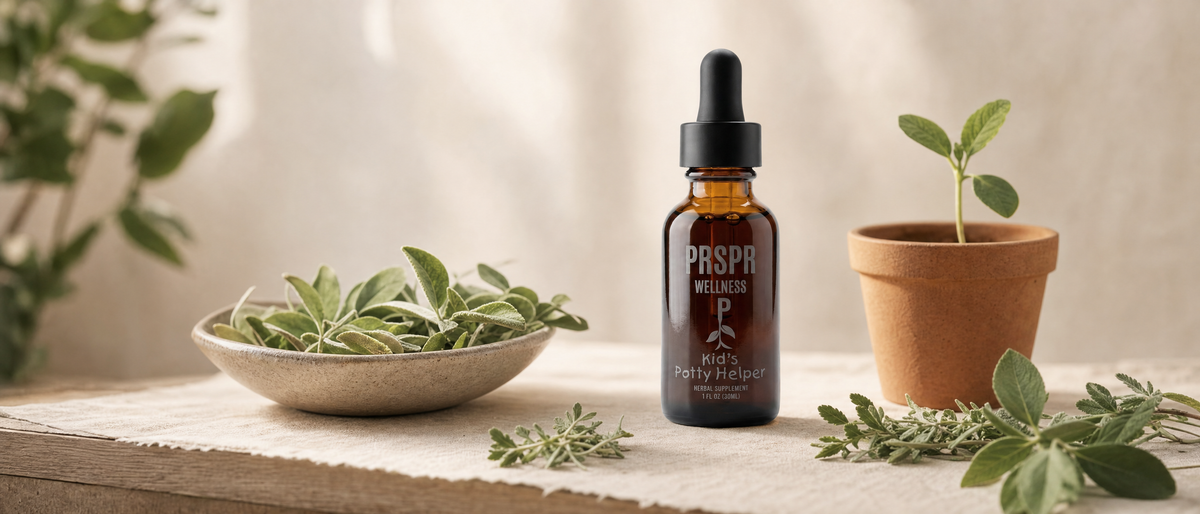
This piece connects to our Kids Potty Helper through one word. It is a dietary supplement, labeled as an herbal supplement, in a 1 fl oz (30 mL) amber glass dropper bottle. Its listing describes it as made with a blend of plant-based ingredients and designed for children. This article is about that label word, not the formula.
Like everything we carry, it is made in a GMP-certified facility and third-party batch tested, so what's on the label is what's in the bottle. It sits in our Women & Children's Health collection, listed at $24.99.
To read the full label, see Kids Potty Helper at PRSPR.
Answer all five questions to unlock a clear wellness plan made around your goal, schedule, preferred supplement format, and biggest roadblock.
Get clarity on what matters most right now.
See the product and routine connected to your goal.
Simple next steps you can use right away.
Pick the one you would fix first if you could.
This helps us make the guide easier to follow.
Consistency beats the “perfect” routine you never follow.
Be honest. We’re building something you’ll actually use.
Your guide will include one simple way around it.
Answer two more questions to unlock your product starting point, five-step plan, two-week routine, and one practical tip for your biggest roadblock.
Enter your details to open your five-step plan.
Verified PRSPR customer reviews
Expires when you close this page
*Your personal credit for completing the quiz. It's applied automatically at checkout on one-time purchases and expires when the timer runs out.
View full product detailsEverything in your plan, together — one add to cart.
Expires when you close this page
*Your personal credit for completing the quiz. It's applied automatically at checkout on one-time purchases and expires when the timer runs out.
View full product details Anatomy
You see an anatomy chart on a classroom wall, a model in a doctor's office, or a diagram in a textbook: a long coiled tube packed into the middle o...
 Chemistry
You are reading a label, and the word "betaine" shows up. Maybe it is on the back of a shampoo bottle as part of a long ingredient list. Maybe it i...
 Botany
You see it in a Mediterranean travel photo: a squat, twisted trunk, silvery leaves, and a branch heavy with small green fruit. Or you see it at the...