
◎
Get clear
Get clarity on what matters most right now.

What does USDA organic mean? It is one of those label phrases most people have seen thousands of times and almost nobody has read the rulebook for. This week a lot of people went looking. So here is a plain answer, built only from what the US Department of Agriculture and the federal regulations actually say.
The short version: "organic" on a US food label is not a mood or a marketing adjective. It is a defined term with a federal rule, a certification system and a seal behind it.
Here is what the search data looked like. According to Google Trends, for searches in the US over the past seven days related to the seed term "usda organic," the top related queries were "usda certified organic" at 100, "what is usda organic" at 87, "usda organic certification" at 42, "usda organic label" at 33, "usda organic standards" at 24, "usda organic logo" at 19, "what does usda organic mean" at 19, "usda organic meaning" at 12, "usda organic seal" at 12 and "usda organic certifier" at 7.
A note on those numbers. Google Trends scores are relative within the seed term, not absolute search counts. A top query scored 100 is the most searched query inside that topic, and one scored 7 is searched far less, but neither number tells you how many people searched. They show proportion, not volume.
Read as a group, the list is a vocabulary lesson in question form. What is it. Who certifies it. What do the label words mean. What does the seal look like. That is the order we will take.
Start with the definition, because the regulation has one. The USDA organic regulations live in Title 7 of the Code of Federal Regulations, Part 205, and the definitions section, 7 CFR 205.2, defines "organic" as "a labeling term that refers to an agricultural product produced in accordance with the Act and the regulations in this part." The "Act" there is the Organic Foods Production Act, which the USDA's Agricultural Marketing Service names as the law that established the National Organic Program.
The USDA's own standards page puts it in similar words: "Organic is a labeling term that indicates that the food or other agricultural product has been produced through approved methods." The same page says the standards "describe the specific requirements that must be verified by a USDA-accredited certifying agent before products can be labeled USDA organic."
So the honest one-line answer to "usda organic meaning" is this: a regulated labeling term for agricultural products that were produced and handled under the federal organic rules and checked by an accredited certifier.
The National Organic Program, run by the USDA's Agricultural Marketing Service, is the office behind the term. In the Agricultural Marketing Service's words, the program "develops and enforces consistent national standards for organically produced agricultural products sold in the United States." Those USDA organic standards are split into crop, livestock and handling rules. The crop rules, per the Agricultural Marketing Service, require that land "must have had no prohibited substances applied to it for at least 3 years before the harvest of an organic crop," and the same page lists genetic engineering, ionizing radiation and sewage sludge as prohibited.
The word "certified" has a definition too. Under 7 CFR 205.2, certification is "a determination made by a certifying agent that a production or handling operation is in compliance with the Act and the regulations in this part, which is documented by a certificate of organic operation."
So when a package says "usda certified organic," the certificate is held by an operation, a farm or a handler, issued by a certifying agent. The regulation defines that agent as "any entity accredited by the Secretary as a certifying agent." The Agricultural Marketing Service describes the arrangement directly: the National Organic Program "accredits third-party organizations to certify that farms and businesses meet the national organic standards."
Every certified package names its usda organic certifier. 7 CFR 205.303(b)(2) says packaged products labeled "100 percent organic" or "organic" must, on the information panel, below the handler or distributor, carry a statement such as "Certified organic by" followed by the name of the certifying agent. If you want to check a farm or business, the National Organic Program links its public lookup, the Organic Integrity Database, under the heading "Certification status" on its program page.
Per 7 CFR 205.100, any operation that produces or handles agricultural products "intended to be sold, labeled, or represented as" "100 percent organic," "organic," or "made with organic" must be certified, unless an exemption applies. The main exemption, in 7 CFR 205.101(a), covers operations whose gross agricultural income from organic sales totals $5,000 or less annually. The Agricultural Marketing Service adds that products from those noncertified operations may not display the USDA certified organic seal.
This is the part most shoppers never see spelled out. The usda organic label is not one claim. 7 CFR 205.301 sets four composition tiers, each measured "by weight or fluid volume, excluding water and salt."
For the two top tiers, 7 CFR 205.303 lets the package use the term on the front, show the percentage of organic ingredients for products labeled "organic," and display the USDA seal.
The round mark people search as the "usda organic logo" is called the "USDA seal" in the regulation, and 7 CFR 205.311 controls it. First, who may use it: 7 CFR 205.311(a) limits the seal to products in the "100 percent organic" and "organic" categories, plus certain livestock feed. The "made with" tier cannot carry it.
Second, what it looks like. Per 7 CFR 205.311(b), the color version sits on a white background with a brown outer circle, the term "USDA" in green over a white upper semicircle, and the term "organic" in white over the green lower half circle. A black version on a white or transparent background is also allowed. The rule even permits four light lines across the lower half "to resemble a cultivated field." The Agricultural Marketing Service lists the colors as Pantone 348 green and Pantone 175 brown, and says the USDA has trademarked the seal, so the usda organic seal may appear with or without the registration symbol.
We think the reason "what is usda organic" sits so high on this list is that the word does a lot of quiet work on a package and almost nobody was shown the tiers. "Organic," "100 percent organic" and "made with organic" look like the same phrase in different fonts. Under 7 CFR 205.301 they are three different thresholds.
So here is how we read a package. Find the exact words on the front panel and match them to a tier. Look for the seal, and remember 7 CFR 205.311 keeps it off the "made with" tier. Then find the "Certified organic by" line on the information panel and, if you are curious, look that operation up.
That is the same reason we keep writing vocabulary pieces like what non-GMO means on a label. Label words carry exact meanings. This piece covers the vocabulary only.
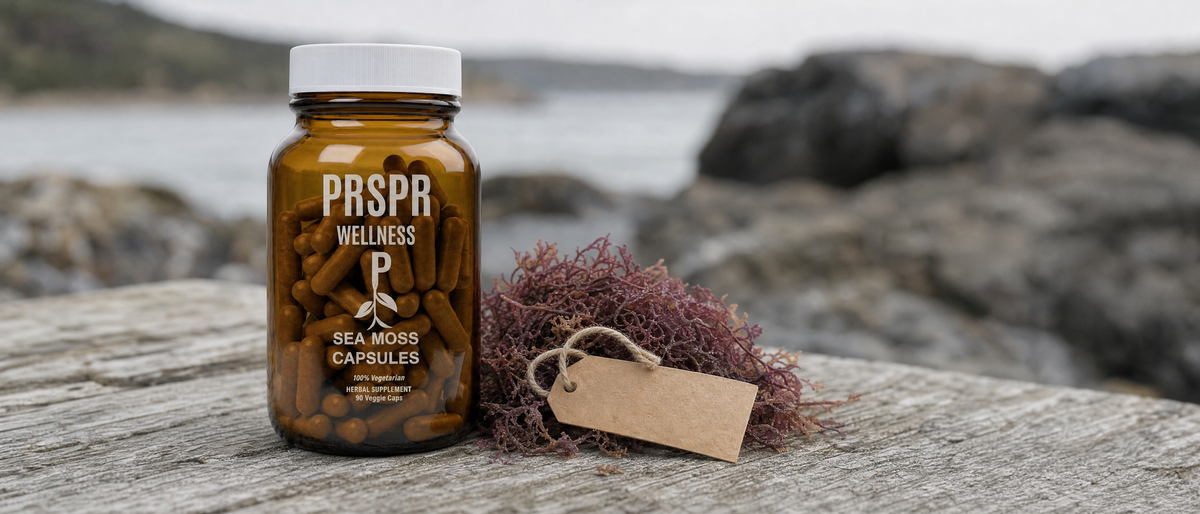
This post comes out of our sea moss vocabulary series. Seamoss Capsules: Irish Moss Superfood is a dietary supplement, and its listing describes it as made with organic Irish moss (Chondrus crispus). We have already covered the seaweed itself in why Irish moss and sea moss are the same seaweed, and the questions people ask most in our organic Irish sea moss FAQ. The word "organic" in that listing is what sent us to the rulebook for this one.
Seamoss Capsules are listed at $44.99. Like everything we carry, they are made in a GMP-certified facility and third-party batch tested, so what's on the label is what's in the bottle. You can see them alongside the rest of the range in our Vitamins & Supplements collection.
If you want to read the full listing for yourself, see Seamoss Capsules: Irish Moss Superfood at PRSPR.
Under 7 CFR 205.2, "organic" is a labeling term for an agricultural product produced in accordance with the Organic Foods Production Act and the USDA organic regulations in 7 CFR Part 205.
It is the federal organic labeling system run by the National Organic Program at the USDA's Agricultural Marketing Service, which sets the standards and accredits the certifiers who check farms and businesses.
No. The Agricultural Marketing Service says the "made with organic" front panel must not include the USDA organic seal anywhere, and 7 CFR 205.311(a) limits the seal to the "100 percent organic" and "organic" categories and certain livestock feed.
Answer all five questions to unlock a clear wellness plan made around your goal, schedule, preferred supplement format, and biggest roadblock.
Get clarity on what matters most right now.
See the product and routine connected to your goal.
Simple next steps you can use right away.
Pick the one you would fix first if you could.
This helps us make the guide easier to follow.
Consistency beats the “perfect” routine you never follow.
Be honest. We’re building something you’ll actually use.
Your guide will include one simple way around it.
Answer two more questions to unlock your product starting point, five-step plan, two-week routine, and one practical tip for your biggest roadblock.
Enter your details to open your five-step plan.
Verified PRSPR customer reviews
Expires when you close this page
*Your personal credit for completing the quiz. It's applied automatically at checkout on one-time purchases and expires when the timer runs out.
View full product detailsEverything in your plan, together — one add to cart.
Expires when you close this page
*Your personal credit for completing the quiz. It's applied automatically at checkout on one-time purchases and expires when the timer runs out.
View full product details Mind vocabulary
What is cognition? You have probably seen the word "cognitive" printed on a label, in a headline, or in a product name, and kept scrolling. It is o...
 Biology vocabulary
What is metabolism? You see the word on labels, in gym talk and in nutrition headlines, almost always used as if it were a single setting. Read eno...
 Sleep vocabulary
What are sleep cycles? You hear the phrase on podcasts, see it on sleep trackers, and read it in articles that assume you already know what it mean...