
◎
Get clear
Get clarity on what matters most right now.

"What is vegetarian" sounds like a question with an obvious answer until you are standing in a kitchen, a restaurant line or a supplement aisle and the word shows up next to "vegan." The two labels overlap, but they are not interchangeable. If you have ever wondered what "100% Vegetarian" or "veggie caps" on a bottle actually tells you, read on.
Plenty of people are looking it up. According to Google Trends, for US searches over the past seven days related to the seed term "vegetarian," the top related queries included "what is vegetarian" at 54, "what is a vegetarian" at 23 and "vegetarian diet" at 23. Among rising queries, "do vegetarians eat eggs" was up 40%. For the seed term "vegan," the top related queries included "what is vegan" at 54, "what is a vegan" at 18 and "vegan diet" at 15.
A quick note on those numbers. Google Trends scores are relative within each seed term: 100 marks the most searched query in that set, and the others are scaled against it. They are not search counts. A rising percentage measures growth in interest, not volume.
This piece sticks to vocabulary: what each word means, where it came from, the in-between labels you will run into, and how those words get applied to a capsule. Every definition comes with its source.
Start with the dictionary. Dictionary.com defines a vegetarian as a person who does not eat, or does not believe in eating, meat, fish or fowl. Its entry adds that some vegetarians also avoid foods that come from animals, such as eggs or cheese. That second clause is where the confusion starts: the core is meat, fish and poultry, and the rest varies by person.
The Vegetarian Society, the UK charity, keeps its own starting point just as short. Its guidance for new vegetarians is to stop eating meat, fish and chicken. According to the Society's history page, it was formed on 30 September 1847 in Ramsgate.
Dictionary.com says "vegetarian" was first recorded in the 1835 to 1845 window, built from "veget(able)" plus the suffix "-arian." The Vegetarian Society's history page narrows that down: it says the first known printed use appeared in an 1842 edition of the Healthian Journal, and notes that the way it was used suggests readers already knew the term.
So when someone asks "what is a vegetarian," the cleanest answer is the dictionary one: no meat, no fish, no poultry. Whether eggs and dairy are in or out is a second question with its own labels, covered below.
"Vegan" is the stricter word. The Vegan Society defines veganism as a philosophy and way of living that seeks to exclude, as far as is possible and practicable, all forms of exploitation of and cruelty to animals for food, clothing or any other purpose. On the food side, the Society says vegans avoid meat (including fish, shellfish and insects), plus dairy, eggs and honey.
Dictionary.com defines a vegan as a vegetarian who omits all animal products from the diet, and lists a second sense: a person who does not use any animal products, such as leather or wool.
Dictionary.com describes "vegan" as a contraction of "veg(etari)an," first recorded between 1940 and 1945. The history lines up with both societies' accounts. The Vegetarian Society's history page says that in 1944 Donald Watson proposed a separate group for members who avoided dairy and eggs, which led to the Vegan Society. The Vegan Society's own definition page dates its beginnings to 1944 and credits Donald Watson and its founding members.
So the short answer to "what is vegan" is: a vegetarian base with every other animal-derived product removed too.
Between "eats no meat" and "uses no animal products at all" sits a set of narrower terms. You will see them in any conversation about a vegetarian diet or a vegan diet.
| Label | Meat, fish, poultry | Dairy | Eggs | Source of the definition |
|---|---|---|---|---|
| Vegetarian | No | Varies | Varies | Dictionary.com |
| Lacto-ovo vegetarian | No | Yes | Yes | Dictionary.com |
| Lactovegetarian | No | Yes | Not stated | Dictionary.com |
| Vegan | No | No | No | The Vegan Society |
Dictionary.com defines a lacto-ovo vegetarian as a vegetarian whose diet includes dairy products and eggs, and lists "ovo-lacto-vegetarian" as another name for the same thing. It defines a lactovegetarian as a vegetarian whose diet includes dairy products, first recorded between 1905 and 1910.
The lacto-ovo idea is older than the label. The Vegetarian Society's history page describes Reverend William Cowherd preaching a vegetable diet in Salford in 1809 that excluded flesh but included dairy and eggs, and it calls that the ovo-lacto vegetarian diet. The same page notes that dairy and eggs were a running debate inside the Society, one that produced the 1944 split.
The practical takeaway: compared with a lactovegetarian, a lacto-ovo vegetarian adds eggs. When you see these prefixes, the label is telling you which animal-derived foods are still in.
A capsule has two parts, the fill and the shell, and the shell can decide which diet word belongs on the label.
The traditional shell material is gelatin. Dictionary.com defines gelatin as a substance obtained by boiling the ligaments, bones, skin and similar parts of animals in water, and its usage note states it plainly: gelatin isn't vegetarian. A 2017 review in the Indian Journal of Pharmacology (Prakash and colleagues, "Are your capsules vegetarian or nonvegetarian") describes gelatin as coming from the breakdown of animal collagen.
That same review sorts capsule shells by origin: gelatin shells are typically of animal origin, while shells based on HPMC (a cellulose-based material) or starch are of vegetarian origin. "Veggie cap" is the everyday shorthand for a capsule whose shell is not gelatin. The term on its own does not tell you which plant-origin material a given brand uses, so if that detail matters to you, the label or the brand is where to look.
Put the definitions side by side and the gap is obvious. "Vegetarian" rules out meat, fish and poultry. "Vegan" rules out every animal-derived product. A product can clear the first bar without anyone having checked it against the second.
The FDA uses the same common meanings. In its January 2025 draft guidance on labeling plant-based alternatives to animal-derived foods, the agency writes that FDA regulations do not currently define "vegetarian" or "vegan." It goes on to say "vegetarian" is commonly used on food labels to mean no ingredients from meat, fish or poultry, though the food may contain dairy or eggs, while "vegan" is commonly used to mean no animal-derived products at all. The document is a draft written about foods, but it shows how the words are generally read.
So read the label for what it says, not for what it might imply:
We like labels that say exactly what they mean. The dictionary and the two societies that shaped these words agree on the core: vegetarian is about meat, fish and poultry, vegan is about all animal-derived products.
When we describe a product, we use the word on the listing. If a label says vegetarian, we say vegetarian.
If you want to keep building your label vocabulary, start with our breakdown of the definitions behind "Dietary Supplement," "Supplement Facts" and "Serving Size", then read what the USDA Organic seal means and the label tiers behind it, and see why black seed, black cumin and Nigella sativa are three names for the same bottle. Questions about your own body belong with a clinician.
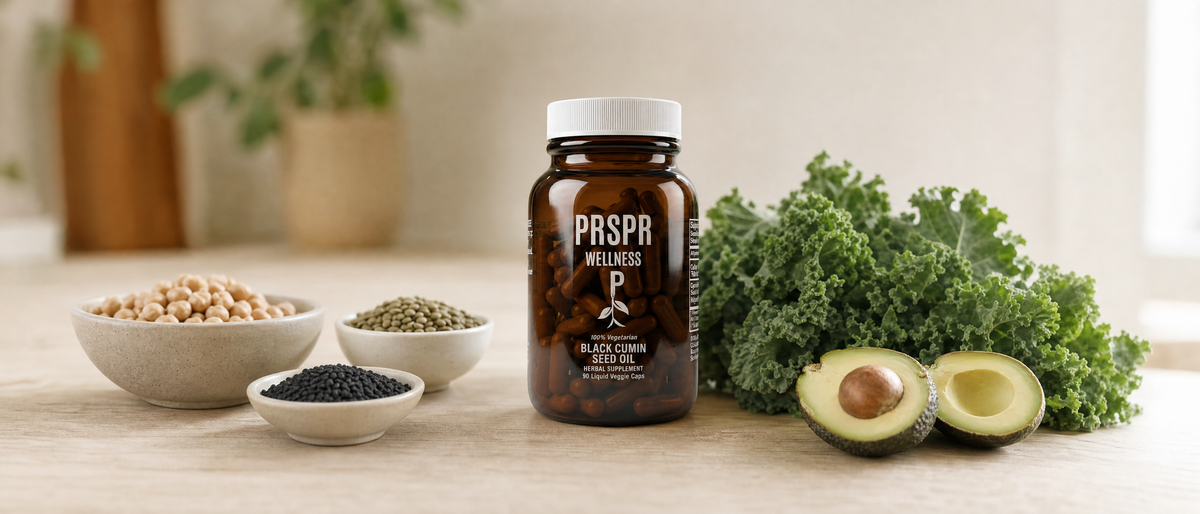
Our Black Seed oil (90 Cap) is a dietary supplement made with Nigella sativa in a vegetarian veggie-cap capsule, for convenient daily use. The label reads "Black Cumin Seed Oil," "Herbal Supplement," "100% Vegetarian" and "90 Liquid Veggie Caps," which is exactly the vocabulary this piece walks through.
Note what that label says and what it does not: it says vegetarian. If you are shopping specifically for a vegan product, read the full label and reach out to us with your question before you buy.
Like everything we carry, it is made in a GMP-certified facility and third-party batch tested, so what's on the label is what's in the bottle. It is listed at $41.99, and you can browse the rest of our Vitamins & Supplements collection alongside it.
To read the full label, see the Black Seed oil (90 Cap) at PRSPR.
Dictionary.com defines a vegetarian as a person who does not eat meat, fish or fowl; some vegetarians also avoid eggs or dairy, and some do not.
Lacto-ovo vegetarians do. The Vegetarian Society's history page describes a diet that excludes flesh but includes dairy and eggs as the ovo-lacto vegetarian diet, and Dictionary.com defines a lacto-ovo vegetarian as one whose diet includes dairy and eggs. Vegans do not: the Vegan Society lists eggs among the foods vegans avoid.
According to the Vegan Society, a vegan seeks to exclude, as far as is possible and practicable, the use of animals for food, clothing or any other purpose. On a plate, that means no meat, fish, dairy, eggs or honey.
As vocabulary: a vegetarian diet leaves out meat, fish and poultry and may include dairy and eggs, while a vegan diet leaves out every animal-derived food, according to the definitions from Dictionary.com and the Vegan Society.
Not by definition. "Veggie cap" is everyday shorthand for a shell that is not gelatin, which Dictionary.com describes as made from animal bones and tissue. Whether a whole product is vegan depends on everything in it, so check the label or ask the brand.
Answer all five questions to unlock a clear wellness plan made around your goal, schedule, preferred supplement format, and biggest roadblock.
Get clarity on what matters most right now.
See the product and routine connected to your goal.
Simple next steps you can use right away.
Pick the one you would fix first if you could.
This helps us make the guide easier to follow.
Consistency beats the “perfect” routine you never follow.
Be honest. We’re building something you’ll actually use.
Your guide will include one simple way around it.
Answer two more questions to unlock your product starting point, five-step plan, two-week routine, and one practical tip for your biggest roadblock.
Enter your details to open your five-step plan.
Verified PRSPR customer reviews
Expires when you close this page
*Your personal credit for completing the quiz. It's applied automatically at checkout on one-time purchases and expires when the timer runs out.
View full product detailsEverything in your plan, together — one add to cart.
Expires when you close this page
*Your personal credit for completing the quiz. It's applied automatically at checkout on one-time purchases and expires when the timer runs out.
View full product details Botany
You pick up a fallen leaf on a walk, or you read a product label that says a botanical comes from a leaf, and you realize you do not have the words...
 Food Science
You are fine, you just ate, and then one specific food lands in your head and will not leave. Not food in general. That food. Researchers have a na...
 Fitness Terms
You have heard it from a coach, a gym sign-up form, a friend who just bought a set of dumbbells. Strength training. Resistance training. Hypertroph...