
◎
Get clear
Get clarity on what matters most right now.

Some clocks in your house will change themselves. The oven clock, the car dashboard, and the watch in your drawer probably will not. This coming Sunday is the end of daylight saving time, and if you have been searching for the exact moment, here it is: daylight saving time 2026 ends at 2:00 a.m. local time on Sunday, November 1. At that moment, clocks fall back to 1:00 a.m. and that hour plays out a second time.
In Google Trends data for the US over the past 7 days, related searches for the seed term "daylight saving time" included "what is the status of federal efforts to make daylight saving time permanent?" (Breakout), "daylight saving time end date" (+300%), "daylight saving date" (+70%), and "daylight saving time date" (+60%) among rising terms. A rising percentage shows growth compared with the previous period, and "Breakout" means very large growth. Among top terms, "daylight saving time 2026" led with a score of 100, followed by "daylight saving time end" (66), "end of daylight saving time" (33), "daylight saving time change" (20), "what is daylight saving time" (16), and "when does daylight saving time end" (9). Top scores are relative interest, scaled so the most popular term in the set equals 100; they are not search counts.
Daylight saving time is the period of the year when clocks are set one hour ahead of standard time. The National Institute of Standards and Technology (NIST), which runs the federal time and frequency division, describes it simply: clocks move one hour ahead at the start of daylight saving time and back one hour at the end, which shifts daylight from the morning to the evening.
The two transition days are uneven. Per NIST, in spring the clock skips from 2 a.m. straight to 3 a.m., so that day has one less hour. In fall, 2 a.m. becomes 1 a.m. and the hour repeats, so that day has an extra hour.
The federal rule is written into the Uniform Time Act of 1966 at 15 U.S.C. 260a. As amended, the statute says daylight time begins at "2 o'clock antemeridian on the second Sunday of March" and ends at 2 o'clock antemeridian on the first Sunday of November.
For this year, NIST lists the daylight saving time date range as March 8, 2026 at 2 a.m. to November 1, 2026 at 2 a.m., local time. Applying the same second-Sunday rule, the next start falls on March 14, 2027.
| Event | Rule in 15 U.S.C. 260a | 2026 date (NIST) | What the clock does |
|---|---|---|---|
| Start | Second Sunday of March, 2 a.m. | Sunday, March 8 | 2:00 a.m. jumps to 3:00 a.m. |
| End | First Sunday of November, 2 a.m. | Sunday, November 1 | 2:00 a.m. falls back to 1:00 a.m. |
NIST also notes that under the current rules daylight saving time lasts 238 days, or about 65% of the year. So the daylight saving time end date is not the start of the "normal" season in any numeric sense. Standard time is now the shorter of the two.
The calendar you live with today is the result of more than a century of federal changes. The Congressional Research Service (CRS), the research arm of Congress inside the Library of Congress, traces the main steps in its report "Daylight Saving Time" (order code 98-99):
Every daylight saving time change on that list came from Congress. That pattern matters for the permanent-time debate further down.
The US Department of Transportation (DOT) oversees the nation's time zones. DOT explains that the job landed there because time standards matter to so many modes of transportation, and that the official list of time zones sits in its regulations at 49 CFR part 71.
Under the Uniform Time Act, a state can exempt itself from daylight saving time by state law. DOT is clear about the catch: if a state chooses to observe daylight saving time, it must begin and end on the federally mandated dates. The statute (15 U.S.C. 260a) spells out what an exemption means: the whole state, including its political subdivisions, stays on standard time for that period. A state that spans two time zones may exempt the entire state or only the part in one zone.
Who skips it today? NIST lists Hawaii, American Samoa, Guam, Puerto Rico, and the Virgin Islands. Arizona does not observe it either, with one exception: the Navajo Indian Reservation, which does. DOT's list also includes the Northern Mariana Islands. CRS reports that Arizona was the first state to exempt itself, in 1968.
So in most of Arizona and in Hawaii, the end of daylight saving time does not move the clock at all.
NIST and DOT both title their pages "Daylight Saving Time," singular. The statute talks about "daylight time." Yet the official title of the current House bill on the subject reads "To make daylight savings time permanent," with an s. Both forms show up even in federal documents, so either one will get you to the right answer in a search bar.
The legal phrase "2 o'clock antemeridian" is worth a second look too. Antemeridian is the long form of a.m. (before midday), and postmeridian is p.m. Breaking a word into its Latin parts is the fastest way to remember it, the same approach we use in our explainer what does sublingual mean.
The proposal most people have heard of is the Sunshine Protection Act. Here is the record, from the Government Publishing Office's GovInfo bill texts:
As of the GovInfo record we checked on October 26, 2026, that Senate referral is the latest action listed. The bill has not been enacted, which is why clocks still fall back on November 1.
What would it do? Per the GovInfo text, H.R. 139 would repeal section 3 of the Uniform Time Act of 1966 (15 U.S.C. 260a), the section that creates the seasonal switch, and adjust the standard time offsets in 15 U.S.C. 261 instead.
We think the clock debate is easier to follow once you separate three things: the rule (two Sundays a year, fixed by statute), the referee (DOT), and the proposals (bills that are not law until both chambers pass them and they are signed). Most confusion comes from mixing up a vote with a law.
We also think the primary text beats a headline. The GovInfo bill pages say plainly what passed and when.
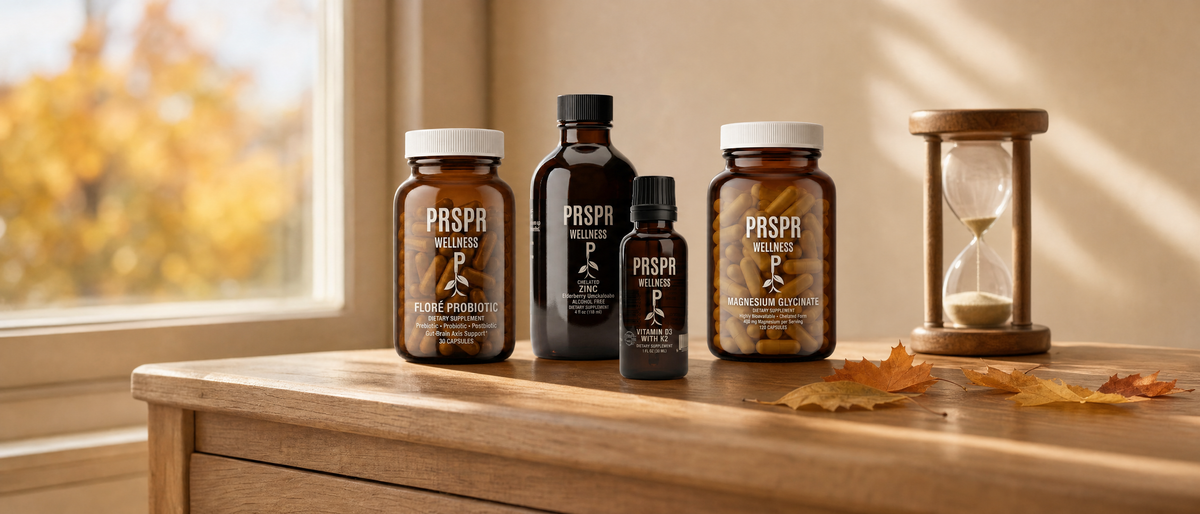
A turn of the calendar is a good occasion for a different kind of check: reading the labels in your cupboard for what they say about formats, counts, and measures. The Seasonal Wellness Stack is four separate products, each with its own label:
That is two capsule formats, one measured liquid, and one dropper bottle in a single set. If a teaspoon-based direction ever has you converting units, our guide to how many mL in a teaspoon walks through it. The stack is priced at $149.99, which the listing compares with $190.33 for the four purchased individually, a difference of $40.34. Each product is made in a GMP-certified facility and third-party batch tested. You can compare it with our other sets in Bundles.
See the Seasonal Wellness Stack at PRSPR
In 2026, daylight saving time ends at 2:00 a.m. local time on Sunday, November 1, per NIST. Under 15 U.S.C. 260a, it ends on the first Sunday of November every year.
It is the part of the year when clocks run one hour ahead of standard time. NIST describes it as moving clocks ahead one hour at the start and back one hour at the end, shifting daylight from morning to evening.
Per GovInfo, H.R. 139, the Sunshine Protection Act of 2025, passed the House on July 14, 2026 and was referred to the Senate Committee on Commerce, Science, and Transportation on July 15, 2026. It is not law; an earlier version, S. 623, passed the Senate on March 15, 2022 and was not enacted.
Answer all five questions to unlock a clear wellness plan made around your goal, schedule, preferred supplement format, and biggest roadblock.
Get clarity on what matters most right now.
See the product and routine connected to your goal.
Simple next steps you can use right away.
Pick the one you would fix first if you could.
This helps us make the guide easier to follow.
Consistency beats the “perfect” routine you never follow.
Be honest. We’re building something you’ll actually use.
Your guide will include one simple way around it.
Answer two more questions to unlock your product starting point, five-step plan, two-week routine, and one practical tip for your biggest roadblock.
Enter your details to open your five-step plan.
Verified PRSPR customer reviews
Expires when you close this page
*Your personal credit for completing the quiz. It's applied automatically at checkout on one-time purchases and expires when the timer runs out.
View full product detailsEverything in your plan, together — one add to cart.
Expires when you close this page
*Your personal credit for completing the quiz. It's applied automatically at checkout on one-time purchases and expires when the timer runs out.
View full product details Botany
You pick up a fallen leaf on a walk, or you read a product label that says a botanical comes from a leaf, and you realize you do not have the words...
 Food Science
You are fine, you just ate, and then one specific food lands in your head and will not leave. Not food in general. That food. Researchers have a na...
 Fitness Terms
You have heard it from a coach, a gym sign-up form, a friend who just bought a set of dumbbells. Strength training. Resistance training. Hypertroph...