
◎
Get clear
Get clarity on what matters most right now.

How many milliliters is 1 teaspoon? It sounds like a question with one answer, and on a food or supplement label it mostly is. In your kitchen drawer, though, the answer depends on which spoon you grab. That gap is why the question keeps getting asked.
According to Google Trends, for US searches over the past seven days related to the seed term "teaspoon," the top related queries included "teaspoon ml" at 39, "teaspoon to tablespoon" at 26 and "what is a teaspoon" at 25. Among rising queries, "is a teaspoon bigger than a tablespoon" was up 120%, "how many ml is a teaspoon of medicine" was up 90%, "half teaspoon to ml" and "1.5 teaspoon to ml" were each up 80%, "how many milliliters is 1 teaspoon" and "how many ml is 1/4 teaspoon" were each up 70%, and "what is half a teaspoon in ml" was up 60%.
A quick note on those numbers. Google Trends scores are relative within each seed term: 100 marks the most searched query in that set, and the others are scaled against it. They are not search counts. A rising percentage measures growth in interest, not volume.
So people want a number, a comparison and some fractions. This piece covers all three, plus the abbreviations and the difference between a measuring teaspoon and the spoon you stir coffee with. Every figure comes with its source.
Start with the word. Dictionary.com's first American definition of teaspoon is "a small spoon generally used to stir tea, coffee, etc." Its second is simply "a teaspoonful." Dictionary.com dates the word to 1680 to 1690, built from tea plus spoon.
The unit sense came along with the spoon. Dictionary.com's British entry calls the teaspoon "a unit of capacity used in cooking, medicine, etc," and its explanation section puts it plainly: "a teaspoon is equal to one-third of a tablespoon, or five milliliters."
That double life is the whole story. "Teaspoon" names a piece of cutlery and a measured volume, and the two do not have to match.
For labels, the U.S. Food and Drug Administration settles it. Its nutrition labeling regulation, 21 CFR 101.9, says in paragraph (b)(5)(viii): "For nutrition labeling purposes, a teaspoon means 5 milliliters (mL), a tablespoon means 15 mL, a cup means 240 mL, 1 fl oz means 30 mL, and 1 oz in weight means 28 g."
So the labeling answer to "teaspoon ml" is 5 mL, flat. The same regulation lists the teaspoon as one of the "common household measure" units a label may use, alongside cup, tablespoon, ounce and fluid ounce.
There is a second, more precise number. The National Institute of Standards and Technology (NIST), in its table of approximate conversions from US customary measures to metric, converts 1 teaspoon to 4.93 mL and 1 tablespoon to 14.79 mL. That is the customary teaspoon to two decimal places, rather than rounded to a whole number for a label.
| Source | 1 teaspoon | 1 tablespoon |
|---|---|---|
| FDA labeling (21 CFR 101.9) | 5 mL | 15 mL |
| NIST customary conversion | 4.93 mL | 14.79 mL |
The gap is under a tenth of a milliliter per teaspoon. When a label prints mL next to teaspoons, it is using the FDA's round 5.
No. It is the other way around. Dictionary.com's British entry for tablespoon defines the unit as "equal to half a fluid ounce or three teaspoons." The FDA's labeling values agree: a tablespoon means 15 mL, a teaspoon means 5 mL, and 15 divided by 5 is 3.
So the teaspoon to tablespoon conversion is three to one. Three teaspoons fill one tablespoon, and one teaspoon is a third of a tablespoon.
The tablespoon is also the younger word. Dictionary.com dates it to 1755 to 1765, from table plus spoon, and notes the serving-spoon sense came first.
The two words are easy to confuse in short form. The FDA regulation, at 21 CFR 101.9(b)(7)(iv), says that if a manufacturer uses abbreviations, "the following abbreviations shall be used: tbsp for tablespoon, tsp for teaspoon, g for gram, mL for milliliter, oz for ounce, and fl oz for fluid ounce."
NIST's conversion table writes the tablespoon as "Tbsp," with a capital T. Either way, the extra "b" is the tell. Tsp is the small one.
The FDA regulation also limits which teaspoon fractions a serving size may use. Per 21 CFR 101.9(b)(5)(i), "Teaspoons shall be expressed as 1/8, 1/4, 1/2, 3/4, 1, or 2 teaspoons." That is why quarters and halves are the fractions you meet most.
Converting them is plain arithmetic on the FDA's 5 mL labeling teaspoon. Here is the math, with NIST's 4.93 mL customary teaspoon alongside, rounded to two decimals:
| Teaspoons | FDA label (5 mL) | NIST (4.93 mL) |
|---|---|---|
| 1/4 tsp | 1.25 mL | 1.23 mL |
| 1/2 tsp | 2.5 mL | 2.47 mL |
| 3/4 tsp | 3.75 mL | 3.70 mL |
| 1 tsp | 5 mL | 4.93 mL |
| 1.5 tsp | 7.5 mL | 7.40 mL |
| 3 tsp (1 tbsp) | 15 mL | 14.79 mL |
So, by the labeling definition, the answer to "how many ml is 1/4 teaspoon" is 1.25 mL. The answer to "what is half a teaspoon in ml," or "half teaspoon to ml," is 2.5 mL. And "1.5 teaspoon to ml" works out to 7.5 mL, which is also half a tablespoon.
Here is where the two meanings of "teaspoon" split apart. A measuring teaspoon is made to hold a set volume. A spoon from the cutlery drawer is made to stir tea.
University of Utah Health's Poison Control Center says a teaspoon is supposed to be "equal to 5 milliliters (mL)," but reports that "kitchen spoons have been found to range between 1.5 mL and 9 mL." That is a spread of several milliliters between spoons that all get called teaspoons.
As a unit, the same as any labeled teaspoon: 5 mL by the FDA's labeling definition. The practical point is about the tool, not the number. The Utah Poison Control Center advises using the measuring tool that comes with the product, usually a marked syringe, dropper or cup, and says "It is best to measure liquid medicine using milliliters not teaspoons." If nothing came in the box, it suggests asking a pharmacist for one.
That is why so many liquid labels pair a spoon word with a milliliter figure. The milliliter is the number a marked device can show you exactly. Questions about what or how much to take are for your doctor or pharmacist.
Liquid supplements borrow the same household vocabulary. You will see a direction written in teaspoons, then the metric figure in brackets right after it. The bracket is the label doing the conversion for you, using the 5 mL teaspoon above.
Read it the way you would read any unit: the spoon word tells you the household measure, and the mL tells you the exact volume. The rest of the direction line, and any question about whether it fits you, belongs to the label itself and to a clinician.
We like units that mean one thing. On a label, a teaspoon is 5 mL and a tablespoon is 15 mL. Three of one make the other. That is the whole rule.
The trouble starts when the word leaves the label and lands in a drawer full of spoons that were never built to measure anything. So when a label gives you mL, use the mL, and measure with something that has markings on it.
Keep the abbreviations straight, too. Tsp is small. Tbsp has the extra letter and three times the volume.
If ounces trip you up as well, our guide to weight ounces, fluid ounces, grams and cups covers the bigger units. For the smallest one, our piece on why a dropper is a measuring instrument picks up where the teaspoon leaves off. And our explainer on "Serving Size" and the other label phrases defined in federal rules shows where these household measures sit on the panel.
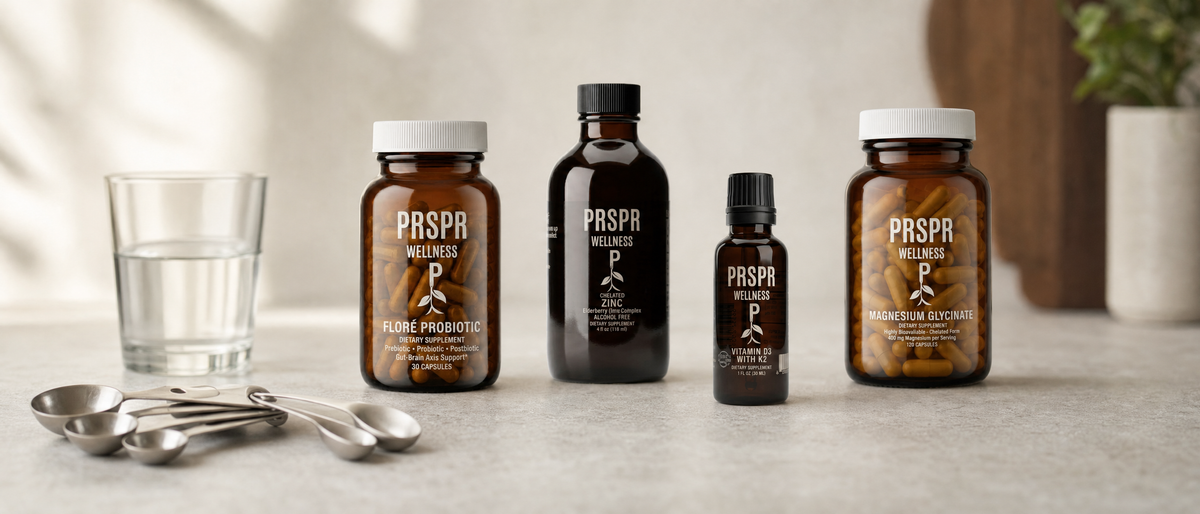
This piece started with a measurement on our own shelf. Our Seasonal Wellness Stack brings together four PRSPR products: FLORÉ Probiotic, Chelated Zinc + Elderberry, Vitamin D3 + K2 Plus MK7 and Magnesium Glycinate. The Chelated Zinc + Elderberry direction is written in "1 teaspoon (5 ml)," a household unit with its labeling milliliter figure in brackets, exactly as the FDA defines it.
Like everything we carry, it is made in a GMP-certified facility and third-party batch tested, so what's on the label is what's in the bottle. It sits in our Bundles collection, listed at $149.99.
To read the full directions for each of the four products, see the Seasonal Wellness Stack at PRSPR.
For labeling, 5 mL. The FDA's rule at 21 CFR 101.9(b)(5)(viii) says "a teaspoon means 5 milliliters (mL)." NIST converts the US customary teaspoon to 4.93 mL.
No. A tablespoon is three teaspoons. The FDA defines a tablespoon as 15 mL and a teaspoon as 5 mL for labeling.
Using the FDA's 5 mL labeling teaspoon, half a teaspoon is 2.5 mL, and a quarter teaspoon is 1.25 mL.
Under 21 CFR 101.9(b)(7)(iv), tsp is the abbreviation for teaspoon and tbsp is the abbreviation for tablespoon. NIST writes tablespoon as Tbsp.
University of Utah Health's Poison Control Center reports kitchen spoons have been found to range between 1.5 mL and 9 mL, so they do not reliably hold 5 mL. The same page advises using the marked measuring tool that comes with the product, and asking a pharmacist if one is missing.
Answer all five questions to unlock a clear wellness plan made around your goal, schedule, preferred supplement format, and biggest roadblock.
Get clarity on what matters most right now.
See the product and routine connected to your goal.
Simple next steps you can use right away.
Pick the one you would fix first if you could.
This helps us make the guide easier to follow.
Consistency beats the “perfect” routine you never follow.
Be honest. We’re building something you’ll actually use.
Your guide will include one simple way around it.
Answer two more questions to unlock your product starting point, five-step plan, two-week routine, and one practical tip for your biggest roadblock.
Enter your details to open your five-step plan.
Verified PRSPR customer reviews
Expires when you close this page
*Your personal credit for completing the quiz. It's applied automatically at checkout on one-time purchases and expires when the timer runs out.
View full product detailsEverything in your plan, together — one add to cart.
Expires when you close this page
*Your personal credit for completing the quiz. It's applied automatically at checkout on one-time purchases and expires when the timer runs out.
View full product details Botany
You read "geranium" on a plant tag at a garden center, then read it again on an ingredient label, and the two plants look nothing alike. One is a b...
 Anatomy
You reach for a cup, stand up from a chair, or take a breath without thinking about it. Each of those moments runs on the muscular system, and if y...
 Botany
You run a hand over a green carpet on a shaded rock, pick up a bag of peat moss at the garden center, or walk under oaks draped in gray Spanish mos...