
◎
Get clear
Get clarity on what matters most right now.

Coneflower echinacea: two words that get typed together constantly, as if one were simply the other's nickname. Sometimes it is. Search "coneflower" and you will meet purple ones, yellow ones, a black-eyed one and a tall green-centered one, and only some of them belong to the genus Echinacea.
That is the whole puzzle. "Coneflower" is a common name, and common names are shared freely across plants. Scientific names are not. This piece covers the vocabulary only: which coneflower carries which genus name, and where the look-alikes sit. Every naming fact below comes from a named botanical reference.
First, the search data. According to Google Trends, for US searches over the past seven days related to the seed term "coneflower," the top related queries included "purple coneflower" at 100 and "coneflower plant" at 71. "Coneflower echinacea," "yellow coneflower," "white coneflower" and "black eyed susan" each scored 17, followed by "prairie coneflower" at 12, "cutleaf coneflower" at 10 and "rudbeckia" at 9. The fastest-rising related query was "rudbeckia fulgida," up 160%.
A quick note on reading those figures. Google Trends scores are relative within the seed term: 100 marks the most-searched query in that set, and everything else is scaled against it. A rising percentage measures growth in interest, not the size of the audience. What the list shows is the shape of the confusion: most of it is people trying to work out which coneflower is which.
Every plant on this list belongs to one big family. The Lady Bird Johnson Wildflower Center's plant database files purple coneflower, black-eyed Susan, cutleaf coneflower and prairie coneflower all under Asteraceae, which it labels the Aster Family. NC State Extension calls the same family the daisy family on its purple coneflower page.
Inside that family, the plants split into different genera, and the genus is the first word of a scientific name. "Coneflower" ignores those lines completely. It describes a look, a raised center with petals around it, and that look turns up in several genera at once. So a coneflower plant could be an Echinacea, a Rudbeckia or a Ratibida, and the common name alone will not tell you which.
The scientific name will. So let's sort the coneflowers by the two-word name that settles it.
Start with the name everyone knows. The Lady Bird Johnson Wildflower Center lists Echinacea purpurea with two common names: "Eastern Purple Coneflower" and "Purple Coneflower." When people say coneflower and mean echinacea, this is usually the plant they are picturing.
The genus name has its own story. According to NC State Extension, Echinacea is Greek for "spiny one," and the species name purpurea means reddish-purple. Put together, the scientific name reads roughly as "the spiny one that is reddish-purple."
There is a twist worth knowing. NC State Extension's page for Echinacea purpurea also lists "Purple Rudbeckia" among its common names. That is a hint of how tangled the vocabulary already is: one common name for this plant borrows the genus name of an entirely different group.
Echinacea is not only one species. The Wildflower Center lists Echinacea pallida as "Pale Purple Coneflower" and "Pale Coneflower." NC State Extension notes that pallida is Latin for "pale," and describes its rays as "pale, drooping pink to purple."
Then comes the surprise. The Wildflower Center lists Echinacea paradoxa under the common names "Yellow Coneflower" and "Yellow Echinacea." So a yellow coneflower can be a true Echinacea. It can also be something else entirely, as the next section shows.
We looked for a species called "white coneflower" in the references we checked and did not find one listed as a species common name. What NC State Extension does list are white-flowered cultivars of Echinacea purpurea, including 'Alba,' 'Avalanche' and 'White Swan.' Those are named selections that NC State Extension files under Echinacea purpurea, so a white coneflower in that sense still carries the purple coneflower's scientific name.
Now the look-alikes. Rudbeckia is a separate genus in the same family, and it brings plenty of its own coneflowers.
The classic black-eyed Susan is Rudbeckia hirta. The Wildflower Center lists its common names as "Black-eyed Susan, Common Black-eyed Susan, Brown-eyed Susan, Blackeyed Susan." NC State Extension adds that hirta means "hairy," a reference to the short, stiff hairs on its leaves and stems.
The rising search, rudbeckia fulgida, is a close relative. The Wildflower Center lists Rudbeckia fulgida as "Orange Coneflower," "Orange Rudbeckia" and "Perennial Black-eyed Susan." According to NC State Extension, fulgida means "shining," referring to the glossy yellow ray florets. So people searching black eyed susan and people searching orange coneflower may be looking at the same genus, and sometimes the same species.
The cutleaf coneflower is Rudbeckia too. The Wildflower Center lists Rudbeckia laciniata as "Green-headed Coneflower," "Cutleaf Coneflower" and "Wild Goldenglow," among others. NC State Extension says laciniata means "deeply cut or divided," which is where the "cutleaf" comes from: the lobed leaves.
Ratibida is the third name on the coneflower map. The Wildflower Center lists Ratibida columnifera as "Prairie Coneflower," "Upright Prairie Coneflower" and "Mexican Hat," among other names. NC State Extension explains that columnifera is Latin for "having a column," and describes the heads as "elongated into a column-like shape," a different shape from the "domed" center NC State Extension describes for Echinacea pallida.
And here the yellow coneflower question gets one more answer. The Wildflower Center lists Ratibida pinnata as "Grayhead Coneflower," "Pinnate Prairie Coneflower" and also "Yellow Coneflower." That means the single common name "yellow coneflower" points to at least two different genera in the same reference: Echinacea paradoxa and Ratibida pinnata.
Here is the sort, in one place:
| Common name you'll see | Scientific name | Genus |
|---|---|---|
| Purple coneflower | Echinacea purpurea | Echinacea |
| Pale purple coneflower | Echinacea pallida | Echinacea |
| Yellow coneflower | Echinacea paradoxa or Ratibida pinnata | Echinacea or Ratibida |
| Black-eyed Susan | Rudbeckia hirta | Rudbeckia |
| Orange coneflower | Rudbeckia fulgida | Rudbeckia |
| Cutleaf coneflower | Rudbeckia laciniata | Rudbeckia |
| Prairie coneflower | Ratibida columnifera | Ratibida |
Names in the table are as listed by the Lady Bird Johnson Wildflower Center.
We think coneflowers are the clearest case for reading the scientific name before the common one. "Yellow coneflower" alone names two genera in a single reference. "Purple Rudbeckia" is a listed common name for a plant that is not a Rudbeckia. Common names are friendly and freely borrowed. They are not precise.
We have seen the same pattern elsewhere on the shelf. One common name can cover two different plants, which we unpacked in our piece on brahmi, one name for two plants. And a familiar plant can be a garden shrub and a label ingredient at once, which we covered in elderberry as a shrub you can plant.
So when "echinacea" shows up on any label, the useful habit is to look for the genus and species if the label gives them, and to notice when it doesn't. Questions about whether any botanical fits your own situation belong with your clinician.
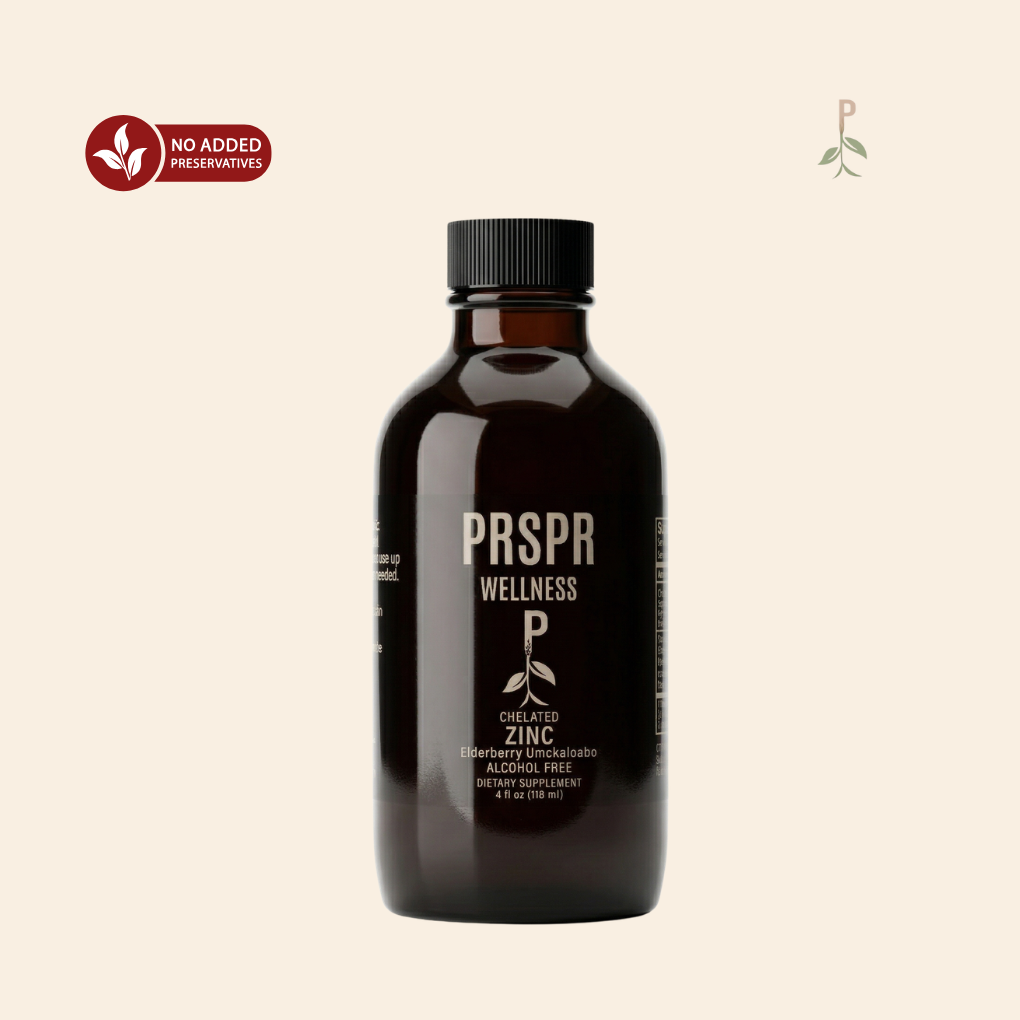
Echinacea is one of the botanicals named on our own shelf. Our Elderberry w/ Zinc is listed as PRSPR Wellness Chelated Zinc + Elderberry, a dietary supplement that combines zinc with a blend of botanical ingredients including elderberry, echinacea and umckaloabo root. The listing names echinacea at the genus level, without a species, so that is how we name it here too.
Like everything we carry, it is made in a GMP-certified facility and third-party batch tested, so what's on the label is what's in the bottle. It is listed at $47.99 and sits in our Vitamins & Supplements collection. If you are curious how elderberry and echinacea show up in different formats around the aisle, we covered that in syrup, tincture and tea: the elderberry aisle formats.
If you want to read the full listing for yourself, see Elderberry w/ Zinc at PRSPR.
Purple coneflower is a common name for Echinacea purpurea, per the Lady Bird Johnson Wildflower Center. Echinacea is the whole genus, which also includes species such as Echinacea pallida and Echinacea paradoxa.
It is often called one, but it is not an Echinacea. The Wildflower Center files black-eyed Susan as Rudbeckia hirta, and lists "Perennial Black-eyed Susan" and "Orange Coneflower" for Rudbeckia fulgida.
It depends on the plant. The Wildflower Center uses "Yellow Coneflower" for both Echinacea paradoxa and Ratibida pinnata, two different genera.
No. The Wildflower Center lists "Prairie Coneflower" for Ratibida columnifera, a separate genus that NC State Extension describes as having column-shaped flower heads.
Answer all five questions to unlock a clear wellness plan made around your goal, schedule, preferred supplement format, and biggest roadblock.
Get clarity on what matters most right now.
See the product and routine connected to your goal.
Simple next steps you can use right away.
Pick the one you would fix first if you could.
This helps us make the guide easier to follow.
Consistency beats the “perfect” routine you never follow.
Be honest. We’re building something you’ll actually use.
Your guide will include one simple way around it.
Answer two more questions to unlock your product starting point, five-step plan, two-week routine, and one practical tip for your biggest roadblock.
Enter your details to open your five-step plan.
Verified PRSPR customer reviews
Expires when you close this page
*Your personal credit for completing the quiz. It's applied automatically at checkout on one-time purchases and expires when the timer runs out.
View full product detailsEverything in your plan, together — one add to cart.
Expires when you close this page
*Your personal credit for completing the quiz. It's applied automatically at checkout on one-time purchases and expires when the timer runs out.
View full product details Mind vocabulary
What is cognition? You have probably seen the word "cognitive" printed on a label, in a headline, or in a product name, and kept scrolling. It is o...
 Biology vocabulary
What is metabolism? You see the word on labels, in gym talk and in nutrition headlines, almost always used as if it were a single setting. Read eno...
 Sleep vocabulary
What are sleep cycles? You hear the phrase on podcasts, see it on sleep trackers, and read it in articles that assume you already know what it mean...