
◎
Get clear
Get clarity on what matters most right now.

"No artificial sweeteners" is one of the most common promises on a food or supplement label, and one of the least explained. Everyone reads it. Very few people could tell you exactly which ingredients it rules out. That gap is showing up in search. On Google Trends this week (US, past seven days), "no artificial sweeteners" carries a top volume score of 100 within its topic, "what are artificial sweeteners" sits at 64, "stevia" at 45, "sucralose" at 30, "artificial sweeteners list" at 14, "list of artificial sweeteners" at 7 and "allulose" at 4.
The rising searches tell the same story from a different angle. "Is stevia an artificial sweetener" is up +60%, and both "what is sucralose" and "aspartame" are up +50%.
So people are asking a vocabulary question: what is on the list, and what is not? This piece sorts the common high-intensity sweeteners the way the U.S. regulator does, explains where stevia and allulose land, and shows you where to look on a label. It does not rank any sweetener or weigh in on what any of them does in the body. Questions like that belong with a qualified healthcare professional.
Start with the word itself. The Online Etymology Dictionary dates "artificial" in English to the late 14th century, from the Latin artificialis, "of or belonging to art," and notes that by the early 15th century it had come to mean "made by man, contrived by human skill and labor." That second sense is the one most people have in mind when they read a label: a sweetener made in a lab rather than pressed out of a plant.
Here is the catch. The U.S. Food and Drug Administration does not organize its sweetener guidance around that word. On its consumer page about aspartame and other sweeteners, the FDA describes "sweeteners or sugar substitutes, such as aspartame, sucralose, and stevia derived substances" as "ingredients used to sweeten and in some cases enhance the flavor of foods." It groups them by the regulatory route each one took to market, not by whether it sounds natural or synthetic.
So the answer has two layers: lab-made sweeteners in everyday speech, regulatory pathways in the FDA's terms. That split is where the confusion starts.
According to the FDA's consumer page on aspartame and other sweeteners, six high-intensity sweeteners are approved in the U.S. as food additives. Several others reached the market through a separate route: a GRAS notice that the FDA reviewed without objection. Here is the full artificial sweeteners list as that page lays it out, with the sweetness figures the FDA gives for each, measured against table sugar.
| Sweetener | FDA pathway | Sweetness vs. table sugar (per FDA) |
|---|---|---|
| Aspartame | Food additive | About 200 times |
| Acesulfame potassium (Ace-K) | Food additive | About 200 times |
| Sucralose | Food additive | About 600 times |
| Neotame | Food additive | About 7,000 to 13,000 times |
| Advantame | Food additive | About 20,000 times |
| Saccharin | Food additive | 200 to 700 times |
| Steviol glycosides (from stevia) | GRAS notice | 200 to 400 times |
| Monk fruit extract (Luo Han Guo) | GRAS notice | 100 to 250 times |
| Thaumatin | GRAS notice | 2,000 to 3,000 times |
If you were looking for a list of artificial sweeteners in the everyday sense, the top six rows are the usual answer. They are the names people generally mean when a label says it leaves artificial sweeteners out. The bottom three come from plants, which is why they sit in a grey zone in everyday speech.
Aspartame is one of the most familiar names on the list, and "aspartame" is climbing in searches this week. On the FDA's page it is listed as an approved food additive, about 200 times sweeter than table sugar. On an ingredient list it simply appears as "aspartame."
That exact question is up +50% this week, so here is the label answer. Sucralose is a high-intensity sweetener that the FDA lists as an approved food additive, and the agency puts it at about 600 times sweeter than table sugar. Like aspartame, it goes on an ingredient list under its own name.
These four round out the food-additive group. Saccharin is the oldest name of the set: the Online Etymology Dictionary says the word "saccharin" was coined in 1879, from the Latin saccharon, meaning sugar. Acesulfame potassium often appears abbreviated as Ace-K. Neotame and advantame are rarer on shelf labels, but they are on the FDA's list all the same.
This is the fastest-rising question on the list, and the answer depends on which layer you mean.
In origin, stevia is a plant. The FDA's sweetener page states that "Steviol glycosides are natural constituents of the leaves of Stevia rebaudiana (Bertoni) Bertoni, a plant native to parts of South America." That is why most people do not file stevia under "artificial" in the everyday sense.
In regulation, stevia sits in its own category. According to the same FDA page, purified steviol glycosides reached the market through GRAS notices rather than food-additive approval, and the page also states that "the use of stevia leaf and crude stevia extracts is not considered GRAS, and their import into the U.S. is not permitted for use as sweeteners." So "stevia" on a label usually refers to a purified extract from the leaf, not the dried leaf itself.
Put simply, stevia is plant-derived and regulated separately from the six food additives. Whether a brand counts it as "artificial" is a labeling choice, which is why the ingredient list matters more than the front of the package.
Allulose is the newest name in this search set, and it is not a high-intensity sweetener at all. It is a sugar. According to the FDA's 2020 guidance on the declaration of allulose, it is a monosaccharide, and it "is present in small amounts in wheat, fruits (e.g., raisins, dried figs) and in many other foods (e.g. molasses, maple syrup, and brown sugar)." It is often described as a "rare sugar" for that reason.
The labeling twist is what makes it interesting. The FDA announced in its December 2020 constituent update that it intends to exercise enforcement discretion regarding the requirement that allulose be included in the amounts of total sugars and added sugars on the Nutrition Facts label, while noting that allulose "still must be included in the amount of total carbohydrates." So allulose can show up in an ingredient list without showing up in the sugars line. It is neither a classic sugar on the panel nor an artificial sweetener by name.
Here is the bridge from the table to the bottle. A front-of-pack phrase is a summary. The ingredient list is the evidence. The FDA's own advice on its sweetener page is direct: "Consumers can identify whether a product has a sweetener by looking for the sweetener's name in the ingredient list on the product label."
That makes a practical checklist:
A phrase like "no artificial sweeteners" is a promise about the first bullet. The rest of the list tells you what fills the gap.
The FDA's consumer page does not use "artificial" as its category. It sorts sweeteners into six approved food additives and substances that went through GRAS notices, such as steviol glycosides and monk fruit extract.
By origin, no: the FDA describes steviol glycosides as natural constituents of stevia leaves. By regulation, purified stevia extracts are handled through GRAS notices, separately from the six food additives. Whether a label counts stevia as "artificial" is up to the brand, so check the ingredient list.
Sucralose is one of the six high-intensity sweeteners the FDA lists as approved food additives, described by the agency as about 600 times sweeter than table sugar. For any question about how it might affect you personally, talk to a qualified healthcare professional.
We think "no artificial sweeteners" is only as useful as your ability to check it. The phrase is short on purpose. The ingredient list is long on purpose. The second one is where the facts live.
We also think names matter. Aspartame, sucralose, stevia and allulose get lumped together in conversation, and the regulator does not lump them together at all. Once you know the categories, a label reads in seconds.
So we write our listings in plain words, and we would rather you read them than take our front label on faith.
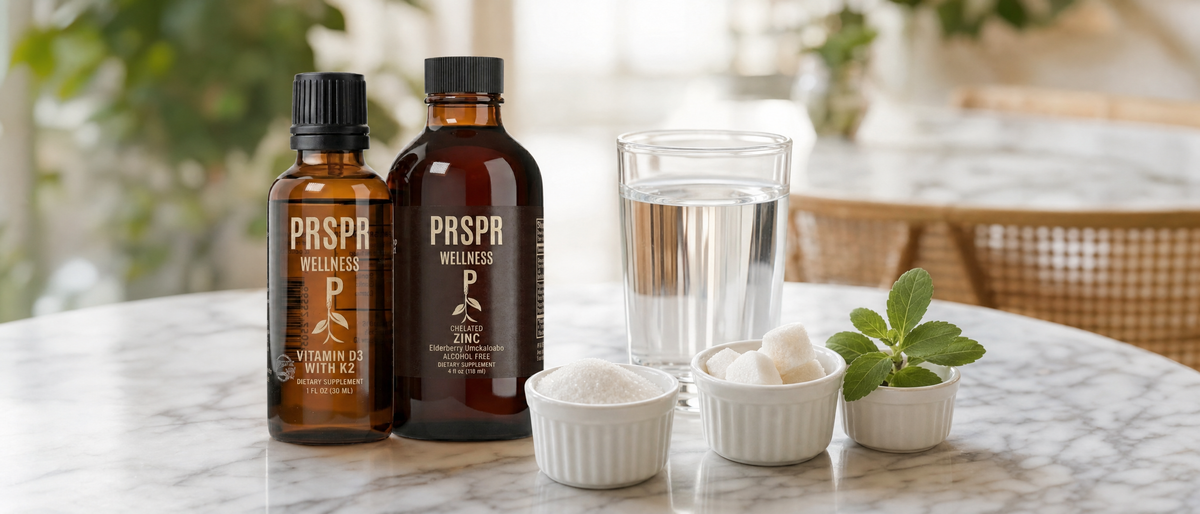
That brings us to the Adult Immunity Bundle. The listing describes it as a two-part system that "combines Chelated Zinc + Elderberry with Vitamin D3 + K2 (MK7)," both in liquid formulas. The Chelated Zinc + Elderberry formula includes organic elderberry, echinacea and umckaloabo root, and the listing says it is made "without alcohol, artificial sweeteners, or harsh fillers." It is "naturally flavored with elderberry and blackberry juice."
That is exactly the kind of line this article teaches you to check: a front-of-listing promise, backed by an ingredient list you can read yourself. If you want the rest of the label vocabulary, our guide to the words on immune support supplement labels walks through the category terms, our explainer on what chelated zinc means covers the mineral form, and our piece on what elderberry is covers the plant behind the flavor.
What we will add in our own voice is how it is made. Every product in the Adult Immunity Bundle is manufactured in a GMP-certified facility and third-party batch tested, so what's on the label is what's in the bottle.
To read the full ingredient list for yourself, open the Adult Immunity Bundle product page, browse the rest of our vitamins and supplements collection, or take the build-your-stack quiz to see where it fits alongside everything else we carry.
Answer all five questions to unlock a clear wellness plan made around your goal, schedule, preferred supplement format, and biggest roadblock.
Get clarity on what matters most right now.
See the product and routine connected to your goal.
Simple next steps you can use right away.
Pick the one you would fix first if you could.
This helps us make the guide easier to follow.
Consistency beats the “perfect” routine you never follow.
Be honest. We’re building something you’ll actually use.
Your guide will include one simple way around it.
Answer two more questions to unlock your product starting point, five-step plan, two-week routine, and one practical tip for your biggest roadblock.
Enter your details to open your five-step plan.
Verified PRSPR customer reviews
Expires when you close this page
*Your personal credit for completing the quiz. It's applied automatically at checkout on one-time purchases and expires when the timer runs out.
View full product detailsEverything in your plan, together — one add to cart.
Expires when you close this page
*Your personal credit for completing the quiz. It's applied automatically at checkout on one-time purchases and expires when the timer runs out.
View full product details Mind vocabulary
What is cognition? You have probably seen the word "cognitive" printed on a label, in a headline, or in a product name, and kept scrolling. It is o...
 Biology vocabulary
What is metabolism? You see the word on labels, in gym talk and in nutrition headlines, almost always used as if it were a single setting. Read eno...
 Sleep vocabulary
What are sleep cycles? You hear the phrase on podcasts, see it on sleep trackers, and read it in articles that assume you already know what it mean...