
◎
Get clear
Get clarity on what matters most right now.

What is ear wax? It is one of those questions most people never think to ask until they suddenly do, and right now a lot of people are asking it at once. What creates ear wax is up +160% this week. Why do we get ear wax is up +100%. How is ear wax made is up +40%. Underneath those risers sit the steadier searches: what is ear wax at a volume score of 27, and ear wax build up at 12.
Read the three climbing searches together and they are really one question asked three ways. What makes it. Why it exists. How it gets made. That is not a question about cleaning. It is a question about anatomy.
So that is where this piece stays. We are going to cover what earwax actually is, its proper name, which glands in the ear canal make it, what it is made of, and why some people have wet earwax and others have dry. All of it comes from named references you can check.
What we are not going to do is tell you how to remove it, soften it or clear it, or what to put in an ear. Anything about your ears, or a child's, is a question for a qualified healthcare professional.
Earwax has a proper medical name: cerumen. MedlinePlus, the consumer health site of the U.S. National Library of Medicine, describes it plainly. The ear canal is lined with hair follicles, and it also has glands that produce a waxy oil called cerumen.
That one sentence answers the headline search. Ear wax is not dirt that has found its way into your ear. It is something the ear canal makes on its own, from its own glands, as part of its normal anatomy.
It also explains why the word "wax" stuck. Cerumen is oily and waxy, and it looks and behaves enough like other waxes that people have been calling it that for a very long time.
The Online Etymology Dictionary dates the English word cerumen, meaning earwax, to 1741. It traces it to medical Latin, coined by the Swiss anatomist Gaspard Bauhin from the Latin cera, "wax." The same entry notes that, according to German sources, he built it on the model of the word bitumen. The adjective, ceruminous, is dated to 1741 as well.
The root goes back further still. The dictionary links cera to a word-forming element meaning wax or waxy, from the Greek kēros, "beeswax."
The plain English word is much older than the Latin one. The Online Etymology Dictionary dates earwax, from ear plus wax, to the early 1300s, and traces wax to the Old English weax, the sticky substance bees make to build their cells. So both names, the medical one and the everyday one, point back to beeswax.
The fastest climbing search on this week's list is what creates ear wax, and the answer is glands.
A 2025 study in the journal Microbiology Spectrum sets out the anatomy in one line. It describes earwax as forming when secretions from sebaceous and apocrine sweat glands mix with keratinized epidermal cells that are expelled by the self-cleaning action of the ear canal.
That sentence packs in three separate ingredients, so it is worth taking them one at a time.
Mix those together and you have cerumen. The same study describes the gland secretions themselves as lipids and peptides, which is chemistry language for fats and short chains of amino acids.
Put the pieces in order and you get the answer to how is ear wax made.
First, the glands in the ear canal release their secretions: the oily output of the sebaceous glands and the output of the apocrine glands. Second, skin cells from the lining of the canal are shed. Third, those shed cells mix with the secretions. The result is the waxy material you know as earwax.
Then it moves. MedlinePlus says the wax will most often make its way to the opening of the ear, where it falls out or is removed by washing. The Microbiology Spectrum study uses a phrase for this that is worth remembering: the self-cleaning action of the ear canal. In other words, the canal is not a dead end where wax collects forever. Under normal anatomy, material travels outward over time.
That is the full manufacturing line, from gland to opening, without anyone having to do anything to it.
The second climbing search, why do we get ear wax, is a question about purpose. Here we will let the reference speak for itself, because this is anatomy, not advice.
MedlinePlus lists two things earwax does for the ear. It traps dust, bacteria, other germs and small objects, and keeps them from entering and damaging the ear. And it protects the delicate skin of the ear canal from getting irritated when water is in the canal.
So the short answer is that the body makes it on purpose. It is a coating and a trap at the entrance to a narrow passage, and the canal's self-cleaning movement carries it out again. That is the design, as the National Library of Medicine describes it.
Here is the part of the story most people have never heard. Earwax does not look the same from person to person, and the difference is written in a gene.
The same Microbiology Spectrum study explains that the human ear canal contains wet or dry earwax, and that the type is determined by a single-letter variation, known as a single-nucleotide polymorphism, in a gene called ABCC11 on chromosome 16. People with the GG or GA versions of that position have wet earwax. People with the AA version have dry earwax.
That is a striking piece of biology. Something as ordinary as earwax texture comes down to one letter in one gene, inherited like any other trait. Two people can both have perfectly ordinary ears and very different-looking cerumen, and neither is doing anything wrong.
It also makes a good reminder about comparing notes. If you have ever looked at someone else's and wondered why it looked different from yours, genetics alone means the comparison is not apples to apples.
The last term on the list, ear wax build up, is the one closest to a health question, so we are going to treat it strictly as vocabulary.
MedlinePlus says that in some people the glands produce more wax than can easily leave the ear, and that this extra wax may harden in the ear canal and block it. The medical word for that blockage is an impaction, and you will see the phrase cerumen impaction in clinical writing.
MedlinePlus also notes that trying to clean the ear can push wax deeper, and that health care providers recommend against reaching into your own ear to clean it. Beyond that, any question about build up, blockage, or what to do about either belongs with a qualified healthcare professional who can actually look in the ear.
Earwax is one of the most misunderstood things the body makes, and most of the misunderstanding starts with the word "dirty."
It is not dirt. It is cerumen, made on purpose by glands in the ear canal, from oil, gland secretions and shed skin, and carried outward by the canal's own movement. It even has a Latin name, dated to 1741, built from the word for wax. That deserves a little more respect than it usually gets.
We also think the wet and dry split is the most interesting fact on this list, and the least known. If you have ever compared notes with someone and wondered why theirs looked different, the answer may be one letter in one gene.
And we want to be direct about where our job stops. This is an anatomy lesson. It is not a how-to, and we will not turn it into one.
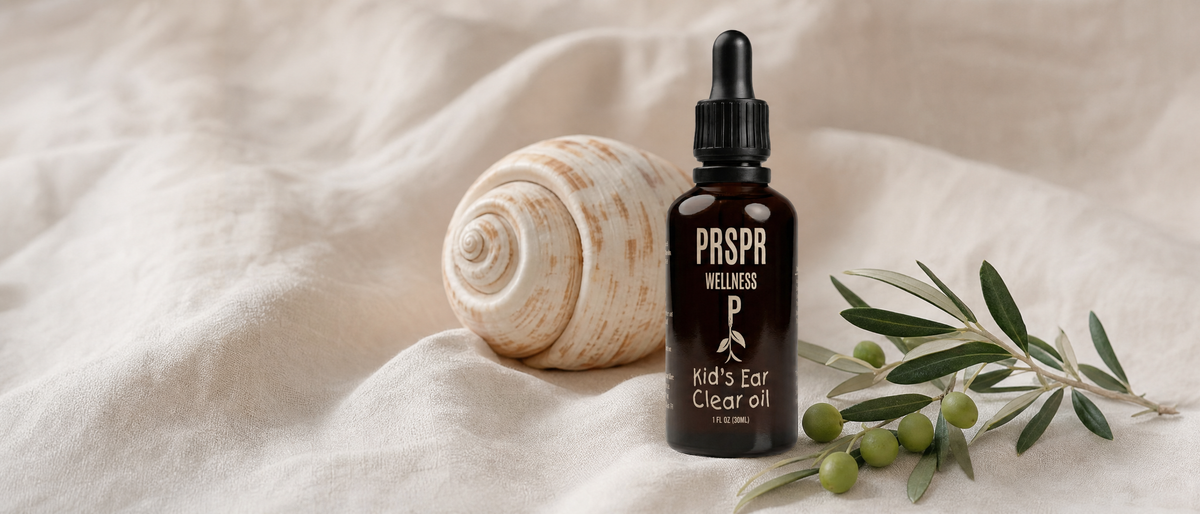
Kids Ear Clear Oil is a blend of organic, wild-harvested herbs in Extra Virgin Olive Oil, made for kids and adults. That is what the product is, and it is the whole of what we say about it here. This article is about how the ear makes cerumen. It is not a guide to using any product, ours included.
If you want the story of the base oil itself, our piece on what extra virgin actually means on an olive oil label covers the grading. For the botanical side of ear oils as a category, our explainer on mullein and garlic oil walks through the plants and the names.
What we will add in our own voice is how it is made. Kids Ear Clear Oil is manufactured in a GMP-certified facility and third-party batch tested, so what is on the label is what is in the bottle. No guessing, no filler, no cutting corners.
If you want to read the label for yourself, open the Kids Ear Clear Oil page, browse the rest of our women's and children's health collection, or take the build-your-stack quiz to see where it fits alongside everything else we carry.
Answer all five questions to unlock a clear wellness plan made around your goal, schedule, preferred supplement format, and biggest roadblock.
Get clarity on what matters most right now.
See the product and routine connected to your goal.
Simple next steps you can use right away.
Pick the one you would fix first if you could.
This helps us make the guide easier to follow.
Consistency beats the “perfect” routine you never follow.
Be honest. We’re building something you’ll actually use.
Your guide will include one simple way around it.
Answer two more questions to unlock your product starting point, five-step plan, two-week routine, and one practical tip for your biggest roadblock.
Enter your details to open your five-step plan.
Verified PRSPR customer reviews
Expires when you close this page
*Your personal credit for completing the quiz. It's applied automatically at checkout on one-time purchases and expires when the timer runs out.
View full product detailsEverything in your plan, together — one add to cart.
Expires when you close this page
*Your personal credit for completing the quiz. It's applied automatically at checkout on one-time purchases and expires when the timer runs out.
View full product details Mind vocabulary
What is cognition? You have probably seen the word "cognitive" printed on a label, in a headline, or in a product name, and kept scrolling. It is o...
 Biology vocabulary
What is metabolism? You see the word on labels, in gym talk and in nutrition headlines, almost always used as if it were a single setting. Read eno...
 Sleep vocabulary
What are sleep cycles? You hear the phrase on podcasts, see it on sleep trackers, and read it in articles that assume you already know what it mean...