
◎
Get clear
Get clarity on what matters most right now.

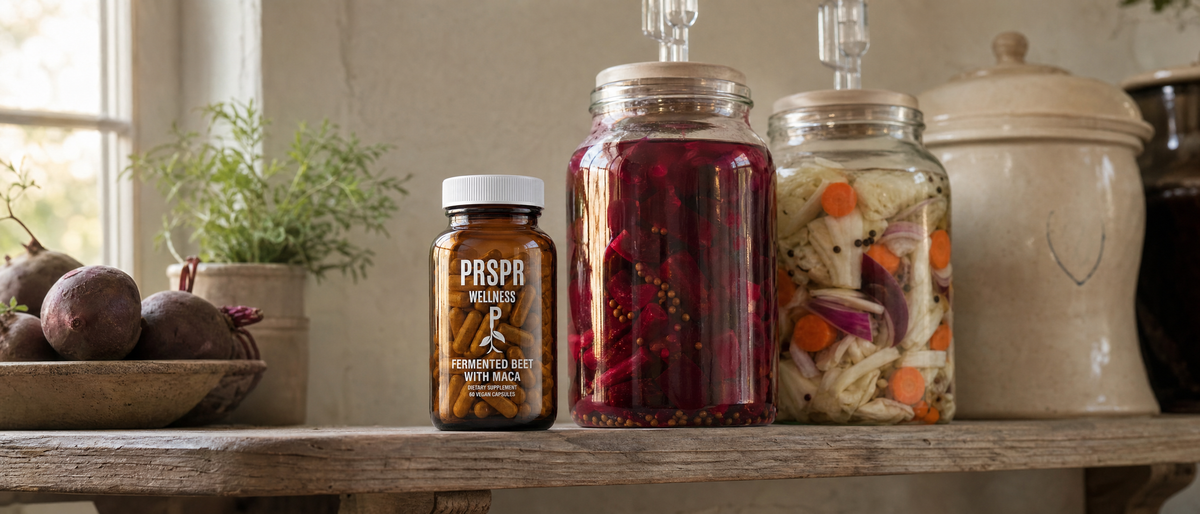
What is fermentation? You have eaten it, drunk it and probably baked with it, and there is a good chance you have seen the word on a supplement label too. Ours says it. The listing for our Fermented Beet Root & Maca describes beetroot and maca root "combined using a fermentation process." So it is fair to ask what that process actually is.
You are not the only one asking. On Google Trends this week (US, past seven days), "what is fermentation" carries a volume score of 100, the top search in the group. "Fermentation process" and "yeast fermentation" each sit at 38, "lactic acid fermentation" at 32, "anaerobic fermentation" at 29, and "is fermentation anaerobic" at 20. On the rising side, "fermentation in food processing" is marked Breakout, "lactic acid fermentation vs alcoholic fermentation" is up +160%, and "products of fermentation" is up +50%.
That is a process-chemistry reading list. So this piece is a process-chemistry explainer: where the word comes from, what happens inside a fermenting cell, how the two famous kinds differ, what each one leaves behind, and what the word means in a kitchen or a factory.
The word is older than the science. The Online Etymology Dictionary dates "fermentation" in English to the late 14th century, when it was an alchemy term with a broad sense, and dates the modern scientific sense to around 1600. It traces the word to the Latin fermentare, "to leaven, cause to rise or ferment," from fermentum, a word for leaven.
The same dictionary suggests fermentum may be contracted from a form tied to the Latin fervere, "to boil, seethe." People named fermentation for what it looked like long before anyone knew what caused it.
The cause turned out to be alive. According to the Institut Pasteur, Louis Pasteur showed in 1857 that "fermentation, far from being a lifeless phenomenon, is a living process," caused by microbes, with a specific microbe associated with each type. The Institut Pasteur also notes that his paper on lactic fermentation came to be regarded as the founding treatise of microbiology.
Then the story took a twist. The Nobel Prize organization records that Eduard Buchner received the 1907 Nobel Prize in Chemistry for his discovery of cell-free fermentation: juice pressed out of yeast cells could still ferment sugar with no living cells present. The work was being done by enzymes. Living microbes supply those enzymes, but the chemistry itself is chemistry.
In biology class, the fermentation process has a precise meaning. A cell starts with sugar and breaks it down through a pathway called glycolysis, which splits one sugar molecule into two smaller molecules called pyruvate and releases a small amount of usable energy along the way.
Glycolysis has a bottleneck. One of its steps needs a helper molecule called NAD+, and each round turns NAD+ into NADH. With oxygen around, many cells hand those electrons off through a longer pathway. Without oxygen, they need another way to get NAD+ back.
That other way is fermentation. The OpenStax textbook Concepts of Biology puts it plainly: "The various methods of fermentation are used by different organisms to ensure an adequate supply of NAD+ for the sixth step in glycolysis." The cell takes pyruvate, passes the electrons from NADH onto it, and turns it into something else. What that something else is depends on the organism, and that is where the different kinds of fermentation come from.
Many people search "is fermentation anaerobic," and in the textbook sense the short answer is yes. Anaerobic means without oxygen, and anaerobic fermentation is how a cell keeps glycolysis going when oxygen is not doing the job. OpenStax groups fermentation with the ways organisms "convert energy for their use in the absence of oxygen."
The everyday word is looser. Some processes sold as "fermentation," such as certain vinegar-making steps, involve microbes that use oxygen. When you see the word outside a biology textbook, it usually means "microbes transformed this," not a strict statement about oxygen.
These are the two kinds everyone compares, and the search for "lactic acid fermentation vs alcoholic fermentation" is up +160% this week. Both start at the same place, pyruvate. They end in different molecules.
In lactic acid fermentation, the cell converts pyruvate directly into lactic acid (lactate) in a single step. According to OpenStax, this is "the fermentation method used by animals and some bacteria like those in yogurt." No gas comes off. The tang in yogurt, and the sourness in many fermented vegetables, comes from the acid this pathway leaves behind.
Yeast fermentation takes a two-step route. First, the cell clips a carbon off pyruvate and releases it as carbon dioxide gas, leaving a molecule called acetaldehyde. Second, it passes electrons from NADH to the acetaldehyde, which becomes ethanol. OpenStax states it directly: "The fermentation of pyruvic acid by yeast produces the ethanol found in alcoholic beverages."
| Lactic acid fermentation | Alcoholic fermentation | |
|---|---|---|
| Starting point | Pyruvate | Pyruvate |
| Steps | One | Two |
| End product | Lactic acid (lactate) | Ethanol |
| Gas released | None | Carbon dioxide |
| Classic organisms | Some bacteria, animal muscle cells | Yeast |
| Kitchen examples | Yogurt, cheese | Beer, wine, rising bread dough |
There are other kinds too. OpenStax notes that "all forms of fermentation, except lactic acid fermentation, produce gas," and describes organisms that make methane or hydrogen sulfide instead. Lactic and alcoholic are simply the two that ended up in our food.
When people search "products of fermentation," they usually mean one of two things, and it helps to separate them.
The rising Breakout search this week is "fermentation in food processing," and that is where the word gets its broadest use. A useful benchmark is the definition published in 2021 by an expert panel of the International Scientific Association for Probiotics and Prebiotics (ISAPP), which defined fermented foods as "foods made through desired microbial growth and enzymatic conversions of food components."
Two parts of that definition matter. "Desired" means the microbes are there on purpose, which separates fermentation from spoilage. And ISAPP notes that microbial activity is required, so a vegetable pickled with vinegar alone does not count. Our earlier piece on which foods are actually fermented sorts that grocery aisle item by item.
ISAPP also notes the definition does not require the microbes to still be alive when the food is eaten. What matters is that they grew and did their enzymatic work during production. So in food processing, "fermented" describes how something was made, not what is in it afterward.
Here is the bridge back to our bottle. The listing for Fermented Beet Root & Maca says the two roots are "combined using a fermentation process." Read with everything above, that phrase tells you something about how the product was made: microbial or enzymatic transformation was part of production.
What the listing does not do is name the kind. It does not say lactic or alcoholic, and it does not name an organism. So we will not guess, and neither should anyone reading the label. When a label uses a process word, the honest reading is exactly what it says: this is how it was made. If you want the ingredient side of the story, our explainer on what beetroot and maca are and why they share a jar covers the two roots themselves.
In biology, it is how a cell breaks down sugar and regenerates NAD+ without relying on oxygen, turning pyruvate into products such as lactic acid or ethanol.
In the textbook sense, yes. In everyday and food-industry use, the word more broadly means microbes transformed something, and some of those processes do use oxygen.
We like words that carry their own history, and fermentation is one of the best. It started as a Latin word for leaven, picked up an image of boiling and bubbling, and became a founding idea of microbiology once Pasteur tied it to living cells. Then Buchner showed the chemistry could run without the cells at all.
We also think the word gets used loosely, and that is worth noticing. A biologist means a specific way of handling sugar without oxygen. A food maker means microbes did the work on purpose. A label means this is how the product was made. None of those meanings is wrong, but they are not the same statement.
So our advice is the same one we give for every label word: read it as a description of process, then look for what the label actually names. If you have a personal health question about any fermented food or supplement, that one belongs with a qualified healthcare professional.
Fermented Beet Root & Maca is, in the listing's own words, "a dietary supplement made with beetroot and maca root, combined using a fermentation process." It comes as capsules and is formulated for convenient daily use. That is how the listing describes it, and that is the description we stand behind.
What we will add in our own voice is how it is made. Fermented Beet Root & Maca is manufactured in a GMP-certified facility and third-party batch tested, so what's on the label is what's in the bottle.
To read the full label for yourself, open the Fermented Beet Root & Maca product page, browse the vitamins and supplements collection, or take the build-your-stack quiz to see where it fits alongside everything else we carry.
Answer all five questions to unlock a clear wellness plan made around your goal, schedule, preferred supplement format, and biggest roadblock.
Get clarity on what matters most right now.
See the product and routine connected to your goal.
Simple next steps you can use right away.
Pick the one you would fix first if you could.
This helps us make the guide easier to follow.
Consistency beats the “perfect” routine you never follow.
Be honest. We’re building something you’ll actually use.
Your guide will include one simple way around it.
Answer two more questions to unlock your product starting point, five-step plan, two-week routine, and one practical tip for your biggest roadblock.
Enter your details to open your five-step plan.
Verified PRSPR customer reviews
Expires when you close this page
*Your personal credit for completing the quiz. It's applied automatically at checkout on one-time purchases and expires when the timer runs out.
View full product detailsEverything in your plan, together — one add to cart.
Expires when you close this page
*Your personal credit for completing the quiz. It's applied automatically at checkout on one-time purchases and expires when the timer runs out.
View full product details Mind vocabulary
What is cognition? You have probably seen the word "cognitive" printed on a label, in a headline, or in a product name, and kept scrolling. It is o...
 Biology vocabulary
What is metabolism? You see the word on labels, in gym talk and in nutrition headlines, almost always used as if it were a single setting. Read eno...
 Sleep vocabulary
What are sleep cycles? You hear the phrase on podcasts, see it on sleep trackers, and read it in articles that assume you already know what it mean...