
◎
Get clear
Get clarity on what matters most right now.

What is hair density? It is one of the most-searched hair words right now, and the searches around it read like a vocabulary lesson. "Density of hair" carries a volume score of 81, and "what is hair density" sits at 56. "Low density hair" comes in at 50, "high density hair" at 34, "fine hair" at 24 and "medium density hair" at 16.
Put those together and you can see what people are sorting out. Density, thickness, fine, coarse, porosity: salon words that get used as if they meant the same thing. They do not. Each one describes something different, and once you can tell them apart, a stylist's consultation or a product page gets much easier to read.
We are staying on the vocabulary side here: what the words mean and how the thing they describe gets measured. Questions about changes in your own hair, or what those changes might mean, are for a qualified healthcare professional. We are not going to answer them in either direction.
Hair density is a count. It describes how many individual hairs grow in a given area of scalp. In a 2009 review of hair evaluation methods in the International Journal of Trichology, Rachita Dhurat and Punit Saraogi describe density as the number of hairs per square centimeter, measured over a marked patch of scalp.
That unit is the whole idea. The density of hair is not about how any single strand looks. It is about how many strands there are, side by side, in one small square.
The word itself explains a lot of the confusion. According to the Online Etymology Dictionary, "density" entered English around 1600, from the Latin densitas, meaning "thickness." So the everyday word for how thick hair looks and the technical word for how many hairs there are share a root. No wonder people swap them.
Clinicians do not eyeball it. The same review describes the phototrichogram, a method that photographs a defined area of scalp under magnification so the hairs in it can be counted per square centimeter.
A study published in Skin Appendage Disorders used a related technique, quantitative trichoscopy, imaging the scalp at 50-fold magnification to count hairs per square centimeter across groups of healthy adults. It reported statistically significant differences in average density between groups of different ancestry. It also found that the densest area was not the same for everyone: the frontal scalp for two of the groups, and the vertex, the crown, for the third.
The takeaway is simple. Density is not one fixed number that everyone shares. It varies between people, and between places on the same head.
In a salon, nobody is counting hairs under a camera. Stylists use three everyday labels instead: low, medium and high. They are descriptive words for that same count, used in the chair rather than in a clinic.
Low density hair means the strands sit farther apart, so more scalp tends to be visible, especially along a part.
Medium density hair is the middle of the range, the label a stylist reaches for when hair reads as neither sparse nor packed.
High density hair means the strands grow close together, so there is simply more hair to work through.
Why does a stylist care? Because density shapes the practical side of a service. It changes how many sections a cut or color takes, how much product a style calls for, and how long the whole appointment runs. For a stylist, density is a planning word.
At home, people describe a couple of informal checks: looking at how much scalp shows along a part, or noticing how much hair gathers into a ponytail. These are impressions, not measurements. Strand width, texture and styling all shape what you see, not just the count.
Use them as vocabulary, a way to describe your hair to a stylist, rather than as a reading of anything.
Here is the mix-up the searches keep circling. Density counts strands. Thickness, in the technical sense, measures one strand. Dhurat and Saraogi list them as separate variables: density in hairs per square centimeter, and thickness in micrometers, measured on individual hairs close to their base under magnification.
How wide is a single hair? According to a 2014 study in PeerJ by Yang, Zhang and Rheinstädter, adult human hair is around 20 to 180 micrometers in width. That is a wide range, and it is the range the word "fine" lives in.
When a stylist calls hair fine, they are describing width: strands toward the narrow end of that range. Coarse is the word for the wide end. Either way, it is a statement about each individual hair, not about how many there are.
That is why the two words combine in every direction. Fine hair can be high density, with lots of narrow strands close together. Coarse hair can be low density, with fewer wide strands spaced apart. A head of hair can look full for either reason.
It is also why "my hair is thin" is such a slippery sentence. It could mean fine strands, low density, or both at once. Separating width from count is the first step to describing your hair accurately.
Porosity is a third word again, and it belongs to the individual strand, not to a count. The same PeerJ study describes the outermost layer of a hair, the cuticle, as flat overlapping cells in a scale-like formation. Porosity is the word stylists use when they talk about that outer surface, so it describes neither width nor count. We gave it a full explainer: what hair porosity actually describes.
Density is a scalp word. It is literally about the patch of skin that hair grows from. That shared location is why density comes up in the same conversations as scalp massage and scalp oils.
But a shared location is where the connection ends. A density figure comes from counting hairs in a square centimeter. A product label lists ingredients. Neither one stands in for the other, and no label, an oil's included, is a measurement of your hair.
What the vocabulary does give you is a cleaner way to talk about routines. If you already use a pre-wash oil, our step-by-step on what a hot oil treatment is walks through the ritual itself. And our piece on head spas and scalp massage explains the trend that has put the scalp front and center. Both are about the practice. Neither is about density.
That separation matters when you shop. A hair product page can tell you what is in the bottle and how it is used. Density is something you describe with your stylist, in hairs and square centimeters or in plain low, medium and high.
Density is a count. Thickness is a width. Porosity is about a strand's outer surface. Three words, three different things, and most hair confusion comes from treating them as one.
The words themselves do not help. "Density" comes from the Latin for thickness, and "thin" gets used for both fine strands and fewer strands. So we think the most useful habit is to ask which one someone means, whether that someone is a stylist, a friend, or a product page.
Knowing the difference lets you describe your hair precisely and read hair labels for what they actually say. That goes for every label on the hair shelf, ours included.
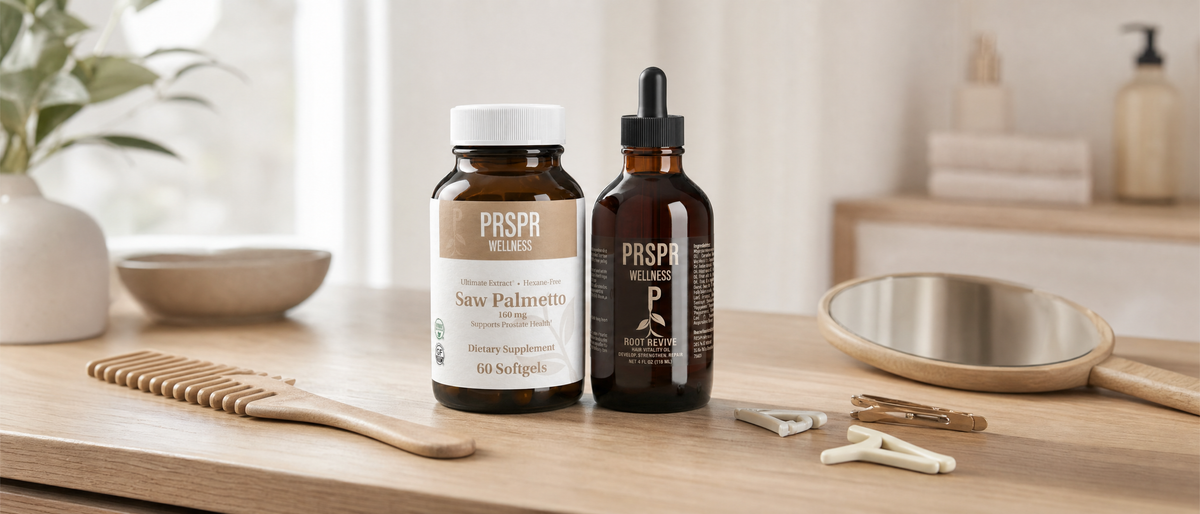
The Hair Harmony Kit pairs two products we carry: Root Revive, a hair oil, and Saw Palmetto capsules. The listing names some of the botanicals in Root Revive, "including Castor, Pumpkin Seed, Black Seed, Amla, and Fenugreek," and describes the Saw Palmetto formula as "plant-based, vegan, and free of artificial additives."
What we will add in our own voice is how it is made. Both are manufactured in a GMP-certified facility and third-party batch tested, so what's on the label is what's in the bottle.
If you want to read the full listing for yourself, open the Hair Harmony Kit page, browse the rest of our bundles collection, or take the build-your-stack quiz to see where it fits alongside everything else we carry.
Answer all five questions to unlock a clear wellness plan made around your goal, schedule, preferred supplement format, and biggest roadblock.
Get clarity on what matters most right now.
See the product and routine connected to your goal.
Simple next steps you can use right away.
Pick the one you would fix first if you could.
This helps us make the guide easier to follow.
Consistency beats the “perfect” routine you never follow.
Be honest. We’re building something you’ll actually use.
Your guide will include one simple way around it.
Answer two more questions to unlock your product starting point, five-step plan, two-week routine, and one practical tip for your biggest roadblock.
Enter your details to open your five-step plan.
Verified PRSPR customer reviews
Expires when you close this page
*Your personal credit for completing the quiz. It's applied automatically at checkout on one-time purchases and expires when the timer runs out.
View full product detailsEverything in your plan, together — one add to cart.
Expires when you close this page
*Your personal credit for completing the quiz. It's applied automatically at checkout on one-time purchases and expires when the timer runs out.
View full product details Mind vocabulary
What is cognition? You have probably seen the word "cognitive" printed on a label, in a headline, or in a product name, and kept scrolling. It is o...
 Biology vocabulary
What is metabolism? You see the word on labels, in gym talk and in nutrition headlines, almost always used as if it were a single setting. Read eno...
 Sleep vocabulary
What are sleep cycles? You hear the phrase on podcasts, see it on sleep trackers, and read it in articles that assume you already know what it mean...