
◎
Get clear
Get clarity on what matters most right now.

How to check porosity of hair is up 300 percent in search this week. It is not climbing alone. High porosity hair characteristics is up 130 percent, how to check hair porosity and hair elasticity are each up 60 percent, and what does low porosity hair look like and oils for low porosity hair are each up 40 percent.
The steady terms underneath tell you where the attention really sits. Low porosity hair carries a volume score of 100, high porosity hair 51, what is hair porosity 20, and low porosity vs high porosity 9. So before anyone gets to a test or a product, a lot of people are still asking the first question: what is hair porosity, and what does the word even describe?
That is a fair question, and it has a plain answer. Porosity is a hair-care classification. It is a way of describing how a strand behaves around water and oil. It is not a medical category, and it is not a verdict on your hair.
We are going to stay on the vocabulary: what the word means, what the low, medium and high labels are said to look and feel like, and how the popular at-home checks work. Questions about your scalp or anything happening in your body belong with a qualified healthcare professional, not a glass of water.
Start with the strand itself. A hair shaft is built in layers. At the center, in many hairs, sits the medulla. Around it is the cortex, which makes up the bulk of the strand. On the outside is the cuticle, a thin layer of flat, overlapping cells that lie along the shaft the way shingles lie on a roof.
The strand is made mostly of keratin, the same protein family that shows up in nails. If you want the longer version of that word, including why it also names a salon service, we covered it in our piece on keratin as a protein and a salon menu item.
Porosity is about that outer layer. The word comes from "porous," which Merriam-Webster defines as full of pores and permeable to liquids. In hair care, it describes how readily water and oil move past the cuticle, and how well the strand holds on to them once they are in.
When the cuticle cells lie flat and tight, liquid has a harder time getting in and a harder time getting out. When the cells are lifted or have gaps between them, liquid moves in fast and leaves fast. Everything else in the porosity conversation is built on that single idea.
Hair-care writing usually sorts strands into low, medium and high porosity. These are descriptive buckets, like calling a fabric tightly woven or loosely woven. They describe behavior. They do not describe quality.
Here is how the categories are usually described in hair-care guides. Read these as descriptions people use, not as a diagnosis you have to accept.
Low porosity hair is the top term on this list, and the phrase refers to a tightly packed cuticle. The usual description:
That list is the honest answer to what does low porosity hair look like. Up close, the tell is how it behaves with water.
Medium porosity sits between the two. The cuticle is described as neither tightly sealed nor noticeably raised. Water goes in at a moderate pace and the hair dries in a moderate amount of time.
High porosity hair describes a cuticle that is raised or has gaps. The common list of high porosity hair characteristics:
Hair-care guides commonly say high porosity can be inherited or can follow bleaching, coloring, chemical straightening and frequent heat styling, all of which work on the cuticle. That is a statement about hair processing, not about your health.
Put side by side, low porosity vs high porosity comes down to direction. Low porosity is slow in and slow out. High porosity is fast in and fast out. Neither one is the good one. They are different textures of the same basic structure.
This is the part of the cluster growing fastest. How to check porosity of hair and how to check hair porosity are really the same question typed two ways, and the answers people find are a small set of informal tests. None of them is a lab measurement.
The float test is the most widely shared method. You take a clean, shed strand, drop it into a glass of room-temperature water and watch. The popular reading goes like this: a strand that floats on top suggests low porosity, a strand that hangs in the middle suggests medium, and a strand that sinks quickly suggests high.
Treat it as a rough signal. Critics of the float test point out that leftover product, natural oil on the strand, the thickness of the hair and the surface tension of the water can all change what the strand does. It is popular because it is easy, not because it is precise.
Mist a small section of clean, dry hair with water and watch the surface. If the droplets sit there and bead, that is usually read as low porosity. If they disappear into the strand fast, that is usually read as high.
Hold a single strand taut and run your fingers from the tip toward the root. A strand that feels smooth is usually read as having a flat cuticle. A strand that feels bumpy or catches is usually read as having a lifted one.
The simplest check is one you already run every week: pay attention to how long your hair takes to air dry compared with how long it took to get wet. Slow on both ends points toward the low end of the scale. Fast on both ends points toward the high end.
The fair way to use any of these is together. If the float test, the spray test and your drying time all point the same way, the label is probably a useful shorthand for your hair.
Hair elasticity is rising right alongside porosity, and the two get blurred together. They describe different things. Elasticity describes how far a strand stretches when you pull it gently, usually while wet, and whether it returns to its length or snaps. Porosity describes how the strand takes up and holds water. You can check them in the same sitting, but one tells you nothing certain about the other.
Then there is oils for low porosity hair. The guides people land on for that search usually sort oils by feel, calling some "light" and others "heavy," and they describe how an oil sits on the strand. That is texture vocabulary, and it is useful as texture vocabulary.
What those guides cannot honestly promise is that an oil changes your porosity. Porosity describes the structure of the cuticle. An oil sitting on top of a strand is a different conversation. If you want to understand an oil bottle on its own terms, our piece on what "carrier oil" means on a castor oil label is a good place to start.
We like porosity as a word. We do not like what search turns it into.
It is a descriptive label for how a strand behaves with water. That is genuinely handy when you are reading a hair-care routine, comparing product textures or trying to make sense of why your hair dries so much faster than your friend's does.
Where it goes wrong is when a kitchen-glass test gets treated like a verdict, or when a label on a bottle implies it can move you from one category to another. Read the words at their actual size. Low, medium and high describe a surface. They do not grade your hair, and they do not come with a prescription attached.
The same habit applies to every hair word you meet online. We walked through the growth-cycle vocabulary in our piece on the vocabulary behind hair shedding searches. Learn the term, know what it describes, and notice when someone is stretching it past that.
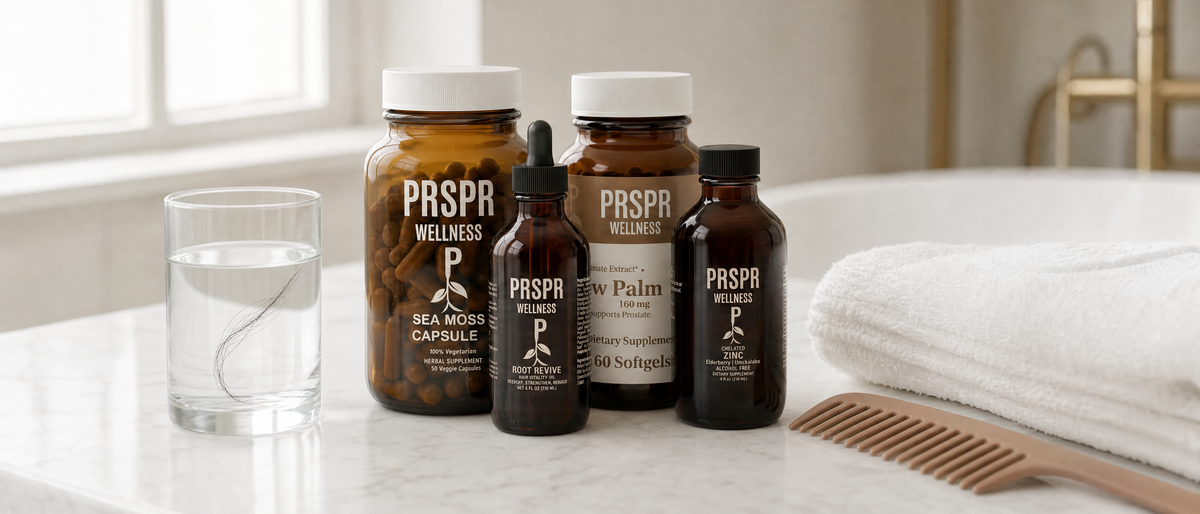
Hair Renewal Protocol - Hair Growth Essentials is a bundle of Root Revive Hair Growth Oil, Saw Palmetto Capsules, Seamoss Capsules and Zinc + Elderberry. Root Revive is described on the listing as a botanical oil blend. That is what the product is, and it is the whole of what we will say it is.
What we will add in our own voice is how it is made. It is manufactured in a GMP-certified facility and third-party batch tested, so what is on the label is what is in the bottle. No guessing, no filler, no cutting corners.
If you want to see exactly what is in the box, open the Hair Renewal Protocol page and read the listing as written. You can also browse the full bundles collection, or take the build-your-stack quiz to see how the pieces fit together.
Answer all five questions to unlock a clear wellness plan made around your goal, schedule, preferred supplement format, and biggest roadblock.
Get clarity on what matters most right now.
See the product and routine connected to your goal.
Simple next steps you can use right away.
Pick the one you would fix first if you could.
This helps us make the guide easier to follow.
Consistency beats the “perfect” routine you never follow.
Be honest. We’re building something you’ll actually use.
Your guide will include one simple way around it.
Answer two more questions to unlock your product starting point, five-step plan, two-week routine, and one practical tip for your biggest roadblock.
Enter your details to open your five-step plan.
Verified PRSPR customer reviews
Expires when you close this page
*Your personal credit for completing the quiz. It's applied automatically at checkout on one-time purchases and expires when the timer runs out.
View full product detailsEverything in your plan, together — one add to cart.
Expires when you close this page
*Your personal credit for completing the quiz. It's applied automatically at checkout on one-time purchases and expires when the timer runs out.
View full product details Mind vocabulary
What is cognition? You have probably seen the word "cognitive" printed on a label, in a headline, or in a product name, and kept scrolling. It is o...
 Biology vocabulary
What is metabolism? You see the word on labels, in gym talk and in nutrition headlines, almost always used as if it were a single setting. Read eno...
 Sleep vocabulary
What are sleep cycles? You hear the phrase on podcasts, see it on sleep trackers, and read it in articles that assume you already know what it mean...