
◎
Get clear
Get clarity on what matters most right now.

Almost nobody searching for this plant uses its English name. What is nigella sativa holds a relative interest score of 32, nigella sativa seeds sits at 45, nigella sativa plant at 10, and black seed nigella sativa at 92, which is the Latin binomial and the common name typed together as if the searcher is checking they are the same thing. The fastest riser on the seed, up about 60 percent, is nigella sativa health benefits, which is an outcome question and one we will leave to a qualified healthcare professional.
That naming pattern is unusual. People do not search prunus dulcis when they mean almonds. They search almonds. Something about this particular plant pushes people to the scientific name, and the reason is genuinely interesting.
This article is about the plant. What it is botanically, what the flower and the seed pod look like, where the seed has been used as a kitchen spice, and why the binomial won. It says nothing about inflammation and nothing about what the seed does. Those are separate questions with separate qualified people attached to them.
Nigella sativa is a flowering annual in the buttercup family, Ranunculaceae. That family placement surprises people, because buttercups read as ornamental meadow plants and this one is sold in capsules.
The plant grows to roughly twenty to thirty centimeters, sometimes taller, with finely divided thread-like leaves that give the whole thing a feathery, almost fennel-like look. The flowers are small and delicate, usually pale blue or white, with five petal-like sepals. Its close ornamental relative, Nigella damascena, is grown in gardens under the name love-in-a-mist, and the two look enough alike that gardeners recognize one on sight from the other.
After flowering, the plant forms an inflated seed capsule, a rounded pod divided into chambers, topped with the persistent spiky remnants of the flower's styles. That pod dries on the plant and splits, and inside it are the seeds: small, angular, matte black, with a hard outer coat. Those seeds are the entire commercial point of the plant.
Its native range runs across southwest Asia and the eastern Mediterranean, and it has been cultivated widely across South Asia, the Middle East, North Africa and southern Europe for a very long time.
Long before any of this reached a supplement shelf, the seed was a spice, and it still is.
In South Asian cooking it is one of the components of panch phoron, the Bengali five-spice blend, and it is scattered on naan and other flatbreads before baking, where the black seeds are the visible speckle. In Turkish and Levantine baking it goes on breads and savory pastries, often alongside sesame. In parts of the Middle East and North Africa it is used in pickles, cheeses and spice mixes.
The flavor is worth describing because it is distinctive and not what people expect. It is faintly bitter, slightly peppery, with a note that people variously compare to oregano, onion or toasted seeds. It is not a sweet spice and it is not a warm one. Toasting it lightly changes the aroma considerably, which is why recipes specify.
Crucially, this is food use, described as food. A spice on bread is a culinary fact, and we are stating it as one.
Here is the answer to the naming puzzle, and it is a problem of ambiguity rather than of pretension.
The English common names for this seed are a mess. Black seed, black cumin, black caraway, kalonji, nigella, charnushka and habbatul barakah are all in use, and several of them are actively misleading. Black cumin also refers to Bunium bulbocastanum, a completely different plant. Black caraway suggests a relationship to caraway, Carum carvi, which does not exist. Nigella on its own could mean the ornamental love-in-a-mist rather than this species.
So a shopper who searches black seed gets results that may or may not be about the same plant, and a shopper who has been burned by that once learns to search the binomial instead. Nigella sativa is unambiguous. It refers to exactly one species and it always has.
That is the general principle behind binomial nomenclature, which Linnaeus formalized in the eighteenth century precisely because common names varied by village. Genus, then species, in Latin, one name per organism worldwide. It exists to end this exact confusion, and in this category it is doing visible work: black seed nigella sativa at 92 is people using the Latin as a verification tool for the English.
Nigella sativa oil is the largest term on this seed at 100, so it deserves a paragraph, described strictly as a process.
The oil is pressed from the seed. Cold pressing means the seed is crushed mechanically without added heat, which produces a lower yield and leaves a dark, strongly aromatic oil. Expeller pressing uses a screw press, where friction raises the temperature during extraction. Solvent extraction, a third route, uses a chemical solvent to pull the oil out and then removes it, which gives the highest yield and the least aromatic product.
Those are three genuinely different manufacturing methods and they produce oils with different color, aroma and composition. A label that says cold pressed is describing the process, not the plant, and it is one of the few processing words in this aisle that maps to something you can smell.
The seed and the oil are also two different products in a shop. Whole seeds go in a spice jar and stay in the kitchen. The pressed oil goes in a bottle or into capsules. Same plant, same seed, two different shelves, and it is easy to search for one and arrive at the other.
We think the search behavior here is a small piece of good news, and worth encouraging.
When a shopper reaches for the scientific name, they have decided that the marketing name is not precise enough for them. That is exactly the right instinct in a category where common names overlap and mislead. A binomial cannot be spun. It either matches the species on the label or it does not.
Our practical suggestion is to apply that habit past this one plant. Any botanical ingredient with more than one common name is worth checking against its binomial before you compare two products, because the two products may not contain the same species. We took the three-names problem for this seed apart in black seed, black cumin, Nigella sativa, and did the same for a root that shares a name with a soft drink in the sarsaparilla piece.
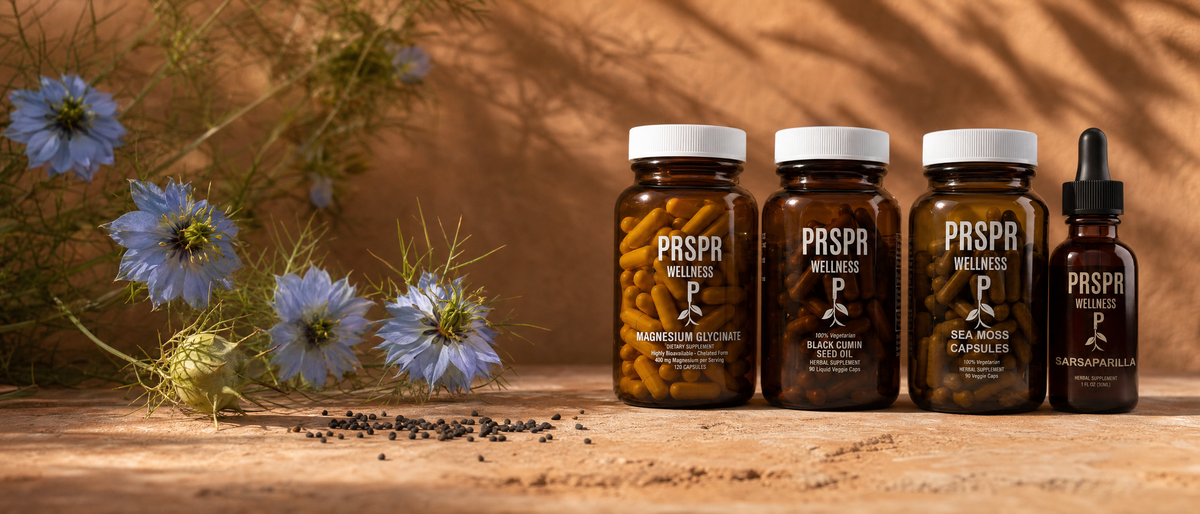
Our Inflammation Reset Stack is a four-part set, and the black seed oil in it is made with Nigella sativa. The other named components on the live listing are Sarsaparilla, Magnesium Glycinate and Seamoss Capsules. That is the composition, listed as the listing lists it.
We name the species on the product rather than only the common name, for the reason this whole article has been about. Black seed is ambiguous. Nigella sativa is not.
The single thing we state in our own voice is the manufacturing: GMP-certified facility, third-party batch tested, so the panel and the capsule agree.
If the botany was the interesting part, keep going. Look at the Inflammation Reset Stack page and check which species each component names, compare it against the rest of the bundles collection, or take the build-your-stack quiz.
Answer all five questions to unlock a clear wellness plan made around your goal, schedule, preferred supplement format, and biggest roadblock.
Get clarity on what matters most right now.
See the product and routine connected to your goal.
Simple next steps you can use right away.
Pick the one you would fix first if you could.
This helps us make the guide easier to follow.
Consistency beats the “perfect” routine you never follow.
Be honest. We’re building something you’ll actually use.
Your guide will include one simple way around it.
Answer two more questions to unlock your product starting point, five-step plan, two-week routine, and one practical tip for your biggest roadblock.
Enter your details to open your five-step plan.
Verified PRSPR customer reviews
Expires when you close this page
*Your personal credit for completing the quiz. It's applied automatically at checkout on one-time purchases and expires when the timer runs out.
View full product detailsEverything in your plan, together — one add to cart.
Expires when you close this page
*Your personal credit for completing the quiz. It's applied automatically at checkout on one-time purchases and expires when the timer runs out.
View full product details Mind vocabulary
What is cognition? You have probably seen the word "cognitive" printed on a label, in a headline, or in a product name, and kept scrolling. It is o...
 Biology vocabulary
What is metabolism? You see the word on labels, in gym talk and in nutrition headlines, almost always used as if it were a single setting. Read eno...
 Sleep vocabulary
What are sleep cycles? You hear the phrase on podcasts, see it on sleep trackers, and read it in articles that assume you already know what it mean...