
◎
Get clear
Get clarity on what matters most right now.

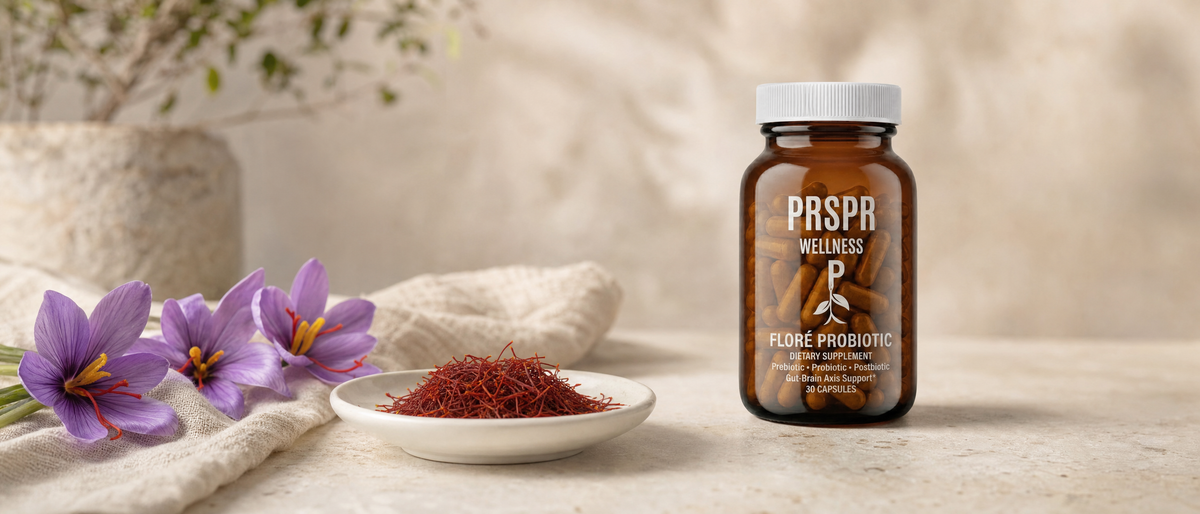
Ask ten people what is saffron and most will say a spice, a color, or the thing that turns rice gold. All three are right, and none of them is the full answer. Saffron is a flower part. Specifically, it is three small red threads pulled by hand out of the middle of a purple autumn crocus, then dried. That is the whole product. Everything else about saffron, from its reputation to its price tag, follows from that one botanical fact.
The search data says plenty of people want the plain version right now. On Google Trends this week (US, past seven days, seed term "saffron"), "what is saffron" holds the top relative volume score of 100. "Saffron extract" scores 27, "saffron crocus" and "crocus" each score 23, "saffron price" scores 22 and "saffron plant" scores 21. One search is climbing fast: "source of saffron" is up +180%. These scores are relative within the saffron seed, so they compare searches to each other, not to the whole internet.
So this piece stays on the plant, the harvest, the trade and the label: where the threads come from, why a gram costs what it does, and what "stigma extract" means on a supplement bottle.
The shortest accurate definition comes from U.S. federal regulation. Under 21 CFR 73.500, the Code of Federal Regulations defines the color additive saffron as "the dried stigma of Crocus sativus L." The same rule notes that this definition is for identity as a color additive only. It is still the cleanest one sentence answer on record.
Two words in that sentence do the work. Crocus sativus is the plant, usually called the saffron crocus. Stigma is the plant part. Not the petal, not the root, not the leaf. The stigma alone.
The name itself traveled a long way to reach English. The Online Etymology Dictionary traces "saffron" to English safroun around 1200, from Old French safran and Medieval Latin safranum, and ultimately from Arabic az-za'faran, a word it lists as being of unknown origin. The same dictionary records "saffron" used as a color name by the late 1300s and as the name of the plant itself from the early 1400s. The spice named the color, then the flower.
A crocus is a small flower that grows from an underground storage organ, and most garden crocuses bloom in spring. The saffron crocus is the odd one. The University of Vermont's North American Center for Saffron Research and Development describes Crocus sativus as a fall blooming crocus that generally flowers from October to November, and warns growers that saffron is not harvested from the familiar spring species. If you want saffron, you need that one crocus.
Open a saffron flower and you find three parts. According to the same UVM center's harvesting guide, the flower is made up of the red threads (the stigma), the yellow center (the stamens) and the purple petals, and those parts have to be separated before drying. The guide puts it bluntly: the stigmas are the saffron. The stamens and petals are sometimes used as a dye, but they are not the spice.
How many threads per flower? The UC Master Gardeners of Santa Clara County instruct growers to pick the stigmas, three per flower, with tweezers. Three threads. That number is the root of almost everything that follows.
The saffron plant has a second quirk that shapes the whole trade. A 2024 paper in the journal Plants describes saffron as "the only sterile triploid species of the Crocus genus," and states that it is only propagated vegetatively, via its corms.
In plain terms, saffron does not grow from seed. Every saffron field is planted from corms, which UVM's saffron center defines as a solid underground stem that serves as the base for the flower stem, as opposed to a layered bulb like an onion or a tulip. Each season, new daughter corms form on top of the mother corm. Growers dig them up, divide them and replant.
UVM's "Saffron by the Numbers" fact sheet gives the scale. It recommends a planting density of 6 to 12 corms per square foot and estimates that one acre takes around 196,000 to 400,000 corms. It adds that growers usually keep corms in the same bed for at least four years before digging and replanting.
If you are searching for the source of saffron, there are two answers: a plant part and a place. The plant part is the stigma. The place, mostly, is Iran. A November 2024 University of Vermont Extension article states that Iran is by far the world's largest grower of saffron, and that the crop is also grown in Afghanistan, Spain and other countries with hot, dry climates.
The same UVM Extension article notes that saffron has been grown in parts of Pennsylvania for over 200 years.
The harvest itself is manual from start to finish. The UVM harvesting guide recommends picking flowers in the morning, when they are fully elongated and just beginning to open, and describes most growers snapping each flower off at the base with a thumbnail and index finger. The stigmas are then separated from the petals and stamens as soon as possible, before the flowers wilt. The flowering season, per the same guide, usually lasts four to six weeks, and at peak the flowers need picking every day.
The UVM saffron center's life cycle fact sheet calls saffron "the most expensive spice in the world" and gives the reason in one line: low yield per acre compared to other crops, plus the labor of harvesting the flowers and separating the stigma from the petals. The same 2017 fact sheet puts the common selling price at around $19 per gram, or $540 per ounce.
The yield math explains it. UVM's "Saffron by the Numbers" sheet says one saffron flower usually produces about 0.006 grams of dry saffron, so it takes around 167 flowers to make one gram. UVM Extension's 2024 article gives a range of 150 to 170 flowers per gram, which it rounds to about 4,000 flowers for a single ounce.
Then there is time. In UVM's trials, picking 100 flowers took about 13 minutes on average, and separating the stigmas from 100 flowers took about 23 minutes. Run those figures against roughly 167 flowers per gram and you get about an hour of hand work for every gram of dried threads, before drying, grading or packing.
| Figure | Value | Source |
|---|---|---|
| Stigmas per flower | 3 | UC Master Gardeners, Santa Clara County |
| Dry saffron per flower | about 0.006 g | UVM, Saffron by the Numbers (2020) |
| Flowers per gram | 150 to 170 | UVM Extension (2024) |
| Flowers per ounce | about 4,000 | UVM Extension (2024) |
| Minutes to pick 100 flowers | about 13 | UVM, Saffron by the Numbers (2020) |
| Minutes to separate stigmas from 100 flowers | about 23 | UVM, Saffron by the Numbers (2020) |
| Common selling price | about $19 per gram ($540 per ounce) | UVM, Life Cycle of Saffron (2017) |
Treat that $19 figure as the dated reference point UVM published, not a quote for today. The structure behind it does not change: three threads per flower, picked by hand.
This is where the spice rack meets the supplement aisle. When a bottle lists a saffron ingredient, the wording is not decoration. U.S. rules require it to tell you which part of the plant was used.
Under 21 CFR 101.4(h), the Code of Federal Regulations requires botanical ingredients in dietary supplements to name the part of the plant the ingredient is derived from, using examples like "Garlic bulb" or "Garlic (bulb)." The same paragraph calls for the plant's Latin binomial name in parentheses unless the name is already covered by the standard reference it cites, Herbs of Commerce.
So on a label, "saffron stigma extract" reads in three pieces:
A milligram number next to it tells you how much of that extract is in each serving. A trademark symbol next to the name tells you the ingredient is a specific branded material from a named supplier, not generic saffron.
The short version: "saffron extract" answers what plant. "Stigma" answers what part. Both are worth reading every time.
We like ingredients that have a real story you can check. Saffron has one of the best. A sterile flower that only spreads by corms, three threads per bloom, picked by hand in a few weeks each fall, and a price that makes perfect sense once you do the arithmetic.
We also think you should read a saffron line on any label the way you would read a spice jar: plant, part, form, amount. If a bottle says "saffron" and nothing else, you are missing half the sentence. If it says stigma, extract and a milligram figure, you know exactly what category of ingredient you are holding. What any ingredient might do for you is a question for your healthcare provider. What it is, you can answer yourself.
FLORÉ Probiotic is a once daily synbiotic capsule, and saffron is one of its named components. The listing names 28 mg of Affron® saffron stigma extract in each capsule, alongside probiotic strains, Saccharomyces boulardii, PreforPro® bacteriophages, acacia fiber and a heat-treated postbiotic culture. Each bottle holds 30 capsules, for 30 servings at one capsule daily.
If the rest of that ingredient list reads like a vocabulary test, start with our guide to what prebiotic, probiotic and postbiotic mean on a synbiotic label, then our explainer on what acacia fiber is.
FLORÉ Probiotic is manufactured in a GMP-certified facility and third-party batch tested, so what's on the label is what's in the bottle.
Want to see the full panel? Read the FLORÉ Probiotic ingredient list or browse the rest of our new arrivals. Not sure where it fits with anything else you take? Take the PRSPR wellness quiz and build your stack from there.
Answer all five questions to unlock a clear wellness plan made around your goal, schedule, preferred supplement format, and biggest roadblock.
Get clarity on what matters most right now.
See the product and routine connected to your goal.
Simple next steps you can use right away.
Pick the one you would fix first if you could.
This helps us make the guide easier to follow.
Consistency beats the “perfect” routine you never follow.
Be honest. We’re building something you’ll actually use.
Your guide will include one simple way around it.
Answer two more questions to unlock your product starting point, five-step plan, two-week routine, and one practical tip for your biggest roadblock.
Enter your details to open your five-step plan.
Verified PRSPR customer reviews
Expires when you close this page
*Your personal credit for completing the quiz. It's applied automatically at checkout on one-time purchases and expires when the timer runs out.
View full product detailsEverything in your plan, together — one add to cart.
Expires when you close this page
*Your personal credit for completing the quiz. It's applied automatically at checkout on one-time purchases and expires when the timer runs out.
View full product details Mind vocabulary
What is cognition? You have probably seen the word "cognitive" printed on a label, in a headline, or in a product name, and kept scrolling. It is o...
 Biology vocabulary
What is metabolism? You see the word on labels, in gym talk and in nutrition headlines, almost always used as if it were a single setting. Read eno...
 Sleep vocabulary
What are sleep cycles? You hear the phrase on podcasts, see it on sleep trackers, and read it in articles that assume you already know what it mean...