
◎
Get clear
Get clarity on what matters most right now.

Everyone knows the sea is salty. Far fewer people can say how salty, why, or what the number on a chart actually measures. The salinity of seawater is one of those facts that sounds simple until you try to explain it, and this week a lot of people are trying.
On Google Trends this week (US, past seven days), "seawater ph" and "ph of seawater" are each up +50% as rising searches. "Salinity of seawater," "density of seawater," "what is salinity" and "average salinity of seawater" are each up +40%. Among the top searches on the same topic, "salinity" carries a relative volume score of 100, and "why is seawater salty" scores 6.
That is a small ocean-chemistry course hiding in a search box. So here it is in plain terms: what salinity measures, the unit oceanographers use, where the salt came from, what seawater's pH and density mean, and, at the end, what the word "concentrated" is doing when seawater shows up on a label.
Salinity is a measure of how much dissolved salt is in water. The Ocean Observatories Initiative defines it as "the concentration of dissolved salt in a parcel of seawater." That is the whole idea. Everything else is detail about how you count it.
The key word is dissolved. The salt in the sea is not floating around as little white crystals. It is broken apart into charged particles called ions, spread evenly through the water. You cannot see it or filter it out with a strainer. You can only measure it.
And "salt" here means more than table salt. To a chemist, a salt is any compound built from positive and negative ions. Seawater carries a whole set of them, which is why oceanographers talk about "dissolved salts," plural.
The classic way to express it is parts per thousand. According to NOAA's JetStream weather school, "In sea water, there is typically close to 35 grams of dissolved salts in each liter (35ppt)," with a typical range of 33 to 37 grams per liter.
Modern oceanography mostly reports something a little different, called practical salinity. The Ocean Observatories Initiative describes practical salinity as "a more specific unitless quantity calculated from the conductivity of seawater and adjusted for temperature and pressure." In other words, instruments measure how well the water conducts electricity, since more dissolved ions carry more current, and convert that reading into a salinity figure.
You will often see those figures written with "PSU," for practical salinity unit. NASA Earthdata puts the salinity range of the ocean at generally about 32 to 37 PSU. Strictly speaking, practical salinity has no unit at all, which is why many scientists write it as a bare number: salinity 35.
So what is the average salinity of seawater? NOAA's National Ocean Service answers directly: "The average salinity is about 35 parts per thousand," which means about 3.5 percent of the weight of seawater comes from dissolved salts. The U.S. Geological Survey gives the same figure.
Put another way, a liter of typical seawater holds roughly 35 grams of salts and a great deal of water. Seawater is still overwhelmingly water. The salt is a small fraction that makes a very noticeable difference.
The average also hides a lot of variation. NOAA's National Ocean Service notes that salinity is generally low near the equator and the poles and higher at mid-latitudes. Rain, river water and melting ice dilute the surface. Evaporation leaves salts behind and pushes the number up.
This is the question people have been asking for as long as there have been beaches, and the answer starts on land.
According to the U.S. Geological Survey, rain picks up carbon dioxide from the air and becomes slightly acidic. Over time it erodes rock, and the USGS explains that the acids "chemically break down the rocks and carries salts and minerals along in a dissolved state as ions." Those ions ride streams and rivers down to the ocean.
NOAA's National Ocean Service adds a second source: openings in the seafloor. Hydrothermal vents release heated water carrying dissolved metals, and underwater volcanic eruptions contribute too.
Once the ions arrive, much of them stay. Water leaves the ocean by evaporation, but dissolved salts do not evaporate with it. Over a very long time, that one-way traffic is how the sea became the salty solution it is.
Two ions dominate. The USGS says chloride and sodium "make up over 90% of all dissolved ions in seawater." NOAA's National Ocean Service puts the pair at around 85 percent and adds that magnesium and sulfate account for about another 10 percent. The exact share depends on how each agency counts, but the headline is the same: seawater's saltiness is mostly the same two ions that make up table salt. If the chloride half of that pair is new to you, our explainer on what chloride is covers it.
The two fastest-rising searches this week are about seawater pH, so here is the short version.
pH is a scale for how acidic or basic a water-based solution is. NOAA's Pacific Marine Environmental Laboratory describes it as running from 0 to 14, with 7 as neutral. The scale is logarithmic, and the same NOAA lab explains that a change of one pH unit corresponds to a ten-fold change in hydrogen ion concentration.
So what is the pH of seawater? According to NOAA, "The ocean's average pH is now around 8.1," which makes seawater basic, or alkaline, rather than neutral. The word "now" matters. NOAA's Pacific Marine Environmental Laboratory reports that the global average pH of the surface ocean has decreased by 0.11 since the Industrial Revolution, which it calculates as roughly a 30 percent increase in acidity. A small-looking change on a logarithmic scale is a large change in the thing being measured.
Density is mass per volume: how much a given amount of something weighs. Dissolved salts add mass without adding much volume, so seawater is denser than fresh water.
How dense? NASA's Aquarius salinity mission maps sea surface density in a range of about 1,020 to 1,030 kilograms per cubic meter. NOAA's JetStream explains the two dials that move the number: density increases as salinity increases and as temperature decreases. Cold, salty water is dense and tends to sink. Warm, fresher water is lighter and tends to stay on top.
Salt changes freezing too. According to NOAA's JetStream, water at 35 ppt freezes at about 28.5°F (-2°C), below the freezing point of fresh water.
Here is where the ocean meets the shelf. Salinity, pH and density are all ways of describing one thing: water with other things dissolved in it. Chemists call that a solution. And the everyday word for how much is dissolved in a solution is concentration.
That is exactly the vocabulary behind a label ingredient like "concentrated seawater." In general chemistry, to concentrate a solution means to remove some of the water so that more dissolved material remains in each unit of liquid. Seawater, with its salinity of roughly 35, is the starting solution. "Concentrated" tells you the direction it went from there.
What a label word does not tell you is the full specification. For that, you read the listing and the label itself, and you read them as written. If you want the rest of the mineral words on an electrolyte label decoded, our guide to reading an electrolyte label walks through them one by one, and our comparison of pink salt, sea salt and table salt covers the finished salts that come from sea and rock.
It is the amount of salt dissolved in water. For the ocean, NOAA's National Ocean Service puts the average at about 35 parts per thousand.
Rain starts as evaporated water, and dissolved salts stay behind when water evaporates. According to the USGS, salts reach the sea as ions washed off rocks by rain and rivers, and NOAA's National Ocean Service adds seafloor vents as a second source.
No. According to NOAA, the ocean's average pH is around 8.1, which is on the basic side of neutral.
We like questions that look like trivia and turn out to be a lesson in how to read. "Salinity of seawater" sounds like a single number. It is really a definition, a unit debate, a geology story and a chemistry scale, all behind the number 35.
We also think the words matter more than people expect. Dissolved, concentrated, basic, dense: each one means something specific, and knowing them makes every label and chart easier to read.
So when seawater shows up somewhere unexpected, including an ingredient list, we would rather you know what the word means than skim past it.
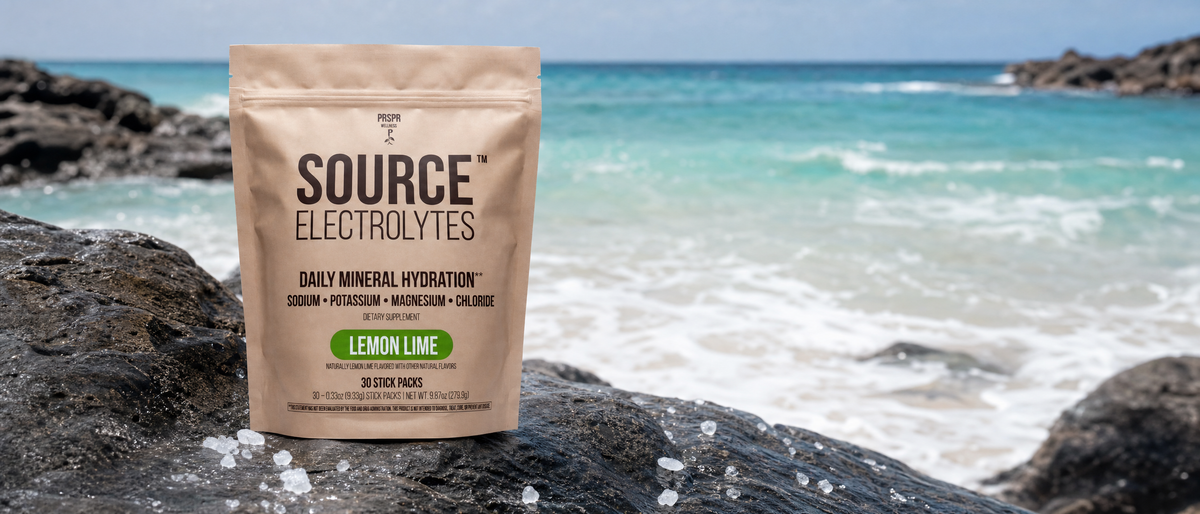
Which brings us to our own seawater mention. PRSPR Source Electrolytes is, in the listing's words, "a stick-pack electrolyte and trace mineral drink mix," and its ingredient list names Vitamin C, calcium, magnesium, zinc, chloride, sodium, potassium, D-Ribose, taurine, Himalayan pink salt, L-theanine and ConcenTrace® concentrated seawater. The listing notes it is made without added sugar and comes in Lemon Lime and Pink Lemonade.
What we will add in our own voice is how it is made. Source Electrolytes is manufactured in a GMP-certified facility and third-party batch tested, so what's on the label is what's in the bottle.
To read the full label for yourself, open the Source Electrolytes product page, browse the rest of the vitamins and supplements collection, or take the build-your-stack quiz to see where it fits alongside everything else we carry.
Answer all five questions to unlock a clear wellness plan made around your goal, schedule, preferred supplement format, and biggest roadblock.
Get clarity on what matters most right now.
See the product and routine connected to your goal.
Simple next steps you can use right away.
Pick the one you would fix first if you could.
This helps us make the guide easier to follow.
Consistency beats the “perfect” routine you never follow.
Be honest. We’re building something you’ll actually use.
Your guide will include one simple way around it.
Answer two more questions to unlock your product starting point, five-step plan, two-week routine, and one practical tip for your biggest roadblock.
Enter your details to open your five-step plan.
Verified PRSPR customer reviews
Expires when you close this page
*Your personal credit for completing the quiz. It's applied automatically at checkout on one-time purchases and expires when the timer runs out.
View full product detailsEverything in your plan, together — one add to cart.
Expires when you close this page
*Your personal credit for completing the quiz. It's applied automatically at checkout on one-time purchases and expires when the timer runs out.
View full product details Mind vocabulary
What is cognition? You have probably seen the word "cognitive" printed on a label, in a headline, or in a product name, and kept scrolling. It is o...
 Biology vocabulary
What is metabolism? You see the word on labels, in gym talk and in nutrition headlines, almost always used as if it were a single setting. Read eno...
 Sleep vocabulary
What are sleep cycles? You hear the phrase on podcasts, see it on sleep trackers, and read it in articles that assume you already know what it mean...