
◎
Get clear
Get clarity on what matters most right now.

What is sulfur? It is a question most people last asked in a chemistry class, and this week a lot of them are asking it again. Some want the periodic table answer. Some want to know why a whole category of smells gets blamed on it. And a fast-growing group wants to know which foods count as sulfur-rich.
All three questions have tidy, checkable answers, and none of them requires a lab coat. This piece covers the vocabulary only: the element itself, where it sits on the periodic table, why the "sulfur smell" usually belongs to a compound rather than the element, and which foods reference sources describe as carrying sulfur compounds. Every fact below names the source it came from.
First, the search data. According to Google Trends, US searches over the past seven days related to the seed term "sulfur" put "what is sulfur" at the top of the related queries, scored 100. "Sulfur smell" followed at 57, "sulfur element" at 26, "sulfur periodic table" at 24 and "sulfur atom" at 18. Among rising queries, "what are sulfur rich foods" grew 250%, "sulfur rich foods" grew 200% and "sulfur foods" grew 40%.
A quick note on reading those numbers. Trends scores are relative within the seed term: 100 marks the most searched query in that set, and the rest are scaled against it. The rising percentages measure growth over a previous period, not total volume. So the food questions are climbing fastest, while the plain definition is still the biggest question in the set.
Start with the periodic table. The Royal Society of Chemistry's periodic table lists sulfur as atomic number 16, in group 16, period 3, in the p-block. That atomic number means every sulfur atom carries 16 protons. PubChem, the chemistry database run by the US National Library of Medicine, gives the symbol as S, classes it as a nonmetal, lists its standard state as solid, and gives an atomic mass of 32.07 with the electron configuration [Ne]3s2 3p4.
Read that configuration as a sulfur atom's address. [Ne] is shorthand for the electrons it shares with neon, and 3s2 3p4 are the six outer electrons that sit beyond them. Sulfur shares group 16 with oxygen, the element directly above it on the table, which is why the two show up in so many of the same kinds of compounds.
PubChem's description calls elemental sulfur a "pale yellow, odorless, brittle solid, which is insoluble in water." The Royal Society of Chemistry says the most common form "appears as yellow crystals or powder." Los Alamos National Laboratory's periodic table describes it as "lemon yellow sintered microcrystals" and notes that it turns a "blood-red color" when melted.
Sulfur also comes in more than one form, a property chemists call allotropy. PubChem's description says elemental sulfur occurs in more than one allotropic form in every state, gas, liquid and solid. Los Alamos names octasulfur as the most common form and notes that sulfur can catenate, meaning it can bind to itself in chains.
Sulfur is old news. PubChem records it as "Known to the ancients; referred to in Genesis as brimstone," and explains that it was called brenne stone, "combustible stone," from which the word brimstone is derived. The same PubChem history traces the name to the Latin sulphurium and the Sanskrit sulveri, and credits the French chemists Gay-Lussac and Thenard with proving its elemental nature in 1809.
As for where it is found, the Royal Society of Chemistry notes that sulfur "occurs naturally as the element, often in volcanic areas." Los Alamos adds that it occurs around volcanoes and hot springs and in minerals such as iron pyrite, gypsum and barite, and that, by mass, it is "the fifth most common element on Earth." PubChem lists pyrite as FeS2 and gypsum as CaSO4·2(H2O), so you can spot the S in both formulas.
Most of it ends up in industry. According to PubChem, most sulfur produced is used to make sulfuric acid, with smaller amounts used to vulcanize natural rubber and to make gunpowder. You will notice the American spelling throughout: PubChem, the Royal Society of Chemistry and Los Alamos all print it as sulfur, while older British texts used sulphur.
Here is the twist behind the second most searched query on the list. Pure sulfur does not smell. PubChem calls it odorless, and Los Alamos says plainly that "Solid sulfur is odorless."
So what is the sulfur smell people search for? In most cases it is a sulfur compound. PubChem notes that hydrogen sulfide, formula H2S, "is a gas that smells like rotten eggs." The US Occupational Safety and Health Administration lists the odor threshold for hydrogen sulfide, the level at which the rotten egg smell first becomes noticeable to some people, at 0.01 to 1.5 parts per million. Los Alamos attributes the smells of "bad breath, rotten eggs, and skunks" to organosulfur compounds and hydrogen sulfide, not to elemental sulfur.
Two related searches fit here. "Sulfur water" usually means well water with that rotten egg note. According to Penn State Extension, the odor comes from hydrogen sulfide gas, produced when "sulfur-reducing bacteria feed on small amounts of sulfur in the water." Penn State also explains why some people notice it only in hot water: a magnesium rod inside a water heater can chemically reduce sulfates to form hydrogen sulfide.
"Sulfur gas" is a loose phrase that can point to more than one compound. Hydrogen sulfide is one. Sulfur dioxide is another, which PubChem lists under the formula SO2. Both are sulfur compounds, and neither is the yellow element.
Now the fastest-rising questions: what are sulfur rich foods, and which sulfur foods show up most often in reference sources? The clearest answers come from the Linus Pauling Institute at Oregon State University, which describes two vegetable groups in terms of their sulfur compounds.
The Linus Pauling Institute calls garlic "a particularly rich source of organosulfur compounds," compounds it says are "thought to be responsible for its flavor and aroma." It also states that Allium vegetables, including garlic and onions, "are the richest sources of organosulfur compounds in the human diet."
The chemistry happens on the cutting board. According to the same source, when garlic cloves are crushed, chopped or chewed, an enzyme called alliinase is released, and the compounds that form do so within 10 to 60 seconds of crushing. One of them is allicin, which PubChem lists with the formula C6H10OS2: two sulfur atoms in every molecule.
The second group is the crucifers. The Linus Pauling Institute describes cruciferous vegetables as "rich sources of sulfur-containing compounds called glucosinolates," which it says give them a pungent aroma and a spicy, sometimes bitter, taste. Its list includes broccoli, Brussels sprouts, cabbage, cauliflower, collard greens, kale, kohlrabi, mustard, rutabaga, turnips, bok choy and Chinese cabbage, with radish, horseradish, watercress and wasabi named as further crucifers. The family name, per the same source, is Cruciferae, or alternately Brassicaceae.
Sulfur also appears in the formulas of two amino acids. PubChem lists L-methionine as C5H11NO2S and L-cysteine as C3H7NO2S, one S apiece. That is a chemistry fact, not a shopping list, and it is a reminder of how widely the element turns up once you start reading formulas.
We think sulfur is a perfect example of a word that does too many jobs. The same five letters get used for a yellow mineral, a rotten egg smell, a well water problem, a family of vegetables and a line on a supplement label. Most of the time, the thing being described is a sulfur compound, and the compound has a more specific name.
That is why we keep going back to primary records. PubChem gives you the formula. The periodic table gives you the address. A university reference tells you which foods are described in terms of which compounds. With those in hand, "sulfur" stops being a vague label word and becomes something you can check. We took the same approach to its neighbors in our piece on selenium and where iodine in food comes from.
And if you have seen "sulfate-free" on a shampoo bottle, that is a different compound class again, which we unpacked in what paraben-free and sulfate-free mean. Questions about your own diet or situation are for your clinician.
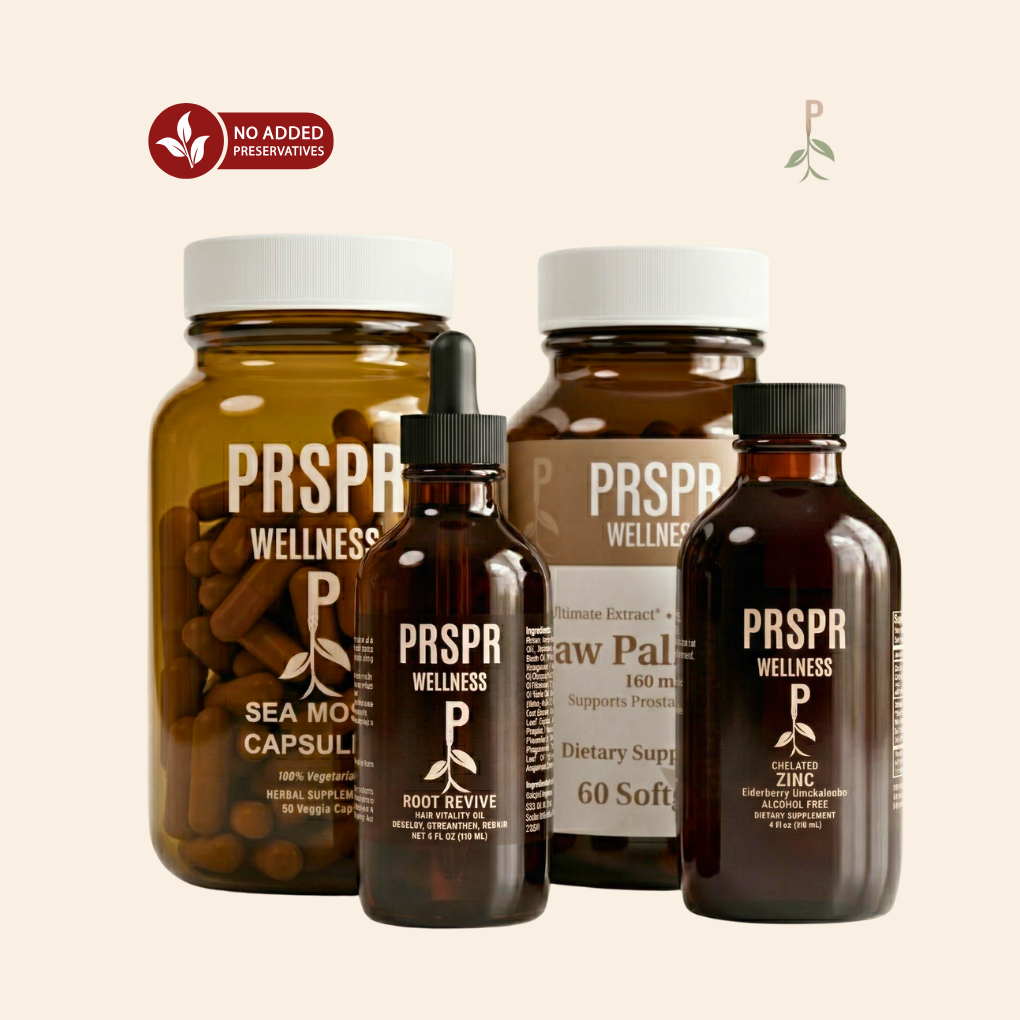
This topic comes from our own shelf. The Hair Renewal Protocol - Hair Growth Essentials is a bundle, and its listing names four components: Root Revive Hair Growth Oil, Saw Palmetto Capsules, Seamoss Capsules and Zinc + Elderberry. The listing's Seamoss Capsules line names "iodine, sulfur, zinc, selenium, and other minerals," which is how sulfur ended up as today's vocabulary lesson.
Like everything we carry, it is made in a GMP-certified facility and third-party batch tested, so what's on the label is what's in the bottle. It sits with our other sets in the Bundles collection, listed at $150.36.
If you want to read every line of the listing for yourself, see the Hair Renewal Protocol at PRSPR.
A chemical element. The Royal Society of Chemistry lists it as atomic number 16 in group 16 of the periodic table, and PubChem describes it as a pale yellow, odorless, brittle solid with the symbol S.
Group 16, period 3, in the p-block, according to the Royal Society of Chemistry. Oxygen sits directly above it in the same group.
Pure sulfur is odorless, per PubChem and Los Alamos National Laboratory. The rotten egg smell is usually hydrogen sulfide, a sulfur compound PubChem describes as a gas that smells like rotten eggs.
The Linus Pauling Institute describes allium vegetables such as garlic and onions as rich sources of organosulfur compounds, and cruciferous vegetables such as broccoli, cabbage and kale as rich sources of sulfur-containing compounds called glucosinolates.
Answer all five questions to unlock a clear wellness plan made around your goal, schedule, preferred supplement format, and biggest roadblock.
Get clarity on what matters most right now.
See the product and routine connected to your goal.
Simple next steps you can use right away.
Pick the one you would fix first if you could.
This helps us make the guide easier to follow.
Consistency beats the “perfect” routine you never follow.
Be honest. We’re building something you’ll actually use.
Your guide will include one simple way around it.
Answer two more questions to unlock your product starting point, five-step plan, two-week routine, and one practical tip for your biggest roadblock.
Enter your details to open your five-step plan.
Verified PRSPR customer reviews
Expires when you close this page
*Your personal credit for completing the quiz. It's applied automatically at checkout on one-time purchases and expires when the timer runs out.
View full product detailsEverything in your plan, together — one add to cart.
Expires when you close this page
*Your personal credit for completing the quiz. It's applied automatically at checkout on one-time purchases and expires when the timer runs out.
View full product details Mind vocabulary
What is cognition? You have probably seen the word "cognitive" printed on a label, in a headline, or in a product name, and kept scrolling. It is o...
 Biology vocabulary
What is metabolism? You see the word on labels, in gym talk and in nutrition headlines, almost always used as if it were a single setting. Read eno...
 Sleep vocabulary
What are sleep cycles? You hear the phrase on podcasts, see it on sleep trackers, and read it in articles that assume you already know what it mean...