
◎
Get clear
Get clarity on what matters most right now.

What is selenium holds a volume score of 100 in search this week. Selenium sulfide sits at 65, selenium foods at 38, selenium brazil nuts and brazil nuts at 36 each, selenium shampoo at 35, selenium element and selenium sulfide shampoo at 27 each, and selenium food at 22.
That is an odd list for one element. Part of it belongs in the snack aisle and part of it belongs in the shower. Most people never handle selenium as an element at all, yet they meet its name in two places that have nothing to do with each other, and the search data has caught them trying to square the two.
A lot of the other searching around selenium is about how much a person should have and what it does. Those are questions for a qualified healthcare professional rather than for a company selling a bundle, and we will not answer them here. This article is about three things that share one name: the element, the shampoo compound and the nut.
Selenium is element 34. The Royal Society of Chemistry's periodic table puts it in group 16 and describes it as a semi-metal that can exist as a silvery metal or as a red powder, with red, gray and black forms. The society describes its properties as sitting between those of sulfur and tellurium.
Its name comes from the Moon. According to the Royal Society of Chemistry, selenium was discovered in 1817 in Stockholm by a chemist who at first mistook it for tellurium, an element named after the Earth. Once it proved to be something new, it was named from selene, the Greek word for the Moon. An element first mistaken for the Earth's element ended up named for the Moon.
Most of what the society lists for it is industrial. It names uses in glass, where it adds color or cuts ultraviolet light; in pigments for ceramics, paint and plastics; in photocells, solar cells and photocopiers; in rectifiers that convert alternating current to direct current; in stainless steel; and in anti-dandruff shampoos. Most of the world's supply, it notes, is recovered from the muds left behind when copper is refined electrolytically.
So the selenium element search is really a chemistry question with an industrial answer. The shampoo and the nut are the two places where the name crosses over into everyday shopping searches.
Selenium sulfide and selenium shampoo are the second- and sixth-biggest terms in this cluster, and they point at a compound rather than at the element or at food.
The name suggests a tidy formula, one selenium atom to two sulfur. A 2024 paper in the journal Materials describes the substance sold as selenium disulfide as messier than that: a medley of eight-membered rings built from selenium and sulfur atoms in varying proportions, forming an orange solid that settles out of liquid readily. The simple formula is shorthand for a family of ring molecules.
In the United States it also has a regulatory home. The FDA's over-the-counter drug rules for dandruff products, in Title 21 of the Code of Federal Regulations, list selenium sulfide among a short set of active ingredients, each at a specified percentage. The same rules define a micronized version by its particle size, finely ground so that its median particle is around five micrometers.
The rest of that short list is worth a glance, because it reads like a small chemistry lesson. Next to selenium sulfide sit coal tar, pyrithione zinc, salicylic acid and plain sulfur. Sulfur and selenium are neighbors in group 16 of the periodic table, and both turn up in the same regulatory list for dandruff products.
That places selenium sulfide shampoo in a different category of product from anything in a kitchen. It is applied to the scalp and rinsed off. A food is eaten. A compound in one and an element in the other share a name and a place on the periodic table, and very little about reading one label transfers to the other. We made a similar point about zinc in sunscreen and zinc in a supplement. Selenium runs the same lesson through a different aisle.
On the food side, the searches are selenium foods and selenium food, and the item people keep landing on is the same one every time.
Brazil nuts are not, botanically, nuts. The New York Botanical Garden points out that in botanical terms a nut is a kind of fruit, and that the Brazil nut is really a seed of Bertholletia excelsa, a tree of the Amazonian rainforest. Its round, woody fruits, about the size of cannonballs, fall to the ground with the seeds packed inside, and the seeds are gathered as a forest product by the people who harvest them for food.
They keep appearing next to selenium because food chemists single them out. A 2022 review in the journal Food Chemistry describes Brazil nuts as highlighted among nuts as one of the richest sources of selenium, and explains that how much selenium a plant food accumulates depends on the selenium profile of the soil it grew in.
That soil point matters more than the headline. A 2019 study in the journal Plants measured two batches of commercially available Brazil nuts and found wide variation in selenium from one seed to the next within the same batch, with the selenium most concentrated in a thin ring just under the seed's surface. A food is not a specification. Two nuts from the same bag are not guaranteed to match, and no single number travels reliably with the name.
The same study also looked at what form the selenium took, and found it was mainly organic, which in chemistry means bound into carbon-based molecules rather than sitting there as a mineral salt. The 2022 review notes that selenomethionine, an amino acid with a selenium atom in its structure, is the form researchers have investigated in most nuts. So even inside one seed, selenium is part of a compound with its own name, which is the same lesson the shampoo aisle teaches from the other direction.
One last detail from this week's numbers. Brazil nuts on its own scores exactly the same as selenium brazil nuts, at 36. In this cluster, the nut and the element now travel as a pair.
Selenium is not the only element with a story that starts somewhere unexpected. Iodine was first isolated from seaweed ash, and we followed it from the sea to the salt shaker in a companion piece.
We think selenium is one of the cleanest demonstrations there is of why an element's name, on its own, tells you very little.
The same word covers a gray semi-metal recovered from copper refining muds, an orange ring compound regulated as a dandruff-product ingredient, and a measurement taken inside a rainforest seed that shifts with the soil the tree grew in. Those are three different materials, handled three different ways, filed under one name. Type "selenium" into a search bar and you get all three back at once, sorted by nothing.
Our view is that form and route are the first two things to read, every time. Is this an element, a compound or a food? Is it applied or eaten? Settle those two and most of the confusion in this cluster disappears. Whether any of it belongs in your own routine, and in what amount, is a separate question, and it belongs to a clinician.
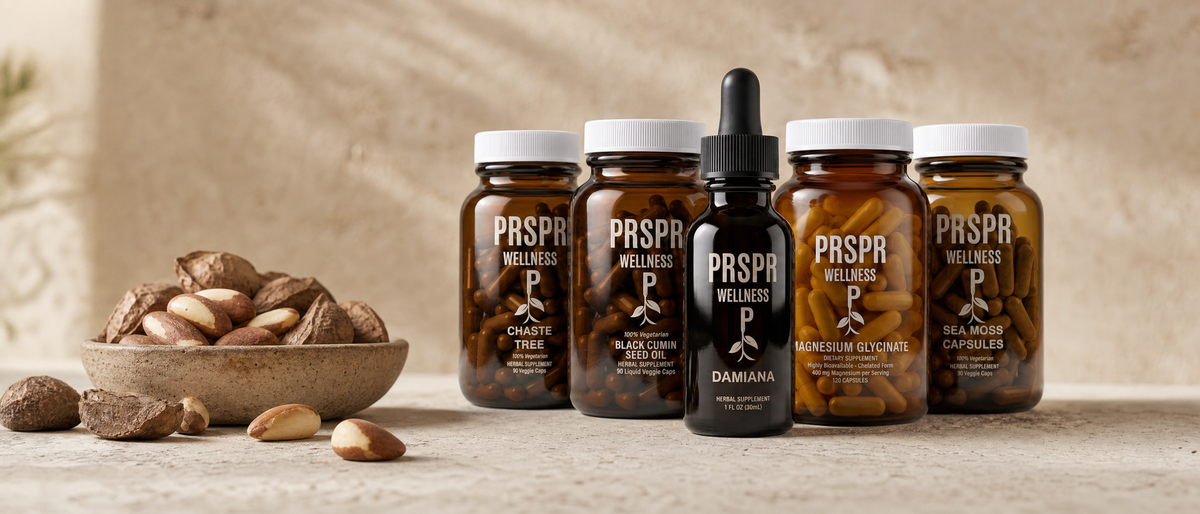
Our Menopause & Perimenopause Bundle is a set of individual products sold together, each with its own supplement facts panel. Its listing names selenium among the minerals it attributes to the bundle's seaweed component, which is why selenium is the element this article is about. That is how the listing puts it, and we are not attaching a figure or anything else to it.
What we will add in our own voice is the quality story alone. Each product in it is made in a GMP-certified facility and third-party batch tested, so what is on the label is what is in the bottle. No guessing, no filler.
If the words on the box are what you want untangled, peri, post and plain menopause as three different terms covers that vocabulary. Otherwise open the bundle page and read each panel, browse the bundles collection, or take the build-your-stack quiz.
Answer all five questions to unlock a clear wellness plan made around your goal, schedule, preferred supplement format, and biggest roadblock.
Get clarity on what matters most right now.
See the product and routine connected to your goal.
Simple next steps you can use right away.
Pick the one you would fix first if you could.
This helps us make the guide easier to follow.
Consistency beats the “perfect” routine you never follow.
Be honest. We’re building something you’ll actually use.
Your guide will include one simple way around it.
Answer two more questions to unlock your product starting point, five-step plan, two-week routine, and one practical tip for your biggest roadblock.
Enter your details to open your five-step plan.
Verified PRSPR customer reviews
Expires when you close this page
*Your personal credit for completing the quiz. It's applied automatically at checkout on one-time purchases and expires when the timer runs out.
View full product detailsEverything in your plan, together — one add to cart.
Expires when you close this page
*Your personal credit for completing the quiz. It's applied automatically at checkout on one-time purchases and expires when the timer runs out.
View full product details Mind vocabulary
What is cognition? You have probably seen the word "cognitive" printed on a label, in a headline, or in a product name, and kept scrolling. It is o...
 Biology vocabulary
What is metabolism? You see the word on labels, in gym talk and in nutrition headlines, almost always used as if it were a single setting. Read eno...
 Sleep vocabulary
What are sleep cycles? You hear the phrase on podcasts, see it on sleep trackers, and read it in articles that assume you already know what it mean...