
◎
Get clear
Get clarity on what matters most right now.

Zinc picolinate vs zinc bisglycinate is up about 80 percent this week, which means a lot of people are standing in front of two bottles trying to work out what the second word does. Underneath it: zinc vitamin at a relative interest score of 75, what is zinc at 59, zinc copper supplement at 39, copper supplement at 37. Also rising, up about 80 percent, zinc food sources, and up about 100 percent, zinc oxide cream.
That last one is the odd entry and it is the most useful thing in the list. Zinc oxide cream is sunscreen and diaper cream. It shares one word with everything else in this cluster and it is not remotely the same product. The fact that it rises alongside supplement searches tells you the word zinc is doing several unrelated jobs at once.
This article separates them. What zinc is as an element, what a zinc compound is, why the word after zinc changes what the product is, and why one mineral name spans a sunscreen tube and a supplement bottle. No immune claim, no dose figure, nothing about what zinc does in a body. Those are questions for a qualified healthcare professional.
Zinc is a chemical element. Atomic number 30, symbol Zn, a bluish-white metal at room temperature. That is the entire base fact and everything else in this article is built on it.
Being an element matters because elements do not degrade and cannot be improved. A zinc atom is a zinc atom. What can change is what it is bonded to, and in practice zinc is almost never supplied as bare metal in anything you would buy. It arrives as a compound: zinc bonded to something else to make a solid that can be put in a capsule, a cream or a lozenge.
The word after zinc on any label is the name of that something else. It is not a grade, a quality tier or a marketing flourish. It is chemistry, and it tells you what kind of substance you are holding.
The comparison that is rising fastest is between two chelated forms, so here is what each name denotes.
A chelate is a compound where an organic molecule wraps around a metal ion and holds it at more than one point, like a claw. The word comes from the Greek for claw, which is a rare case of chemistry naming being vivid rather than opaque. Chelation is a common way of preparing minerals for supplements because the resulting compound is a stable, handleable solid.
Zinc picolinate is zinc chelated with picolinic acid, a small nitrogen-containing organic acid. Zinc bisglycinate is zinc chelated with two molecules of glycine, the simplest amino acid; the bis prefix is Latin for twice and tells you the count. Both are chelates. They differ in which molecule is doing the holding.
There is a practical arithmetic point that applies to both. The compound weighs more than the zinc in it, because the chelating molecule has mass of its own. So a capsule containing a given weight of zinc bisglycinate does not contain that weight of zinc. The panel handles this by printing an elemental figure, which is the weight of zinc itself. When you compare two zinc products, that elemental number is the only one that compares.
We are not going to tell you one form is better. Any such comparison is about absorption or effect, and that is a physiology question for a professional rather than a label question for us. We covered what the delivery word chelated means in general in what chelated actually means on a mineral label, and this piece is the companion to it: that one defines the process, this one contrasts the compounds.
Now the entry that makes the point, and it makes it better than any supplement comparison could.
Zinc oxide is zinc bonded to oxygen. It is a white, insoluble, chemically stable solid. That insolubility is the whole reason it works as a topical ingredient: spread on skin it stays there as a physical layer rather than dissolving into anything, which is why it appears in sunscreens and barrier creams.
The properties that make zinc oxide good on skin are the same properties that make it a poor fit for the other jobs. Insoluble means it does not readily go into solution, and the chelated forms exist precisely because supplement formulators want the opposite behavior.
So zinc oxide cream and a zinc bisglycinate capsule share a metal and nothing else that matters. Same element, different compound, different physical properties, different product category, different aisle, different regulator in some markets. The shared word on the front is the least informative thing about either of them.
This is the general lesson and it is worth carrying: on a mineral label the element tells you very little and the compound tells you almost everything.
Zinc copper supplement at 39 and copper supplement at 37 are searched together often enough to be worth explaining, and the explanation is compositional rather than clinical.
Zinc and copper are both essential trace elements and they are chemically similar enough to interact in the body. That interaction is well documented in nutrition science and it is the reason some formulators pair them in one product: it is a formulation convention that exists because of a known relationship between the two elements.
What we are not going to do is explain what that interaction means for you, or suggest that anyone should or should not be taking either. That is a nutritional question about an individual and it goes to a professional. The reason we mention it at all is that seeing two elements in one product is otherwise baffling, and the honest answer to why is that there is a chemical relationship between them, which is a fact about elements rather than advice about you.
Zinc food sources, up about 80 percent, is the other half of that same instinct: people checking what is in food before they consider a bottle. Reasonable order of operations, and again a question for a dietitian or a food reference rather than a supplement page.
Our view is that the mineral aisle would be far less confusing if people read the second word first.
The element name is the part everyone looks at, and it is the part that carries the least information, because it is identical across products that have almost nothing else in common. The compound name is the part everyone skips, and it is the part that determines what the product physically is: soluble or not, chelated or not, topical or ingestible, comparable to the bottle next to it or not.
So the habit we would recommend is simple and it works across the whole category. Find the mineral. Then find the word after it and look that up. Then find the elemental amount in the panel, because that is the only figure that compares between two products. Three steps, and they turn a shelf of interchangeable-looking bottles into a set of genuinely different objects.
We took the botanical half of our own bottle apart in the elderberry explainer, and looked at how that aisle's formats differ in syrup, tincture, tea. This piece is the mineral half of the same label.
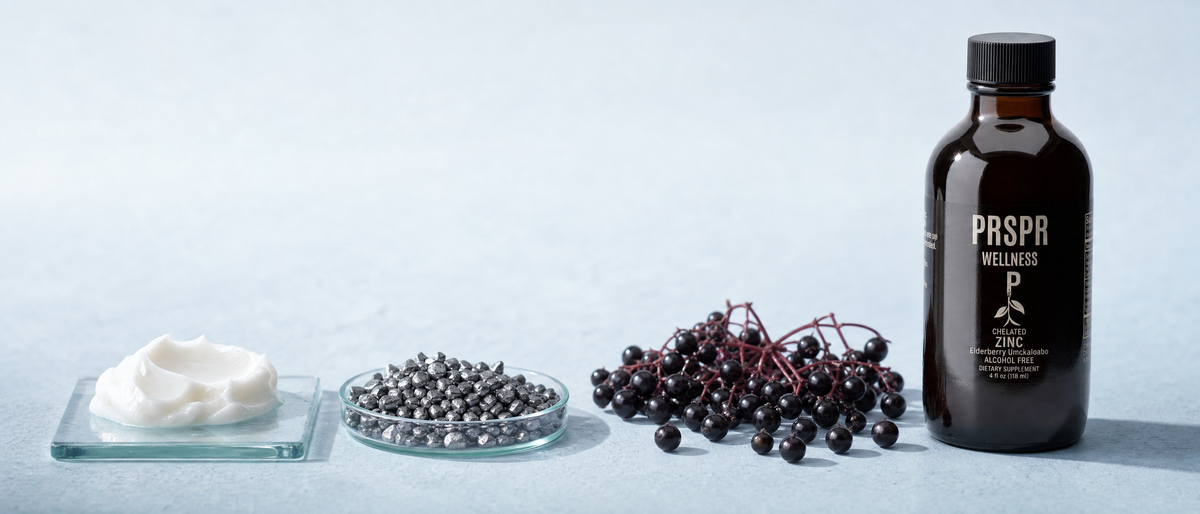
Our Chelated Zinc plus Elderberry combines zinc with a blend of botanical ingredients: elderberry, echinacea and umckaloabo root. The zinc in it is a chelated form, which is why the word chelated is on the front rather than only in the panel.
We put it there on purpose, for the reason this whole article has been about. Zinc alone would tell you the element and nothing else. Chelated zinc tells you what kind of compound it is, which is the part that actually distinguishes one zinc product from another.
The one thing we state in our own voice is process: GMP-certified facility, third-party batch tested, so the panel and the bottle agree.
If reading the second word is the habit you take from this, go and practice it. The Chelated Zinc plus Elderberry page is a reasonable place to start, the vitamins and supplements collection has plenty of mineral panels to compare, and the build-your-stack quiz is there if you would rather start from a routine.
Answer all five questions to unlock a clear wellness plan made around your goal, schedule, preferred supplement format, and biggest roadblock.
Get clarity on what matters most right now.
See the product and routine connected to your goal.
Simple next steps you can use right away.
Pick the one you would fix first if you could.
This helps us make the guide easier to follow.
Consistency beats the “perfect” routine you never follow.
Be honest. We’re building something you’ll actually use.
Your guide will include one simple way around it.
Answer two more questions to unlock your product starting point, five-step plan, two-week routine, and one practical tip for your biggest roadblock.
Enter your details to open your five-step plan.
Verified PRSPR customer reviews
Expires when you close this page
*Your personal credit for completing the quiz. It's applied automatically at checkout on one-time purchases and expires when the timer runs out.
View full product detailsEverything in your plan, together — one add to cart.
Expires when you close this page
*Your personal credit for completing the quiz. It's applied automatically at checkout on one-time purchases and expires when the timer runs out.
View full product details Mind vocabulary
What is cognition? You have probably seen the word "cognitive" printed on a label, in a headline, or in a product name, and kept scrolling. It is o...
 Biology vocabulary
What is metabolism? You see the word on labels, in gym talk and in nutrition headlines, almost always used as if it were a single setting. Read eno...
 Sleep vocabulary
What are sleep cycles? You hear the phrase on podcasts, see it on sleep trackers, and read it in articles that assume you already know what it mean...