
◎
Get clear
Get clarity on what matters most right now.

Supplements for menopause is holding a maximum volume score of 100 this week. Underneath it the same shelf splits into pieces: peri menopause supplements is rising about 40 percent, natural menopause supplements holds 17, post menopause supplements 12, perimenopause supplements 11, and menopause support supplements 8. Off to one side, menopause dry skin supplements is up about 160 percent, and best menopause supplements for weight loss is up about 50.
One word, six shelf labels. That is worth stopping on, because it does not happen with most categories. Nobody searches pre-vitamin D or post-magnesium. Menopause is one of the few words in this aisle that carries a prefix, and the prefixes are doing real work.
This article is about the words. What peri and post denote, where the terminology comes from, and how the supplement category has arranged its shelf language to match. It is not about symptoms, treatment or outcomes. Those questions belong to a qualified healthcare professional, and the two rising terms above, the dry skin one and the weight one, are exactly the kind we will name as search behaviour and not answer.
Menopause itself is a nineteenth century coinage, assembled from Greek parts by French physicians: men, month, and pausis, a cessation. The literal reading is the ceasing of the monthly cycle, and the word arrived in English medical writing from French in the 1800s.
Here is the part almost nobody knows. In clinical usage, menopause is not a period of time. It is a single point, defined retrospectively. The convention is that it is dated to the final menstrual period, and it is only confirmed after twelve consecutive months have passed without another one. That means the event can only be identified looking backwards, roughly a year after it happened. Everything before that point and everything after it needs its own name, which is precisely why the prefixes exist.
Peri is Greek for around or about, the same element in perimeter and periscope. Perimenopause names the transitional stretch leading up to that final period, a stretch measured in years rather than weeks. Post is Latin for after, and postmenopause names everything from the confirmation point onward, which for most people is the majority of the rest of their life. Premenopause is a fourth word, used less consistently, and generally refers to the reproductive years before any transition has started.
So the everyday sentence going through menopause, which almost everyone uses and which is perfectly clear in conversation, is describing perimenopause in clinical terms. That is not a mistake anyone needs to feel bad about. It is a mismatch between a word used precisely by clinicians and the same word used loosely by everyone else, and it is the reason the search box has four spellings of the same idea.
Watch what the category did with that vocabulary.
Supplements for menopause, at a full score of 100, is the umbrella term. It is what somebody types when they have the word and nothing more specific. Underneath it, peri menopause supplements and perimenopause supplements are the same phrase with and without a space, which tells you people are typing a word they have read rather than one they have written before. Post menopause supplements is a smaller, separate group. And menopause support supplements is a hedge, a phrase built to sit next to the category without asserting anything about it.
That last one is the most revealing. Support is one of the great load-bearing words of this aisle. It appears when a maker wants to be adjacent to a subject without making a statement about it, and its presence in the search data means shoppers have learned to type it too. They have absorbed the shelf's own hedging vocabulary and are now searching in it.
Notice also that the two fastest movers here are not stage words at all. Menopause dry skin supplements, up about 160 percent, and best menopause supplements for weight loss, up about 50, are both outcome searches wearing the category's name. They are the biggest risers in the cluster and they are the two we have the least business answering. We flagged the same shape of problem when we wrote about what a best supplements for women search actually returns: a superlative plus an outcome is a question that needs a criterion and a person, and a product page has neither.
The practical value of knowing which stage word is which is not that it changes what you buy. It is that it changes what you can read.
Clinical writing, patient information and reference material all use these terms precisely, and they mean different populations. An article about postmenopause is describing a different group of people from one about perimenopause, and if you do not know that, the two will appear to contradict each other. Search results mix all four freely, so the same page of results can hold material about a transition that has not started, one in progress, and a state that has been settled for a decade.
Knowing the prefix lets you sort them. It also lets you have a more precise conversation with a clinician, which is where every actual question in this cluster belongs. That is the whole benefit of a piece of terminology, and it is the reason we would rather write about the words than pretend to write about the rest.
We think this category has an honesty problem and a vocabulary problem, and the vocabulary problem is the one anybody can fix in an afternoon.
A word invented in the 1800s to name a single point in time is now doing duty as the name of a decade, a shelf, a demographic and a marketing segment. That is a lot to ask of four syllables, and the strain shows up as six near-identical search terms none of which anybody is quite sure how to spell. The people typing them are not confused about their own lives. They are confused because the language was borrowed from clinical writing without the definitions coming along.
So the useful thing we can do is hand the definitions back. Peri means around. Post means after. Menopause is a point, not a passage. That is not advice about anything and it is not meant to be. It is just the vocabulary, stated plainly, so that the next thing you read makes more sense than the last one did.
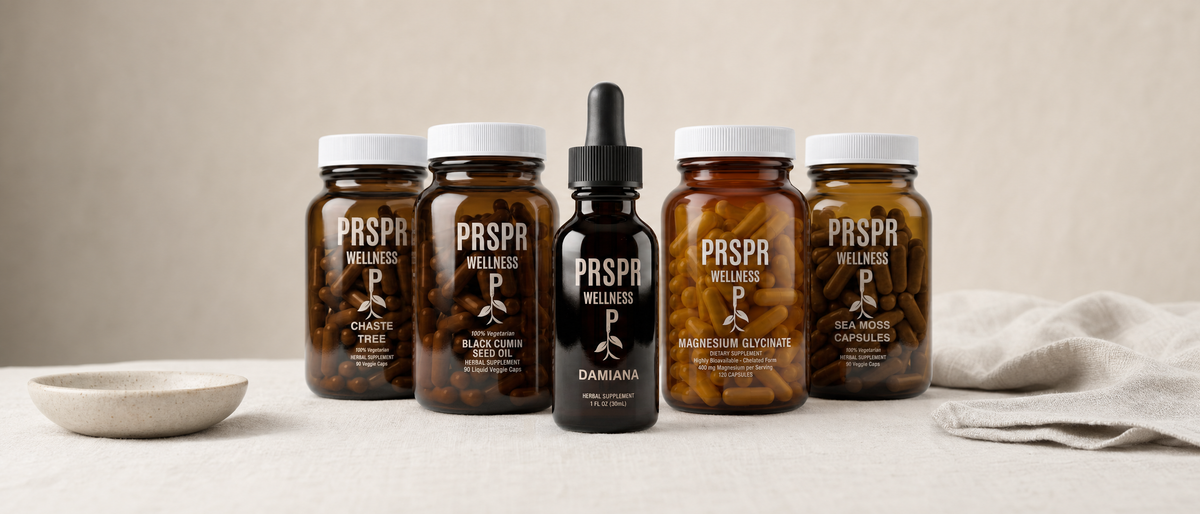
Our Menopause and Perimenopause Bundle is a set of individual products sold together: Magnesium Glycinate, Black Seed Oil, Seamoss Capsules, Chaste Tree, and Damiana. Each keeps its own panel and its own directions. Those are composition facts, listed as the live page lists them, and we are deliberately stopping there.
What we will add in our own voice is the quality story. Each of these is made in a GMP-certified facility and third-party batch tested, so what is printed on a panel is what is in the bottle. No guessing, no filler.
If a single component is what brought you here, our piece on what chaste tree berry is covers that plant on its own terms, and damiana, a Mexican liqueur and a wine valley covers another. Otherwise open the bundle page and read the five panels in order, work through the rest of the bundles collection, or take the build-your-stack quiz if you would rather start from a routine than from a word.
Answer all five questions to unlock a clear wellness plan made around your goal, schedule, preferred supplement format, and biggest roadblock.
Get clarity on what matters most right now.
See the product and routine connected to your goal.
Simple next steps you can use right away.
Pick the one you would fix first if you could.
This helps us make the guide easier to follow.
Consistency beats the “perfect” routine you never follow.
Be honest. We’re building something you’ll actually use.
Your guide will include one simple way around it.
Answer two more questions to unlock your product starting point, five-step plan, two-week routine, and one practical tip for your biggest roadblock.
Enter your details to open your five-step plan.
Verified PRSPR customer reviews
Expires when you close this page
*Your personal credit for completing the quiz. It's applied automatically at checkout on one-time purchases and expires when the timer runs out.
View full product detailsEverything in your plan, together — one add to cart.
Expires when you close this page
*Your personal credit for completing the quiz. It's applied automatically at checkout on one-time purchases and expires when the timer runs out.
View full product details Mind vocabulary
What is cognition? You have probably seen the word "cognitive" printed on a label, in a headline, or in a product name, and kept scrolling. It is o...
 Biology vocabulary
What is metabolism? You see the word on labels, in gym talk and in nutrition headlines, almost always used as if it were a single setting. Read eno...
 Sleep vocabulary
What are sleep cycles? You hear the phrase on podcasts, see it on sleep trackers, and read it in articles that assume you already know what it mean...