
◎
Get clear
Get clarity on what matters most right now.

There is a search that millions of people run and that nothing on the internet can honestly answer. It sits right at the top of this category: "best supplements for women," at 100 on the relative interest scale, with the plainer "best supplements" at 99 just behind it.
Underneath those two, the queries get specific and change character completely. "Magnesium benefits" sits at 78. "Can i take magnesium glycinate" sits at 53. "What is magnesium glycinate for" sits at 46, "taking magnesium glycinate" at 42, and "black seed oil benefits" at 42.
That shape is the interesting part. People open with a superlative and then, a few searches later, end up asking concrete questions about one specific compound. This piece is about that journey: what the opening search actually returns, why it cannot resolve, and how a daily routine gets assembled once you stop asking for the best and start asking what things are.
Three separate problems are stacked inside that phrase, and it is worth pulling them apart because each one is instructive.
The first is the superlative. "Best" needs a criterion, and the search does not supply one. Best by cost per serving? By ingredient transparency? By format? By how likely you are to still be taking it in March? Every one of those produces a different ranking, and a page claiming a single answer has quietly chosen a criterion on your behalf without telling you which.
The second is the plural. "Supplements" is not a category of thing. It is a regulatory and retail bucket containing minerals, vitamins, pressed oils, dried botanicals, amino acids and seaweeds. Ranking across that set is like ranking "tools." A hammer does not lose to a screwdriver.
The third is the audience word, and this is the one people find most surprising. There is no women's chemistry. Magnesium behaves the same regardless of who swallows it. What a gendered category actually encodes is an assumption about priorities, which may or may not be yours. It is a merchandising grouping, and treating it as a formulation fact is the most common mistake in this aisle.
None of that makes the search foolish. It is a completely sensible way to start when you do not yet have the vocabulary. It just means the opening search is a doorway, and the useful information is further in. Which is exactly what the rest of the data shows people doing.
Watch what those specific queries have in common. "What is magnesium glycinate for." "Taking magnesium glycinate." "Can i take magnesium glycinate." These are not superlative questions any more. They are questions about a named compound, its purpose, and its practicalities.
That shift, from ranking to naming, is the whole education in miniature. Once you have a compound name you can compare two labels honestly, look up what the word means, and ask a professional a precise question instead of a vague one. A superlative gives you none of those.
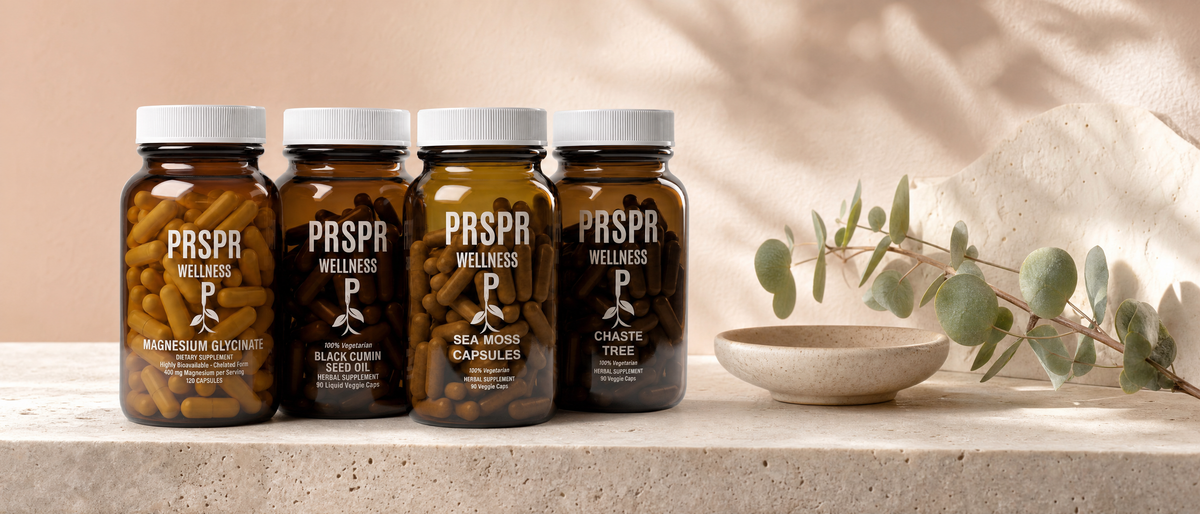
It also changes what a routine looks like. A set assembled from named single-purpose formulas is legible in a way a combined tablet is not. The Women's Daily Edge is built that way: separate bottles rather than one blend, so each supplement facts panel stands on its own and nothing is averaged into a proprietary mix.
The named components are Sea Moss capsules, Magnesium Glycinate, Black Seed Oil and Chaste Tree. A seaweed, a mineral compound, a pressed seed oil and a dried fruit. Four genuinely different kinds of thing, which is easy to see once they are named and impossible to see from the category phrase.
Worth knowing about each name. Sea moss is a red alga harvested from Atlantic coastal waters. Magnesium glycinate is magnesium bound to glycine, an amino acid, which is what the "glycinate" ending is telling you. Black seed oil is pressed from the seeds of Nigella sativa, a flowering annual grown across the Mediterranean, the Middle East and South Asia, and it is usually encapsulated rather than taken by spoon. Chaste tree is the dried peppercorn-sized fruit of Vitex agnus-castus, a Mediterranean shrub whose old common names include chasteberry and monk's pepper.
There is one more reason the opening search stays popular despite never resolving, and it is worth being fair about. Naming things takes effort, and nobody starts with the vocabulary. "Best supplements for women" is what a reasonable person types when they have a real question and no words for it yet. The failure is not the searcher's. It is that the pages answering that query mostly hand back another superlative rather than the words that would let somebody ask a better question next time.
The formats in a set are worth reading the same way as the names. Here they are all counted capsules, including the seed oil, which is supplied in liquid veggie caps rather than as a bottle of oil. Counted things run down predictably, and that predictability is what makes a routine easy to keep going. It is a small logistical point, and it decides more outcomes than most ingredient debates do.
We would rather lose a sale to a better question than win one to a superlative.
That sounds like a pose, so here is the practical version. Somebody who buys because a page told them a product was "best" has learned nothing, cannot evaluate the next product, and has no way to tell whether the thing they bought is working out. Somebody who learns that glycinate names a magnesium bound to an amino acid can read every magnesium label they will ever encounter, ours included, and decide for themselves.
The second customer is harder to acquire and much better to have. They ask sharper questions, they are not moved by packaging, and when they do choose something they stay with it for reasons they can articulate.
So we will keep answering the naming questions and declining the ranking ones. And the questions in that search list about whether you personally should take something, or how much, are genuinely not ours to answer. They belong with a qualified healthcare professional who knows your history.
Can I take magnesium glycinate? Whether any supplement is appropriate for you depends on your health, your medications and your circumstances. That is a question for a qualified healthcare professional, not for a brand that sells it. We will not answer it, and we would be wary of any product page that does.
What is magnesium glycinate for? We can answer the naming half. Magnesium glycinate is magnesium chelated to glycine, an amino acid, and "chelated" means the mineral is bound to an organic molecule rather than supplied as a simple salt. What it is appropriate for in your case is a clinical question, and it belongs with your clinician.
The Women's Daily Edge keeps its components separate, which means you can read each label individually and drop any one of them without unpicking a blend.
Everything we make is manufactured in a GMP-certified facility and third-party batch tested. What is on the label is what is in the bottle. No guessing, no filler, no cutting corners. That is a claim about process rather than about outcomes, which is the only kind of claim we think a supplement company has earned the right to make.
If you want the components covered properly, we wrote about how to read the magnesium forms on a label and about what sea moss actually is. Our wellness quiz takes a couple of minutes, and the set sits with the rest of our bundles.
Answer all five questions to unlock a clear wellness plan made around your goal, schedule, preferred supplement format, and biggest roadblock.
Get clarity on what matters most right now.
See the product and routine connected to your goal.
Simple next steps you can use right away.
Pick the one you would fix first if you could.
This helps us make the guide easier to follow.
Consistency beats the “perfect” routine you never follow.
Be honest. We’re building something you’ll actually use.
Your guide will include one simple way around it.
Answer two more questions to unlock your product starting point, five-step plan, two-week routine, and one practical tip for your biggest roadblock.
Enter your details to open your five-step plan.
Verified PRSPR customer reviews
Expires when you close this page
*Your personal credit for completing the quiz. It's applied automatically at checkout on one-time purchases and expires when the timer runs out.
View full product detailsEverything in your plan, together — one add to cart.
Expires when you close this page
*Your personal credit for completing the quiz. It's applied automatically at checkout on one-time purchases and expires when the timer runs out.
View full product details Electrolytes
Salt is having a comparison week. Searches for celtic sea salt vs himalayan pink salt are up about 70 percent, pink himalayan salt vs table salt is...
 Kids
KidsPick up a box of children's snacks and somewhere on the front there is a number with the letter g after it, next to the word fiber. It looks like o...
 Label Reading
It is printed on the front of a lot of mineral bottles and it is one of the least understood words in the supplement business. Chelated. Search int...